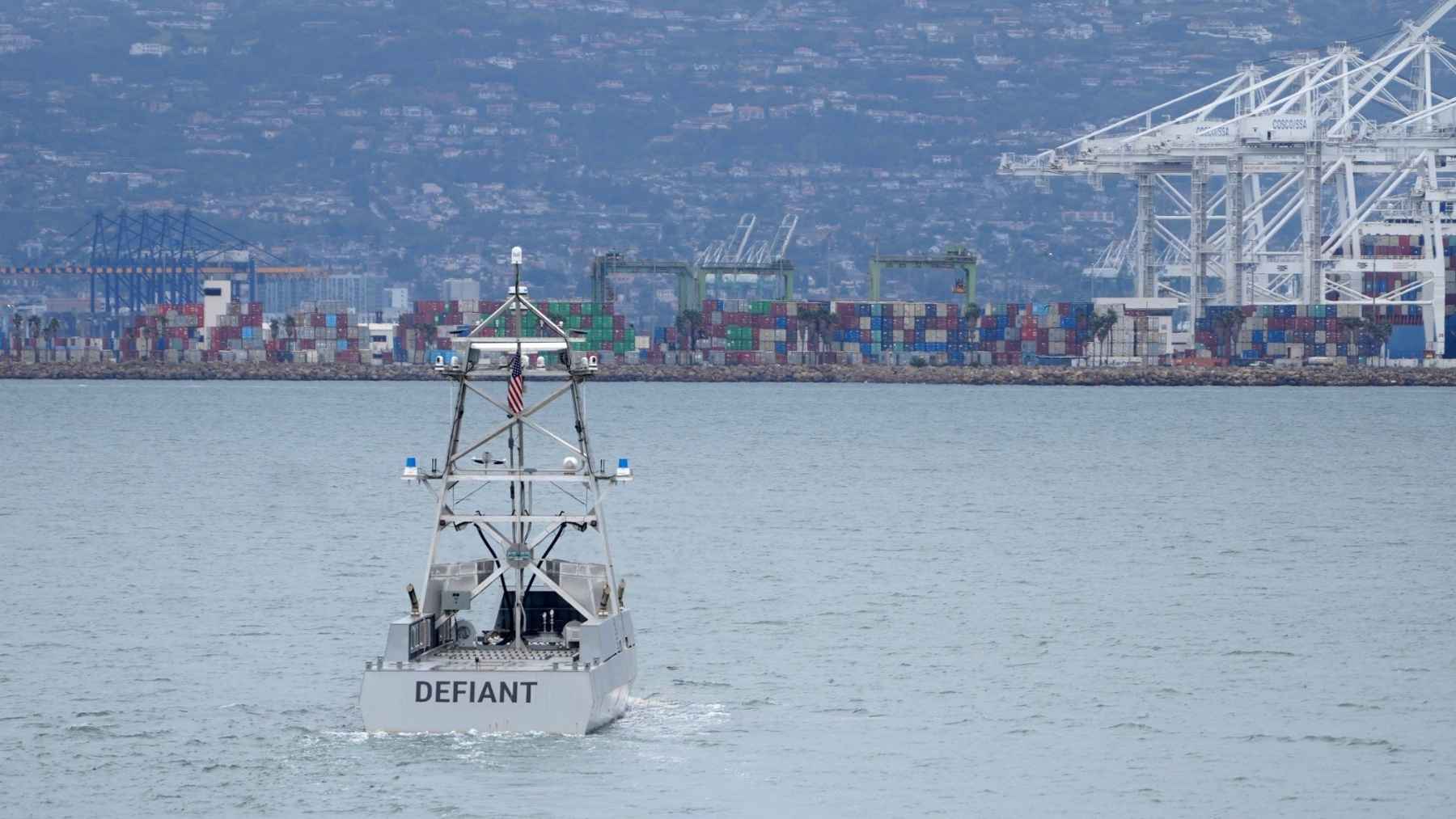

A warship is, once you strip the paint off the idea, an apartment building that shoots. Most of what fills a destroyer’s hull exists to feed, bunk, ventilate and generally keep alive the few hundred people who run the place.
DARPA looked at that century-old arrangement and asked a rude question: what happens to a ship if nobody ever comes aboard? Not a smaller crew. Nobody, ever.
The answer is called USX-1 Defiant, a 180-foot, 240-metric-ton vessel with no bunks, no galley and no doors sized for people. Right now it is sitting its final acceptance trials off the California coast. Pass them, and DARPA hands the ship to the US Navy.
Every “unmanned” ship before this one was a manned ship with the people deleted. This one never had them in the blueprints.
No bunks, no galley, no doors for people
The program behind it is called NOMARS, short for No Manning Required Ship, and the name is the spec sheet. DARPA’s brief was to design the seaframe, meaning the ship minus its mission systems, with zero provision, allowance or expectation for humans on board.
Deleting the people deletes a shocking amount of ship. No passageways, no life support, no bridge, no manual controls. What’s left is a hull no wider than its largest piece of hardware, which buys a smaller, cheaper vessel with far more of its 240 metric tons available for fuel and payload instead of bunk rooms.
It also buys toughness. The design “can handle operations in sea state 5 with no degradation,” NOMARS program manager Greg Avicola said at the christening ceremony last August, and it’s rated to survive 30-foot seas and get back to work once the storm passes. DARPA puts top speed at 20 knots and endurance at up to a year at sea without a port call.
The hull is deliberately simple, too. DARPA designed it so the yards that normally build yachts, tugs and workboats, the Tier III end of American shipbuilding, can produce and maintain it. That’s the industrial-base play hiding inside the robot: a warship you can order from places that have never touched a destroyer.
2,100 nautical miles with nobody aboard
Construction wrapped in February 2025, the hull went into the water at Nichols Brothers Boat Builders in Washington state that March, and DARPA broke the traditional bottle on the bow at Everett in August.
Then it went to work. The first open-ocean leg ran more than 1,100 nautical miles from Port Angeles, Washington, down to Port Hueneme, California, covered in five days with no one aboard.
Port Hueneme is where the trials got interesting. The team refueled the ship at sea from a crewed vessel, the Melissa C, passing lead-lines and connecting hoses without a single person stepping onto Defiant. They used water instead of fuel for the demo, which is the kind of caution you appreciate in people testing a robot for the first time.
The same week brought high-speed turns, straight-line runs close to 20 knots, and harbor entries, exits and dockings handled entirely by the autonomy system. Sailors from the Navy’s Unmanned Surface Vessel Squadron One were on hand at Port Hueneme, getting a close look at their possible future.
Another roughly 1,000 nautical miles of autonomous open-ocean transit brought the ship back to Long Beach at the end of September. Call it about 2,100 autonomous nautical miles through September 2025. DARPA hasn’t published an updated mileage figure since.
The ship spent the winter at Long Beach getting engineering changes for reliability and robustness, and was back on the water in February.
The final exams are happening right now
Which brings us to the current status, and it’s a specific one. Per DARPA’s running program diary, Defiant is undergoing final acceptance trials for its executive autonomy, the perception and navigation stack, along with improvements to its machinery control system software.
Translated out of program-speak: the ship is proving its own eyes and its own engine room before anyone signs for it.
The buyer is already named. After the demonstration wraps, Defiant transfers to the Navy’s Unmanned Maritime Systems Program Office, PMS 406, and per DARPA it becomes the Navy’s first solely autonomous medium unmanned surface vessel at that point. Every MUSV before it, like the Seahawk trimaran that just deployed inside a carrier strike group, was a hybrid, built so humans could climb aboard and take over. Defiant can’t be taken over by hand. There’s nothing to grab.
No transfer date has been announced. The trials underway are the last public gate before it.
A generator with four moving parts wants the job
While the ship sits its exams, its next powerplant showed up. On May 19, Texas-based Hyliion announced that the Office of Naval Research, in partnership with DARPA, selected Defiant as the launch platform for sea trials of its KARNO generator technology.
The delivery is “a drop-in 800 KW power system consisting of four 200 KW KARNO Cores,” per the company’s announcement, in a keel-cooled configuration. It runs on F-76 marine diesel, the Navy’s standard fuel, and puts out 800 volts DC straight into the ship’s electrical architecture.
The interesting part is what a KARNO Core actually is. It’s a linear generator that turns heat into electricity through flameless oxidation, a distant descendant of the 200-year-old Stirling engine. Sealed helium expands and contracts, shoving magnet-carrying shafts back and forth through copper coils, and out comes current. Hyliion says each core has only four moving parts, riding on gas bearings, with no oil anywhere in the system.
On a normal ship, a diesel generator’s appetite for oil changes and filter swaps is somebody’s job. On a ship nobody can board, it’s a design flaw. A sealed generator with almost nothing to service is close to the whole assignment.
One number is deliberately missing here: the date. Land-based testing on simulated Navy load profiles is already running, but neither ONR nor DARPA has given a timeline for the sea trials, as The Defense Post noted. Any year you see attached to this is somebody’s guess.
The Navy is waiting with the paperwork
The money side is unusually clear for a research project. In the reconciliation bill passed in July 2025, Congress appropriated $2.1 billion for developing, procuring and integrating purpose-built medium unmanned surface vessels. That is precisely the category Defiant was built to define.
And it arrives into a fleet suddenly crowded with crewless hulls. The Navy just sent armed drone boats to the Caribbean for a three-month deployment, and the same fleet math now stretches from those all the way up to the $15 billion Columbia-class submarine at the crewed extreme.
Loose ends, honestly listed: no public 2026 mileage total, no KARNO installation date, no transfer date to PMS 406. The gates are visible. The dates aren’t.
What is certain is the shape of the ending. At some point DARPA hands the Navy a warship built so nobody can ever step aboard to take the keys. The paperwork will have to do.