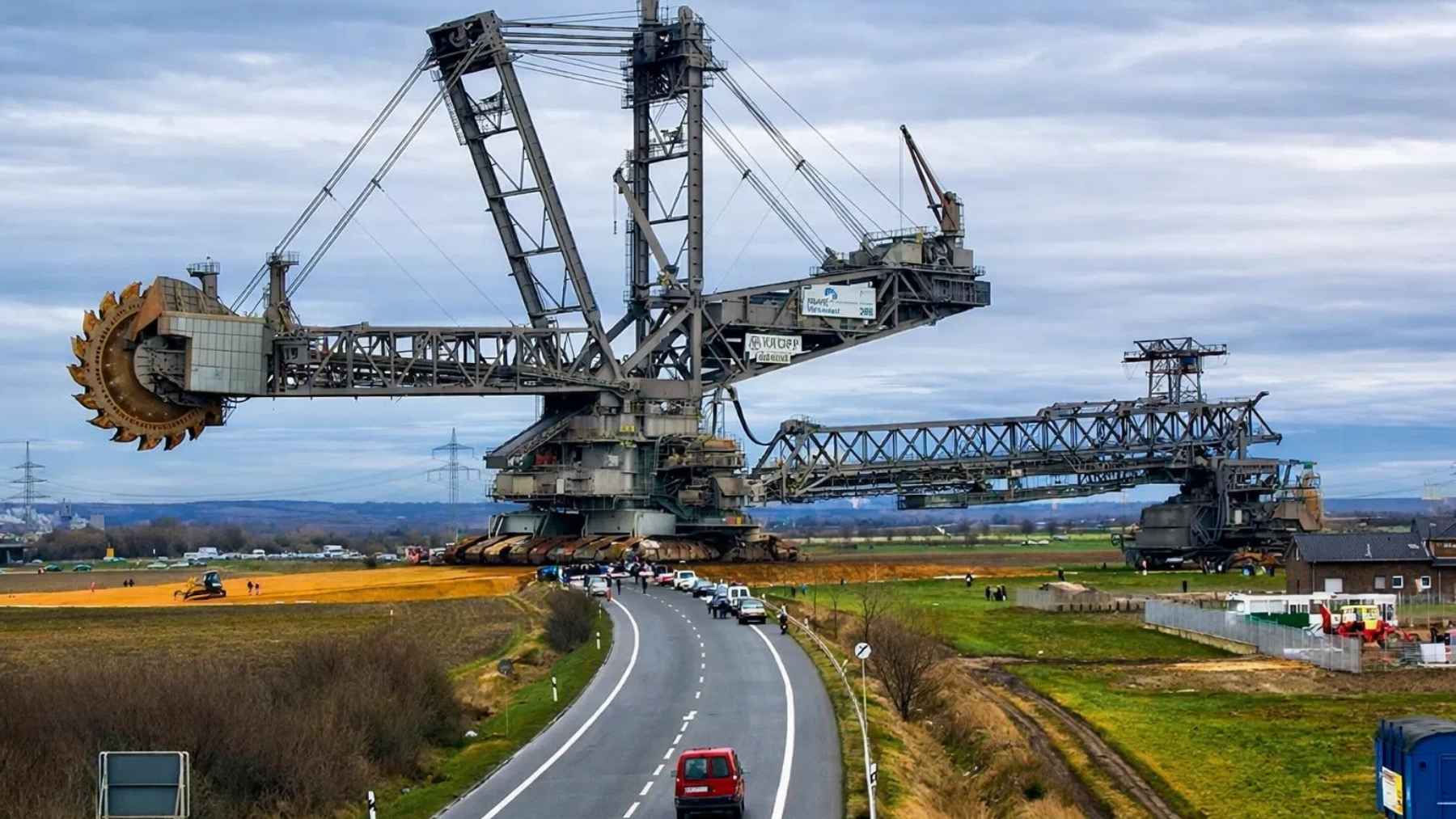

When you try to picture the largest vehicle ever built, you probably land on something that floats or flies, like a container ship or a Saturn V on the launch pad. The heaviest machine that has ever crawled across solid ground isn’t either of those. It’s a bucket-wheel excavator in western Germany called the Bagger 293, and according to Guinness World Records, nothing heavier has ever moved under its own power.
It weighs 14,196 metric tons, or about 31.3 million pounds. It was built in 1995 by the German mining-equipment maker TAKRAF, it stretches roughly the length of two football fields, and it spends its days clawing dirt and rock off the top of a coal seam at the Hambach mine, west of Cologne. On a good day it moves 240,000 cubic meters of earth. That is the entire job: strip everything sitting on top of the lignite so the coal underneath can be dug out and burned.
There’s an awkward twist to all of this, and we’ll get to it. The largest vehicle humans have ever put on land was built to feed a fuel that the country that built it is now in a hurry to quit.
It’s an excavator, and it makes everything else on land look small
Bucket-wheel excavators are a class of machine most people outside mining never think about, which is a shame, because they’re absurd. The Bagger 293 is the biggest one ever made. TAKRAF, which still refers to it in-house as the SRs 8000, built it to a scale that breaks your sense of proportion the moment you put real numbers on it.
Start with the size. It runs about 220 meters long, which is where the two-football-fields comparison comes from, and it stands roughly 94.5 meters, or 310 feet, tall at its highest point. You’ll see it described online as twice the height of the Statue of Liberty, and that’s wrong. That figure comes from mixing up its length with its height. Stand the Bagger 293 next to Lady Liberty and the top of the machine lands right around the tip of her torch, which sits a little over 300 feet off the ground. Still ridiculous. Just not double.
The business end is the wheel it’s named for. According to Guinness, the bucket wheel measures 21.6 meters across, about as tall as a four-story building, and it carries 18 steel buckets around its rim, each one big enough to hold 6,600 liters. As the wheel turns, the buckets bite into the earth, scoop it up, and dump it onto a conveyor that runs back along the machine’s roughly 100-yard arm, so the Bagger never has to stop digging to unload. It just keeps inching forward at a crawl of a couple of feet a minute.
A soccer stadium of dirt, every single day
The 240,000-cubic-meter figure is hard to feel, so RWE, the utility that runs the Hambach mine, frames it like this: that’s enough material every day to fill a soccer stadium to a height of 30 meters. The machine doesn’t dig the coal itself. It handles what miners call overburden, the layers of sand, clay, and rock stacked on top of the lignite, sometimes hundreds of meters of it.
There’s a lot to move, because there’s a lot of coal. The lignite at Hambach is the compressed remains of forests and bogs that grew here tens of millions of years ago, sitting in seams that can run 100 meters thick. Hambach is the largest open-pit mine in Germany, and its floor drops close to 300 meters below sea level, which makes it the deepest artificial hole in the region. The Bagger 293 is the tool that peels it open. One machine, a tiny crew, a quarter of a million cubic meters of ground a day, in any weather, indefinitely. Equipment World reports it takes just two operators to run the whole thing.
It runs on electricity, and it barely touches the ground
A machine this size has no fuel tank, which catches most people off guard. The Bagger 293 is electric, and not in the cute lithium-battery sense. It draws power straight from the grid through a trailing cable, and the draw is enormous: Equipment World puts it at about 16.56 megawatts, roughly what a small town pulls at once, spent entirely on moving dirt.
The footprint is the other surprise. You’d assume 14,000-plus tons would sink into the soft ground of an open mine, but the weight is spread across 12 crawler tracks, the same basic idea as a tank scaled up grotesquely. SlashGear notes the tracks leave marks no deeper than a person walking through mud. The whole thing reportedly cost around $100 million and took four years to build, which, for a machine that has held a Guinness record for three decades and is still working, has aged pretty well.
It isn’t a one-off, either. TAKRAF has built smaller bucket-wheel machines that now work in mines in China, India, and other parts of Europe, though none of them match the 293. And for all its bulk, there’s one record the Bagger doesn’t hold: speed. The fastest land vehicle ever, the jet-powered Thrust SSC, hit 763 mph in 1997, two years after the Bagger started its shift. The Bagger does its 763 miles’ worth of work the slow way, a couple of feet a minute, for thirty years and counting.
The coal it was built for is being switched off
This is the twist from the top. The Bagger 293 exists to uncover lignite, the soft brown coal western Germany has burned for power for more than a century, and Germany is getting out of the lignite business on a fixed clock. RWE has agreed to end lignite-fired electricity generation in 2030, eight years ahead of the original 2038 deadline, a move that leaves roughly 280 million tons of coal in the ground. The Hambach mine where the Bagger works is set to stop coal extraction in 2029, after which the pit is slated to be flooded into a lake.
The shift already shows up in the numbers. According to the International Energy Agency, Germany’s carbon dioxide emissions from coal fell from 346 million tons in 2000 to 173 million tons by 2023, even as it remains the largest coal consumer in Europe. The machines getting built and celebrated now tend to point the other way. Canada just lowered a 953-tonne reactor into a shaft in Ontario to start the Western world’s first grid-scale small nuclear plant, and China recently put the largest all-electric container ship into service, a freighter with no fuel tank at all. Both are bets on the kind of power that doesn’t need a Bagger 293 out front.
None of this makes the Bagger 293 any less staggering to stand in front of. It’s still the heaviest thing humanity has ever driven across land, run by a tiny crew, quietly eating a stadium of earth a day. Its job just has an expiration date now, and not a distant one. When Hambach closes and the water comes in, the largest vehicle ever built will have spent its entire working life chasing a fuel its own country decided to stop burning. For a record-holder, that’s a strange way to bow out, and a fitting one.