
Drone boats have been rewriting naval warfare for a few years now, mostly thanks to Ukraine turning cheap uncrewed skiffs into Black Sea fleet-killers. The problem with the concept has always been the boring part: getting the things to the fight.
A small uncrewed surface vessel is fast and lethal once it’s in the water, but it usually needs a port, a mothership, or a crane to actually get there. The UK Royal Navy just tried a different answer: push the boat out the back of a transport plane at 1,300 feet and let it parachute in.
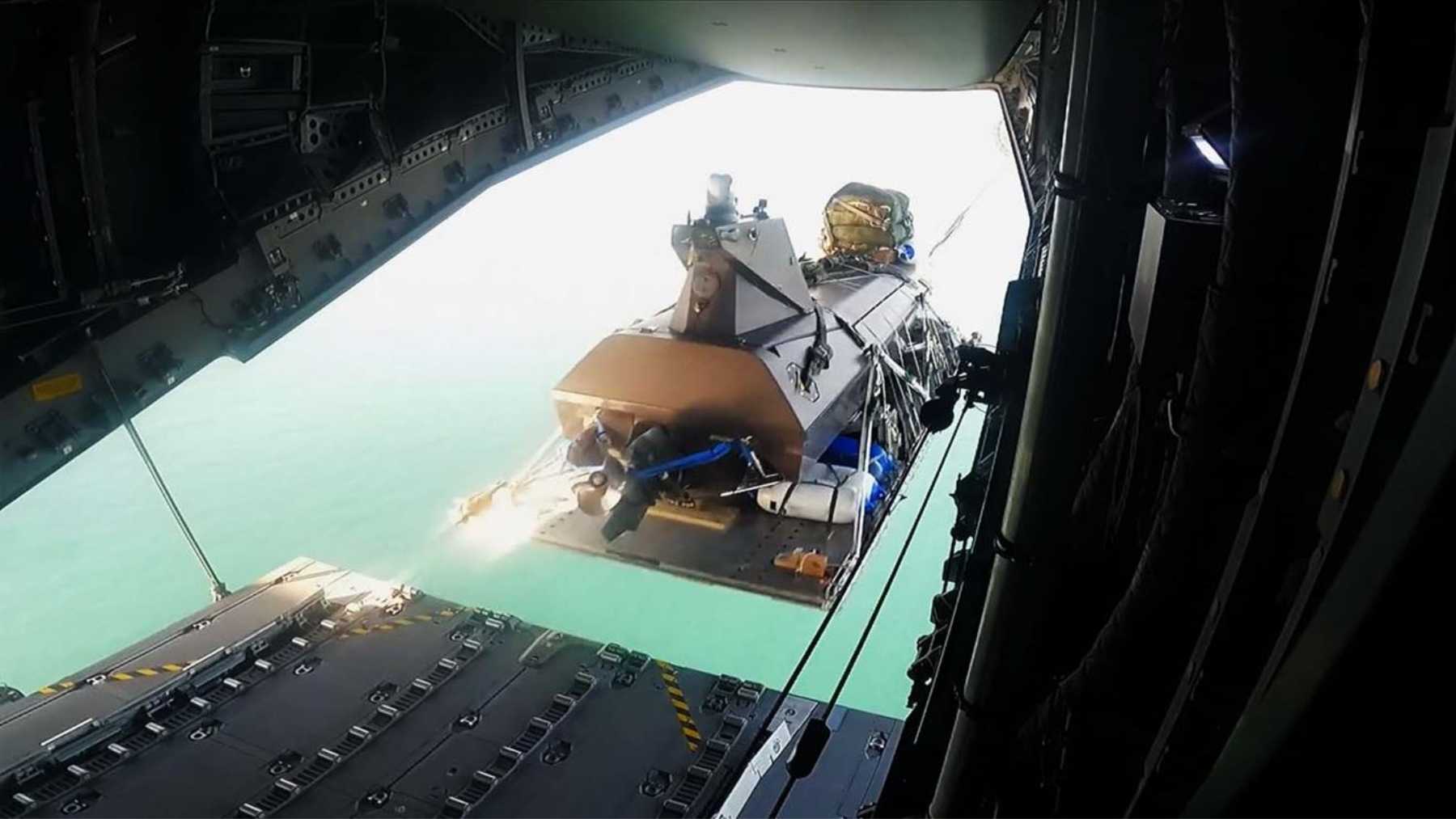
That’s not a hypothetical. On July 8, 2026, Kraken Technology Group and Capewell, working with the Royal Navy under Project Beehive, completed what the companies call the world’s first extracted-load airdrop of an uncrewed surface vessel, from an Airbus A400M over the North Sea, per the Royal Navy.
The boat hit the water, popped free of its cradle, and drove off under its own power. Four times. Same hull, same rig, over six working days.
Four drops, six days, one boat
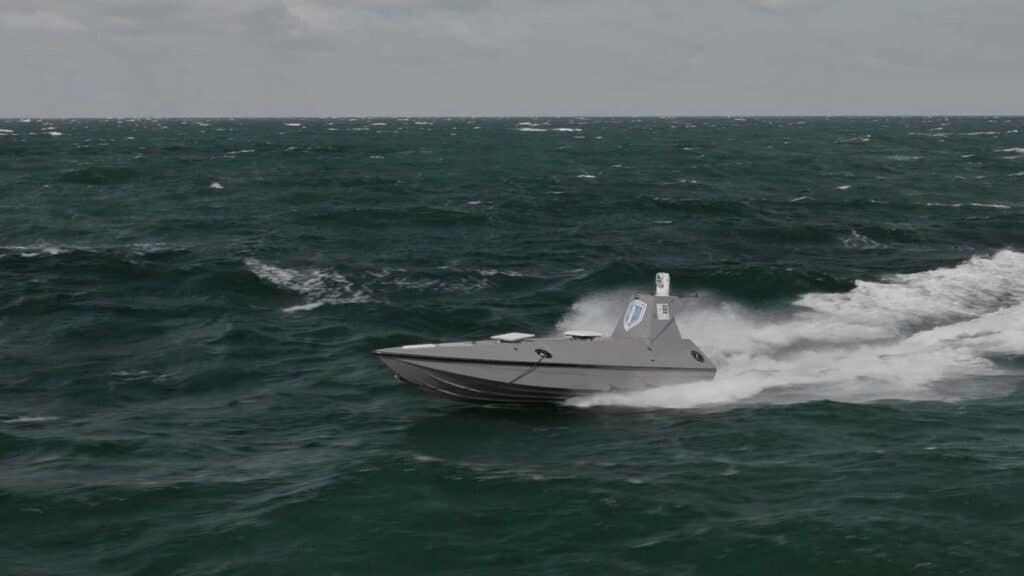
The vessel is Kraken’s K3 Scout: 8.4 meters (28 feet) of composite hull, about the length of two family cars parked bumper to bumper. Kraken lists a 600-kilogram (1,323-pound) payload, a 55-knot top speed, and 650 nautical miles of range at a 25-knot cruise.
The drops happened into conditions up to Sea State 4, meaning waves running as high as roughly 2.5 meters (8 feet). Not calm water. Roughly what you’d expect if you actually needed this capability in a real operation rather than a photo op.
The mechanics matter, because a normal cargo drop won’t work for a boat this size. The A400M performed an extracted-load release: a drogue chute yanks the payload off the rear ramp, the main canopies stabilize it, and the K3 rides down strapped to a delivery sled. On splashdown, an electro-mechanical release cuts the boat loose, and it gets on with the mission.
Kraken founder and CEO Mal Crease said the trials proved the K3 can be dropped “into contested or difficult-to-access waters ready for operation,” per the company’s announcement.
Self-deploy is the whole problem
Small drone boats have a range problem, and everyone in the industry knows it. Captain Adam Ballard, who works on Project Beehive, put it plainly in the Royal Navy’s statement: “we are actively looking at concepts for deployment from motherships or ‘mother aircraft’.”
The tradeoff is brutal in practice. A K3 doing 25 knots across a strategic distance is essentially a very expensive commuter, burning most of its operational life just trying to arrive. An A400M covers that same distance in a fraction of the time and drops the boat within striking range of wherever it needs to be. No port, no crane, no support ship parked in a spot the enemy already has coordinates for.
That last part is the whole game. If your only launch method is a port or a mothership, an adversary knows where to look. If your launch method is any airfield inside the A400M’s fuel radius, they don’t.
The other answer to the same problem, incidentally, is just building a much bigger robot that can make the trip itself, which is the philosophy behind Boeing’s 85-foot Orca drone submarine. Airdropping the small ones is the cheaper trick.
A sled with a 145-year-old pedigree
The unglamorous hardware doing the heavy lifting is Capewell’s Universal Maritime Craft Aerial Delivery System, or UMCADS: a reconfigurable Type V parachute platform built to airdrop a variety of maritime craft, not glued to any one boat design. Capewell has been making aerial delivery gear for the US and allied militaries for more than 145 years, per UK Defence Journal.
The trickier bit is the new IN-Release system, the electro-mechanical mechanism that times the moment the boat separates from its cradle. Get that wrong and you end up with a very expensive drone boat tangled in its own parachute lines, which is the first question any engineer asks about this concept. The answer, for now: four clean separations out of four drops, same boat, same platform.
Capewell’s Mark Lavender added that the campaign showed how quickly the platform reconfigures for other payloads, maritime or land. Which is Capewell politely reminding potential customers that once you’ve built a system to airdrop a drone boat, dropping other things off the same sled is a smaller engineering problem.
Kraken, for its part, is a Fareham-based outfit founded in 2020 with roots in offshore powerboat racing, and the two companies have been working on this specific trick since announcing their partnership in August 2024.
20 boats, £12 million, and a strait everyone is watching
The K3 Scout isn’t a random prototype. In March 2026, the Royal Navy signed a £12.3 million contract, about $16.5 million, for 20 Kraken vessels destined for the Coastal Forces Squadron and 47 Commando Royal Marines, per Army Recognition. That shakes out to roughly $825,000 a hull. A rounding error against a frigate.
All 20 fold into Project Beehive, the Royal Navy’s push to build what it calls a Hybrid Navy: crewed warships and uncrewed platforms working together rather than one replacing the other. The money behind the idea is real too. The UK’s Defence Investment Plan commits more than £5 billion to advanced uncrewed systems through this Parliament, including £1.5 billion for the Royal Navy’s transition, per ADS Advance.
And these boats already have a possible address. Janes reported in June that the Royal Navy and QinetiQ are preparing K3 Scouts for a potential mission in the Strait of Hormuz, one of the most watched chokepoints on the planet. This is not a training toy.
The K3 itself isn’t a one-trick boat either. Kraken pitches it for surveillance, force protection, logistics, casualty evacuation, forward screening, and precision strike, with electronic warfare kit and endurance of up to 30 days on task, per Business Insider. The timing has a bonus, too: NATO launched a pooled A400M fleet project this very week, which means the delivery method demonstrated over the North Sea works across the alliance’s airlift fleets.
The Ukraine shadow over all of this
You can’t talk about drone boats in 2026 without talking about the Black Sea. Ukraine’s Sea Baby and Magura-class USVs did serious damage to the Russian fleet, enough that every Western navy is now trying to replicate the effect without waiting for a war to teach them. NATO already runs autonomous patrols over Baltic seabed cables, and allies are shipping uncrewed vessels to each other’s navies like it’s a group project.
The gap between Ukraine’s approach and what the Royal Navy just demonstrated is the deployment method. Ukraine sails its boats out from Odesa, which works when your target is a few hundred nautical miles away and you own the coastline. It works less well if you’re the UK trying to project force into the eastern Mediterranean or the Indo-Pacific. Air-launched USVs solve that geography problem in a way sailing them out of Portsmouth simply can’t.
The homework that’s left
A few things the trial didn’t cover. Refueling: 650 nautical miles is respectable, but nobody has demonstrated an air-drop resupply chain, and once the boat runs dry, someone has to reach it. Command and control: keeping a link to an autonomous vessel that’s just been dropped in contested waters is its own engineering problem. Self-defense: a 28-foot uncrewed hull isn’t winning a shooting match with a warship.
None of that knocks the trial. It’s the difference between proving the physics, boat survives drop and drives away, and proving the doctrine. The physics part is done. The doctrine part is what Beehive exists for.
Ballard’s own framing is the one worth keeping. Navies have spent a century launching air power from ships. The Royal Navy just spent a week in the North Sea practicing the reverse: launching sea power from an aircraft. That’s the kind of inversion that doesn’t stay a novelty for long.