
This past week the US Energy Department signed a contract to scale up the only plant in the country that enriches advanced reactor fuel, and separately sat down with five companies to work out how to burn 20 tons of surplus plutonium it has spent decades trying to get rid of. America has too much bomb-grade material and not enough reactor fuel, and it is now spending real money trying to turn the first problem into the answer to the second.
That is a strange spot to be standing in while you watch China. On an island off Fujian province, China National Nuclear Corporation is finishing the second of two reactors built to do the opposite: make more plutonium than they burn. The second one was due to start up this year. CNNC has not said whether it has.
The pair are the CFR-600, for China Fast Reactor, 600 megawatts of electricity each. World Nuclear News puts each one at 1,500 megawatts of heat, sodium-cooled, pool-type, with a breeding ratio of about 1.1. That ratio is the whole reason the machine exists. Burn a kilogram of fissile material in the core and roughly 1.1 kilograms come back out, because the reactor manufactures fuel as it runs.
The reprocessing plant that feeds it just started up
The reactors are only half the system. The other half is 1,800 miles inland, at CNNC’s industrial park in Jinta, Gansu province. Reading satellite imagery from February, the International Panel on Fissile Materials reported in May that China’s first 200-metric-ton-per-year demonstration reprocessing plant appears to have begun operating. A second identical plant is finished. A third is under construction.
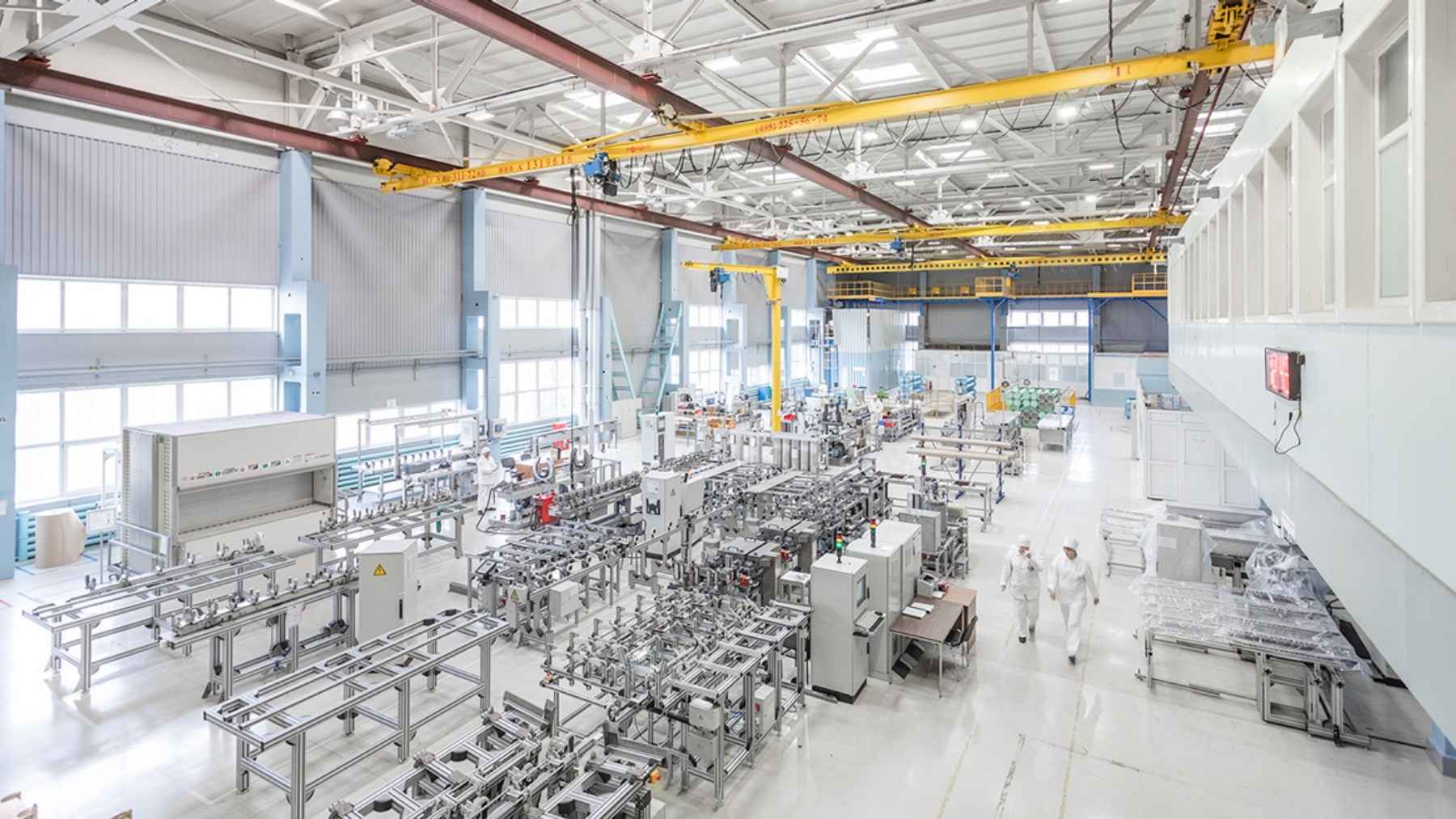
Next to them sits a 20-ton-per-year MOX fuel fabrication line, completed in November 2024. The IPFM says it is believed to have been built to fuel the second CFR-600. Reprocessing pulls plutonium out of spent fuel, the MOX line packs it into fresh fuel, and the breeder turns it into more. That is a closed fuel cycle, assembled in public and explained almost nowhere.
Unit 1 poured first concrete in December 2017 and began low-power test operation in 2023, running on highly enriched uranium supplied by Russia’s TVEL, according to POWER Magazine. No grid connection has ever been announced. Unit 2 broke ground on December 27, 2020, and the IPFM expects it operational in 2026. The Sasakawa analysts say Unit 1’s cooling discharge starts and stops rather than running continuously, which points to a reactor short of full operation, and that Unit 2’s containment building is roofed and close to done.
There is a bigger machine queued behind all of it. CNNC announced at a July 2025 symposium in Fuzhou that it had finished the preliminary design of the CFR-1000, a 1.2-gigawatt commercial fast reactor now waiting on regulatory approval, with operation targeted after 2030.
The core sits in a tank of liquid metal
Pool-type means the core, the pumps and the primary heat exchangers all sit submerged in the same tank of molten sodium, and that sodium never leaves the tank. Two secondary sodium loops carry the heat out to steam generators running at 480 degrees Celsius (896 F), which puts the plant at 41% thermal efficiency.
Sodium is in there because it hauls heat far better than water without needing crushing pressure to stay liquid, and because it barely slows neutrons down. A fast reactor needs its neutrons fast, and water would ruin that.
There is a reason for the second sodium loop, and it is not spare-parts redundancy. Sodium that absorbs a neutron turns into sodium-24, a gamma emitter with a half-life of about 15 hours, so the sodium touching the core is itself radioactive. The intermediate loop keeps that hot radioactive metal away from the water in the steam generators. Which matters, because sodium burns in air and reacts violently with water. Keeping several hundred tons of it at several hundred degrees, sealed off from both, for a 40-year design life is the entire engineering problem.
Everybody else tried this and quit
The reason any of this reads as ambitious rather than routine is the pile of abandoned projects behind it. France built Superphénix, at 1,242 megawatts the largest sodium fast reactor anyone has ever finished. It ran from January 1986 to December 1996 and produced under 7% of the electricity it was capable of over that life, per the International Panel on Fissile Materials, and France closed it in 1998. Japan built Monju, watched three metric tons of sodium leak and catch fire in 1995, lost close to 15 years to it, then dropped the fuel handling machine into the reactor vessel and gave up in 2016. Germany finished a breeder at Kalkar and never switched it on. The site is a theme park now.
The American attempt was Clinch River, killed by the Senate in October 1983. Part of what sank it was a safety test the Energy Department ran in 1982. According to an account in the Bulletin of the Atomic Scientists, the department videotaped molten sodium meeting the concrete of a containment structure. Concrete holds water crystals. The concrete exploded. Fixing that would have meant lining the whole containment in stainless steel.
Russia is the exception, and its record is the honest price list. Between 1980 and 1997 the BN-600 at Beloyarsk had 27 sodium leaks, 14 of which became fires, per the same IPFM survey. The reactor ran through all of it, because Soviet engineers had put each steam generator in its own bunker and installed a spare, so a burned one could be fixed while the plant stayed online. They designed around the fire instead of against it. Admiral Hyman Rickover, who ran a sodium reactor for the early US submarine program, called the machines “expensive to build, complex to operate” back in 1956.
The blanket is what the arms-control people are counting
The uranium-238 in the breeding blanket makes up 99.3% of natural uranium and cannot sustain a chain reaction on its own. Fast neutrons hit it and turn some of it into plutonium-239, which can. Plutonium bred in a blanket comes out unusually pure.
The Institute for Science and International Security estimates that a single CFR-600 could yield 130 to 165 kilograms of weapon-grade plutonium a year if it were run for that purpose. The same report notes that the US Department of Defense has described China characterizing the CFR-600 as a “national defense investment project” subject to military nuclear facility regulations.
China says both units are civilian power reactors. It also stopped saying much else. Under the IAEA’s voluntary plutonium guidelines, the last declaration China filed was in 2017, reporting 40.9 kilograms of separated civilian plutonium as of the end of 2016. It has filed nothing for any year since, the only one of the five recognized nuclear-weapon states to go dark. The IPFM estimates China’s pilot reprocessing plant has been separating around 500 kilograms of plutonium a year over that same stretch.
Nobody has demonstrated that a gram of it has been diverted. The blanket is there because breeding requires it, and the same blanket wraps India’s brand-new reactor for the same reason. The difference is that India published its numbers.
India got one running in April
On April 6, 2026, India’s 500-megawatt Prototype Fast Breeder Reactor at Kalpakkam reached first criticality, the Department of Atomic Energy announced. Sodium-cooled, pool-type, MOX core, uranium-238 blanket, the same machine as Xiapu and 100 megawatts smaller.
It took 22 years. Construction started in 2004 aiming at 2010, and the IPFM puts the final cost at roughly $3.9 billion in purchasing-power terms against $1.7 billion planned. The reactor is now in phased power ascension and has not yet connected to the grid. Once it does and holds commercial operation, India will be the second country after Russia to run a commercial fast breeder.
America is doing the opposite thing with the same element
Sodium fast reactors are having a moment in the United States, at sizes that would fit inside the Fujian plant’s turbine hall. TerraPower’s Natrium plant in Wyoming is 345 megawatts, with a molten-salt tank that pushes output to 500 when the grid spikes. The NRC issued its construction permit on March 4 and TerraPower started building the reactor on April 23. Oklo’s Aurora at Idaho National Laboratory is rated by the NRC at a maximum of 75 megawatts and is meant to be trucked to a site. It cleared a Department of Energy safety review on June 11.
Here is where the two countries split, and it is not about reactor size. On March 6 the Energy Department announced it is restarting HB-Line at the Savannah River Site in South Carolina to recycle surplus plutonium into MOX fuel, a move it says will speed its plutonium disposition mission by 10 to 13 years and save up to $350 million. Then on May 27 it opened negotiations with five companies, Exodys Energy, Flibe Energy, Oklo, SHINE Technologies and Standard Nuclear, over roughly 20 metric tons of surplus plutonium, 4.4 tons of metal and 15.3 tons of oxides. DOE has declared about 61.5 tons of weapon-grade plutonium surplus to national security needs.
One program is built to consume plutonium. The other is built to make more of it. The physics underneath is identical, which is exactly why the American fuel argument keeps circling back to material nobody wanted ten years ago.
The alternative is enrichment, and America is short there too. The Piketon cascade in Ohio has been turning out HALEU at about 900 kilograms a year. On July 1, Centrus signed a $900 million contract with DOE to scale that plant to 12 metric tons annually. A first Natrium core alone needs something like 15 to 20 tons.
China’s program is not shy about the photogenic parts. It craned a 1,000-ton conical lid onto a containment building in Guangdong in June and put out pictures. The breeders on Changbiao Island get no such treatment. Sodium moves heat, fast neutrons turn uranium-238 into plutonium-239, and the blanket does that whether the reactor gets called civilian or not. The engineering is the part nobody has ever fully tamed, and the country with the longest operating record tamed it by bunkering its steam generators and keeping a spare on the shelf. China now has two of these to run for the next forty years, plus a gigawatt version waiting on a permit. If the second one at Xiapu started up this spring, nobody outside CNNC has said so.