
Your phone battery is worse than it was two years ago. You’ve felt it, the slow slide where a full charge stops lasting the day, until eventually the thing needs replacing. An EV battery does the same on a longer clock, shedding a little range every year it spends on the road.
That slow fade is just annoying in a gadget. On the power grid, where batteries are increasingly the thing keeping the lights on after dark, it turns into a real engineering problem, and it gets worse the harder you push the cell.
The work that wears a chemical battery out fastest is the twitchy, sub-second stuff: catching a sudden dip in grid frequency, smoothing a spike, then doing it again a few seconds later, thousands of times a day. Lithium can do that job. It just hates doing it, and it ages faster every time it does.
Which is the exact gap two American companies are trying to fill with a much older idea. A heavy steel wheel, spinning in a vacuum, storing energy as pure motion and handing it back to the grid in milliseconds. One of them, Torus, has an agreement with the largest grid operator in the western United States to deploy up to 500 megawatts of the stuff. The other is aiming its wheels straight at the hungriest customer on the grid right now: AI data centers.
Flywheels got written off decades ago as the storage idea that never quite made it. In 2026 they’re quietly back, and the pitch is narrower and a lot more honest than it used to be.
What a spinning wheel does that lithium can’t
A flywheel is about as old as the potter’s wheel, and the physics hasn’t budged. You spin a heavy mass up to speed with an electric motor, and the energy sits there as rotational motion. When the grid needs power, the same motor runs backward as a generator, the wheel slows down, and the motion comes back out as electricity. Store energy as spin, pull it back through a motor. That’s the whole trick.
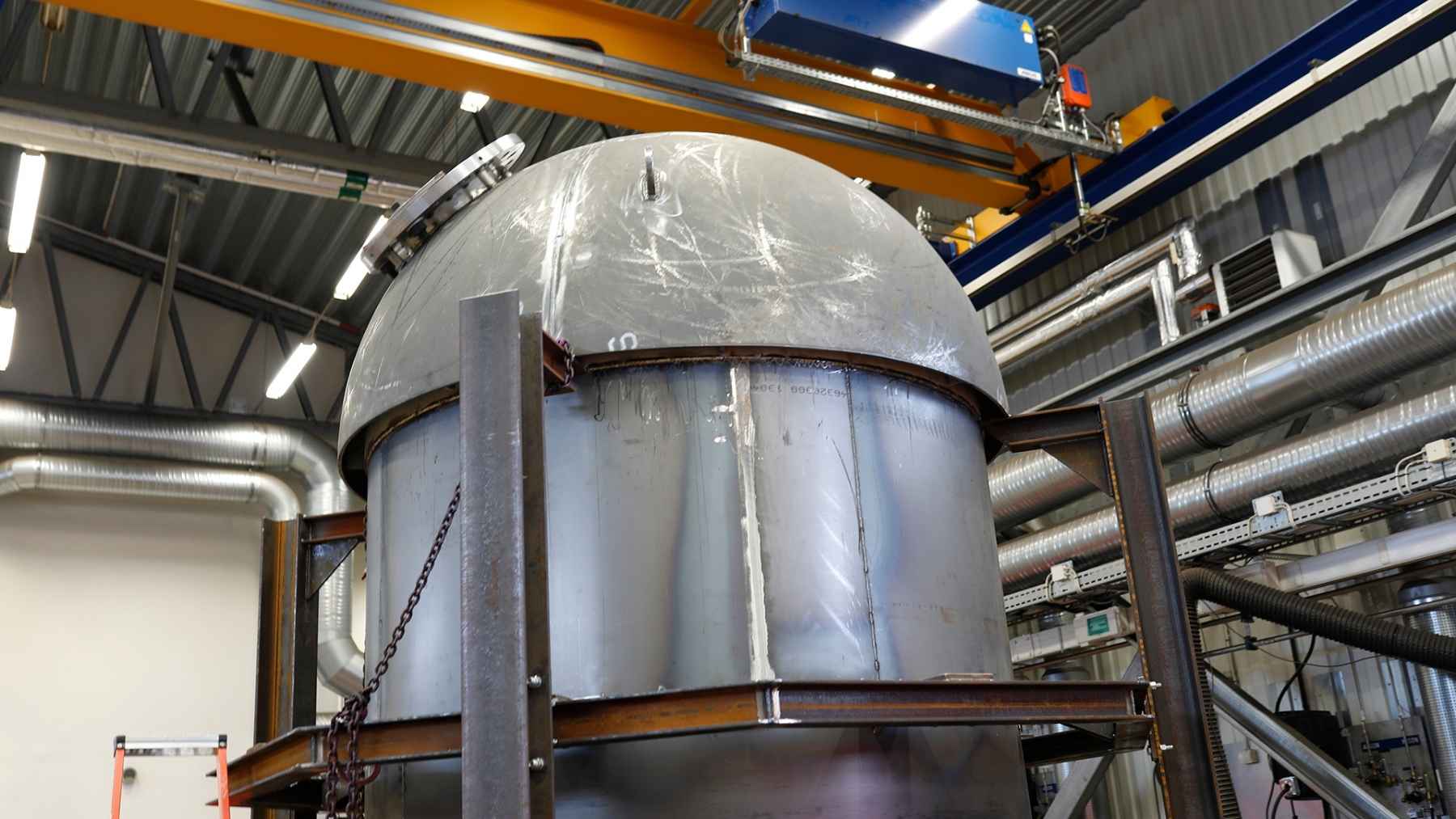
The modern part is what surrounds the wheel. Grid-scale flywheels ride on magnetic bearings and spin inside a vacuum chamber, so there’s almost nothing to rub against and almost no air to fight. That buys two things. The wheel keeps spinning for a long time without bleeding much energy, and there are no chemical reactions and effectively no parts that wear out.
That last bit is the sales pitch. A lithium cell loses a sliver of capacity with every charge and discharge, and it really hates being hammered fast. A steel wheel does not care. Torus rates its flywheel for “25,000 cycles with no capacity fade,” and says day-one performance and year-20 performance are identical. Believe the exact number or not, the direction is real: mechanical storage shrugs off the fast cycling that grinds batteries down.
The catch has always been energy. A wheel is brilliant at delivering a big jolt of power for a short burst, and lousy at storing a lot of energy for a long stretch. It’s a sprinter, not a marathon runner. Which is why nobody sane is proposing to swap out a field of Tesla Megapacks for flywheels. The wheel is there for the fast stuff the battery is bad at, not the heavy lifting the battery is good at.
Torus is really a battery company with a flywheel bolted on
The biggest name in this revival is Torus, out of South Salt Lake, Utah, co-founded in 2021 by Nate Walkingshaw and Gilbert Lee. In September 2025 it raised $200 million from the asset manager Magnetar, one of the largest single checks ever written for anything flywheel-adjacent.
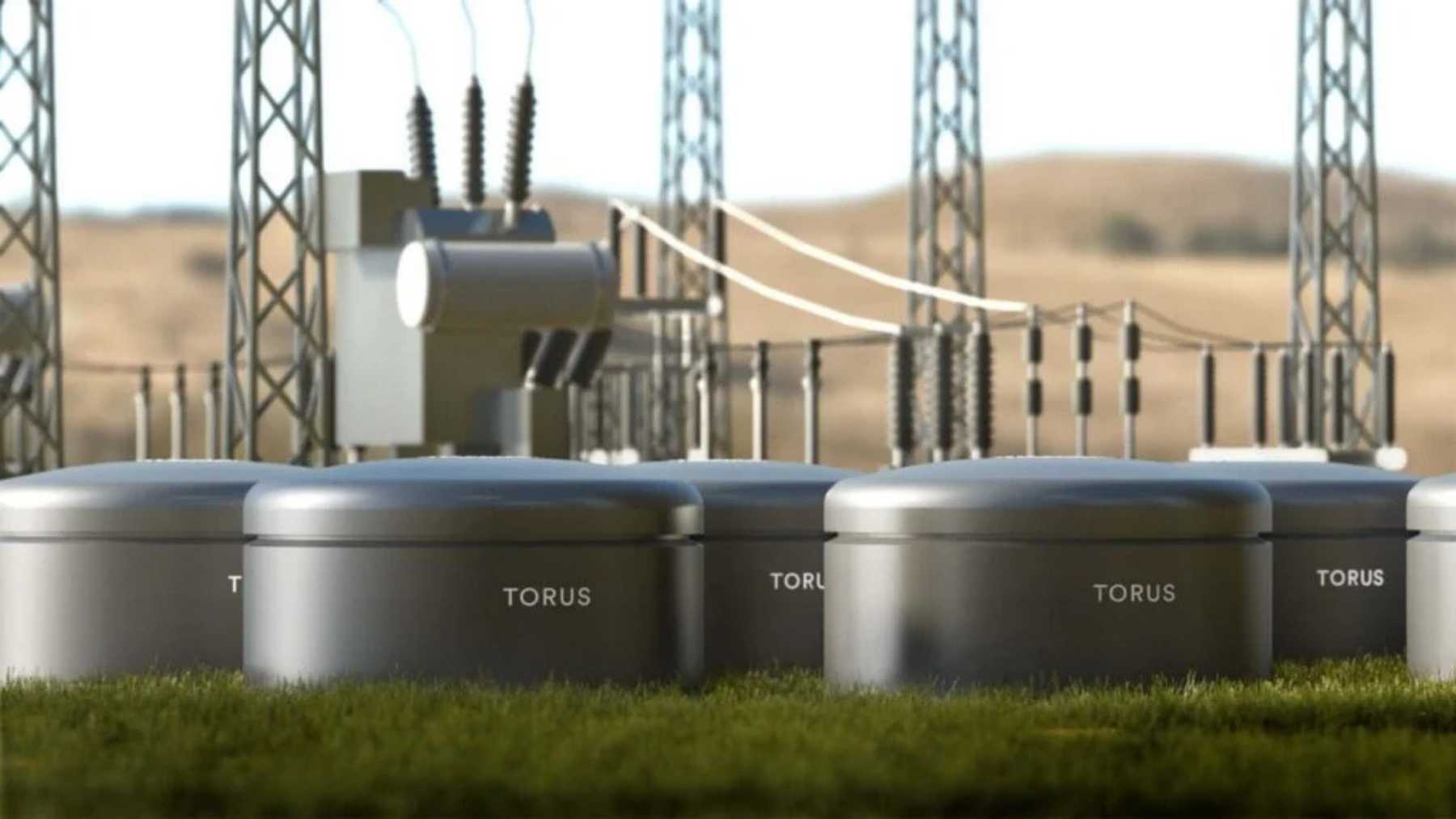
I say “adjacent” on purpose. Torus does not sell a pure flywheel. It sells a hybrid: a steel flywheel it calls Nova Spin, paired with a lithium-iron-phosphate battery it calls Nova Pulse. The wheel handles the millisecond bursts and frequency support. The battery handles the hours of duration. The flywheel is the fast reflex, the battery is the muscle.
That distinction matters for the headline deal. Torus has an agreement with PacifiCorp, the largest grid operator in the western U.S., that has grown from an initial 70 megawatts into a memorandum of understanding covering up to 500 megawatts of demand-response capacity across Utah, Oregon, Washington, Idaho, Wyoming and Northern California.
It’s worth being precise here. That’s an MOU, not a signed and financed 500 MW contract. And PacifiCorp happens to be owned by Warren Buffett’s Berkshire Hathaway Energy, which tells you something about who’s watching this technology.
The rest of the Torus story checks out. The company says it completed more than 230 installations in 2025 at a claimed 99.9% uptime, its Nova Spin flywheel made TIME’s Best Inventions list in 2024, and it’s building a 540,000-square-foot factory in Salt Lake City called GigaOne, with the metal coming from U.S. steel.
By flywheel standards, Torus is enormous. By grid-battery standards, it’s a rounding error, and most of what it actually ships is battery.
The other bet is aimed straight at AI
The purer flywheel play is Revterra, a small Houston outfit founded in 2017 by Ben Jawdat, who has a physics PhD from the University of Houston and a background in superconductivity. Its wheels are made of cheap steel, and the clever part is the bearing.
Instead of active electromagnets that burn power to hold the rotor up, Revterra uses passive magnetic bearings that levitate a seven-ton steel rotor with almost no energy input. The company says its 100-kilowatt-hour system loses only about 50 watts while idling, against more than 1,000 watts for a lot of conventional flywheels. That’s the difference between a wheel that holds its charge and one that quietly runs itself down.
And Revterra has picked its customer carefully. Its first commercial target isn’t the utility grid at all. It’s the AI data center, and the reason is the graphics processors doing the training. Revterra CFO Patrick Flam, speaking to Greentown Labs, said the power draw of those GPUs “can fluctuate more than 90 percent” in the span of milliseconds.
That kind of violent, high-speed swing is exactly what chews up chemical batteries and rattles a grid connection. A steel wheel eats it for breakfast. Revterra’s current module stores 100 kWh and, in its data-center configuration, delivers up to 2 megawatts, spinning at 3,600 rpm so it locks onto the 60-hertz U.S. grid directly, no inverter required. Narrow job, and the wheel is genuinely good at it.
Flywheels have missed this train before
Here’s the part the press releases skip. Flywheels have been “about to matter” to the grid for a quarter of a century, and they keep not mattering.
Beacon Power built flywheel frequency-regulation plants in the 2000s, raised tens of millions in a 2000 IPO, and filed for bankruptcy in 2011 as batteries got cheaper. Amber Kinetics, Temporal Power, Pentadyne and a handful of others took their swings and mostly landed in niches or nowhere. A recent CleanTechnica analysis put it flatly, calling the current Torus story “a battery-heavy bet with a side helping of flywheels” rather than a flywheel comeback.
The uncomfortable truth is that speed used to be the flywheel’s trump card, and it isn’t anymore. Modern lithium batteries, advanced inverters and HVDC controls already respond fast enough for most of the grid services that actually pay. On cost it isn’t close either. The same analysis notes that four-hour utility battery systems now come in well below what historic flywheel projects cost per unit of storage, citing figures from the national lab NREL.
So the flywheel isn’t fighting for the whole grid. It’s fighting for the shrinking sliver of jobs where you need enormous power for a very short time, over and over, without wrecking a battery to do it. Data centers are the best argument going that this sliver is getting bigger rather than smaller.
Where this actually lands
None of this ends with steel wheels replacing lithium. The companies building them aren’t even claiming that. Torus is mostly selling batteries, and Revterra is chasing a single high-power niche it happens to be very good at.
The honest version of the pitch is that the grid is turning into a stack of storage types, each doing the one thing it’s best at, from sodium cells built for cheap bulk storage to carbon-dioxide domes that store power as liquid. The flywheel is quietly claiming the fastest, most punishing shifts on that roster.
Whether that niche is big enough to build a durable business on is the open question, and it’s the same one that sank Beacon Power fifteen years ago. The difference this time is the customer. If AI keeps throwing up data centers that swing 90% of their power draw around in milliseconds, the spinning steel wheel finally has a job that plays to exactly what it’s good at, and that lithium would rather not touch.
 @leonllrmc ROOKIE3 months ago