
Battery-powered autonomous underwater vehicles have been chasing the same three numbers for the better part of two decades: stay down longer, go deeper, and stay quiet enough that nobody on the surface notices. Pick two and the third falls off the table, which is why every survey contractor and navy on the planet has been stuck planning missions around the recovery schedule of a lithium pack. But a Canadian-built drone running on hydrogen fuel cells just turned in a real-world test result that hits all three at once.
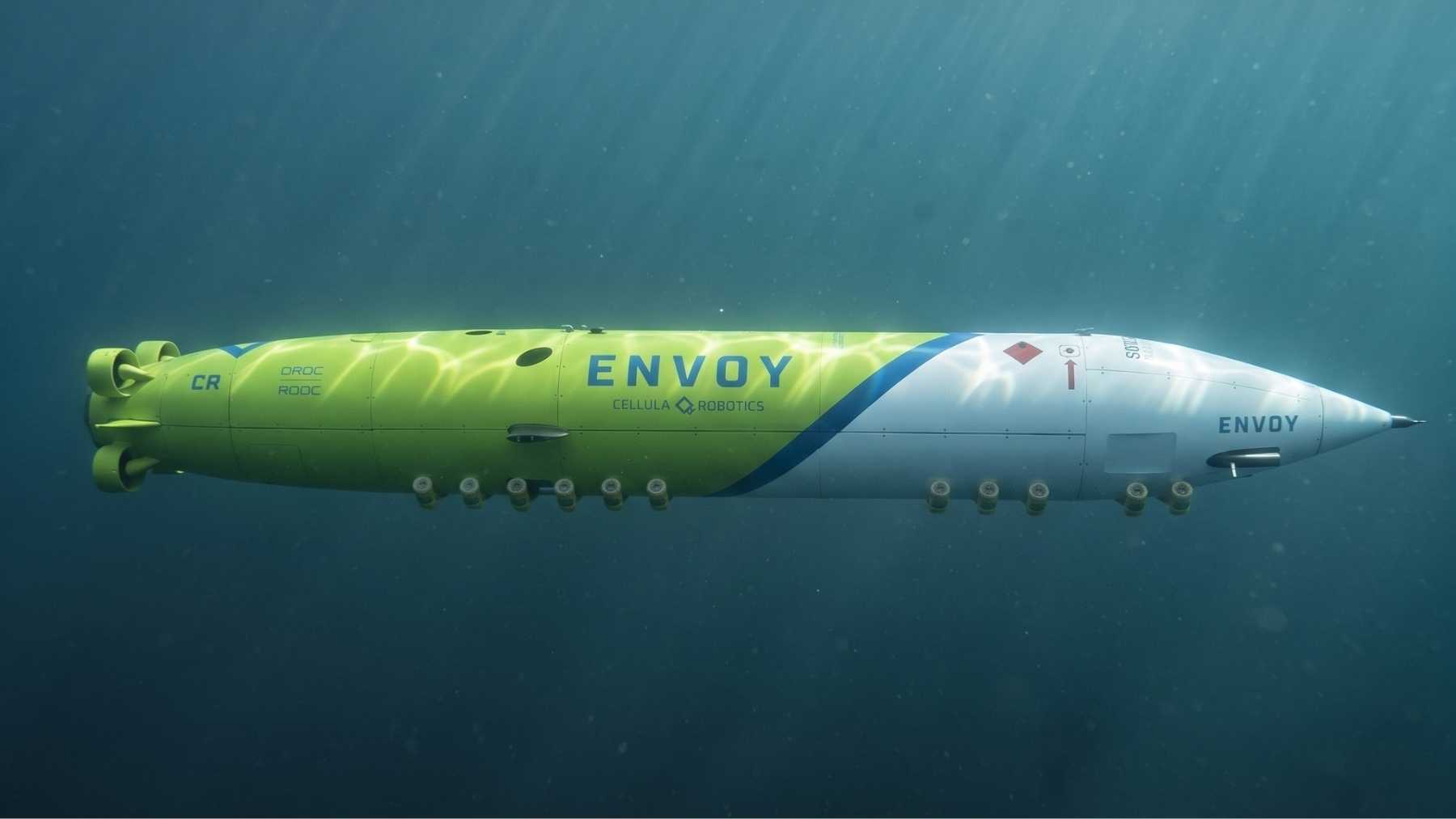
The vehicle is the Envoy AUV from Cellula Robotics, a Burnaby, British Columbia outfit that has been quietly building survey-class subsea robots for industry leaders like BAE Systems and the Royal Canadian Navy. The Envoy completed a fully submerged mission covering more than 2,000km powered by a hydrogen fuel cell system, spanning 385 hours and a total distance of 2,023km, exceeding the platform’s published performance specifications. And it did the trip the hard way.
2,023 km submerged, and not in a straight line
Most endurance records in this corner of the industry get set by pointing the vehicle in one direction and seeing how far it coasts before the battery quits. Cellula didn’t do that. Unlike standard straight-line transit tests, this deployment utilized a non-linear underwater profile designed to represent real-world subsea operations, and during the mission the vehicle executed more than 4,000 turns and maneuvers, a process that significantly increases energy demand compared to steady, linear travel.
Which is the whole point. A seabed survey or a pipeline inspection isn’t a straight line. It’s thousands of course changes, depth holds, and hover-and-look moments, each one drawing extra current. Neil Manning, CEO of Cellula Robotics, leaned on that in his statement to Interesting Engineering: “The significance of this result is not just the distance traveled, but that it was achieved fully submerged in a mission profile that better reflects real subsea operations.”
For scale, the Envoy isn’t a torpedo-sized toy. It measures 27.9 feet in length, 3.3 feet in diameter, and has a displacement of approximately 8,160 lbs. That’s roughly the footprint of a midsize sedan stood on its nose, swimming itself around the equivalent of the drive from Vancouver to Houston without coming up for air.
Why batteries have been stuck for 15 years
The battery AUV problem isn’t that lithium-ion is bad. It’s that lithium-ion forces you to trade. Add cells and you add weight, which adds drag, which eats the range you just bought. Push deeper and the pressure housing gets heavier, which eats more range. Run faster and you eat range twice. The math has barely moved in over a decade, which is why most commercial battery AUVs still budget missions in hours, not weeks.
Hydrogen sidesteps the trade. Hydrogen fuel cells offer more than twice the energy density of rechargeable batteries. Cellula puts hard numbers on what that buys you: the ENVOY AUV, a compact, mid-range endurance model, can run survey and inspection missions for up to 15 days and cover a range of 2,000 km on a hydrogen fuel cell, whereas the GUARDIAN AUV, specifically designed for extended deployments in more volatile environments, can last 45 days in the field, cover 5,000 km, and deploy various payload options at extended ranges.
That endurance is the headline, but the depth spec is the part the brochure tends to bury. All Cellula fuel cell powered systems are depth rated to 3,000 m, with plans to extend to full ocean depth already underway. Three kilometers down covers the vast majority of the continental shelf and most of the seabed infrastructure anyone actually cares about — cables, pipelines, anchor points — without the pressure housing tax that kills battery range.
The acoustic angle nobody wants to say out loud
The third number is the one defense buyers care about most and that nobody puts on a press release in plain English. A diesel-electric AUV makes noise. A combustion-driven anything underwater makes noise. Battery vehicles are quieter, but they still have to surface, which is its own kind of acoustic and visual giveaway. Fuel cells split the difference in a useful way.
The Envoy’s propulsion system relies on proton exchange membrane (PEM) fuel cells supplied by Connecticut-based Infinity Fuel Cell and Hydrogen, the same firm that has built fuel cells for NASA, defense agencies, and aerospace partners, and as the cells silently combine hydrogen with oxygen, the only by-product is water. Hydrogen Exchange put the operational picture more bluntly: a drone that runs 1,257 miles silently, leaves no acoustic plume from a combustion engine, and produces only water vapor on recovery is exactly the platform those programs are commissioning.
For the broader subsea robotics market, hydrogen splits the difference and pushes past both, delivering long endurance with zero emissions in an environment where neither smoke nor heat can hide. That’s the part battery rivals can’t answer with another firmware update.
Who’s actually buying these things
This isn’t a science-fair record. The specific vehicle Cellula put through the 2,023 km run is already in government hands. Marine Technology News reported on June 3 that the specific Envoy used in the endurance testing is owned by Defence Research and Development Canada, the Canadian government’s defense science agency, and that Cellula has been maturing the platform under a DRDC contract over several years.
And the Envoy has a party trick that turns the endurance number into something more useful than raw range. The Envoy carries a suction anchor that lets it grab onto the seabed and sit there, so it doesn’t have to burn energy holding position to keep watching a single spot — park it on a pipeline junction or a cable landing and it can monitor for days with no ship overhead and no trips to the surface. A 16-day stakeout on a cable is a very different product than a 16-day cruise across an ocean, and the same hardware does both.
Cellula isn’t the only player putting hydrogen in the water either. Germany’s Euroatlas-built Greyshark Foxtrot is chasing similar territory from the other direction: a European defense technology company has unveiled what it calls the world’s longest-endurance unmanned submarine, which can remain submerged for up to four months without the need for a support vessel, built by Bremen-based Euroatlas as an autonomous underwater vehicle developed for long-range underwater surveillance missions, including protecting critical subsea infrastructure such as energy pipelines and communications cables in contested waters. We’ve covered the Greyshark program separately, and the two vehicles together tell you what kind of capability the procurement side is suddenly willing to pay for.
What the test result actually proves
Cellula was careful about the claims, and the company isn’t pretending it just invented physics. What the run does establish is that the endurance, depth and acoustic targets battery AUVs have been swapping between for years can be hit together in one platform without exotic R&D money. The demonstration reinforces the Envoy AUV’s suitability for sustained subsea deployment where persistence and range are the primary drivers of offshore efficiency, and the successful completion of the 2,000km profile establishes hydrogen fuel cells as a practical enabler.
The same source documented an underrated detail for the hydrogen economy at large. It tells utilities, regulators, and capital allocators that hydrogen technology is being trusted with multi-million-dollar assets in environments where rescue is impossible and failure is final. If you’re a hydrogen skeptic, a fuel cell drone successfully running 385 hours under several hundred meters of seawater is a harder result to wave away than a road car spec sheet.
None of this means battery AUVs go in the bin tomorrow. Short-range survey work, harbor inspection, anything you can recover in a shift — lithium still wins on cost. But the long-endurance corner of the market, the one the navies and pipeline operators have been throwing money at, just got a working answer. Fifteen years of asking the same three questions, and somebody finally turned in a test card with all three boxes checked.
 @kevinfitzgibbon ROOKIE3 months ago