
The underwater-drone endurance numbers have been creeping up all year, and each one lands as its own headline. Germany’s BlueWhale can loiter for a month. A German hydrogen sub is built to vanish for four. Helsing’s little seabed listener holds out for three. Every one of those is a real leap, and every one of them gets measured in weeks or months, because sooner or later the machine runs out of power.
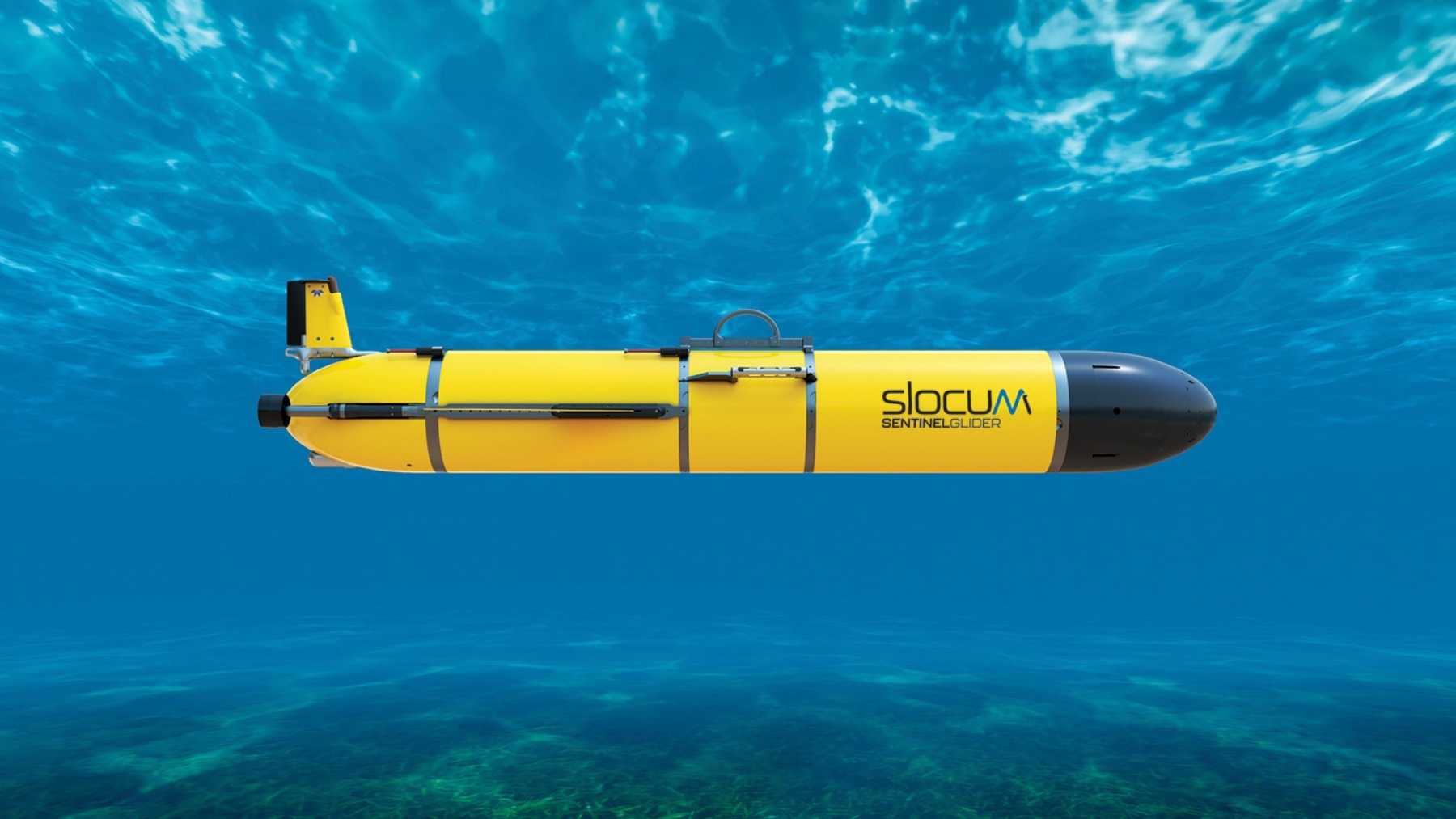
Teledyne Marine just quietly walked past the whole conversation. Its Slocum Sentinel glider is rated to stay underwater for more than two years on a single load of batteries. It manages that not by hauling a bigger battery around, but by refusing to spin a propeller to get anywhere.
The UK just signed up for a batch. In a contract that started in March, the Royal Navy ordered a fresh run of Teledyne gliders, including this newest and largest one, while it quietly retires the survey ships it used to send out to do the same job.
It stays under for years because it hardly moves itself
Most underwater drones swim. There’s a motor, a propeller, and a battery that drains every minute the propeller turns. That’s the whole reason endurance is such a fight. Pushing through water costs energy, and the tank is only so big.
A glider ducks the problem by mostly not moving under its own power. Instead of a drive propeller, the Sentinel carries a pump that Teledyne calls a buoyancy engine, and it shoves about four liters of fluid in and out to change how heavy the vehicle sits against the water around it. Make it a hair denser and it sinks. A hair lighter and it rises. Its stubby wings turn that slow up-and-down into forward motion, the same trick a paper plane or a sailplane uses when it trades height for distance.
So it falls forward, glides, rises, and glides again, tracing a long sawtooth through the water at about three-quarters of a knot. You could out-walk it without breaking a sweat. But the pump only runs for a few seconds at the top and bottom of each dive, so the glider spends nearly all its time coasting on physics and burning almost nothing.
It isn’t strictly propeller-free, and it’s fair to say so. Teledyne bolts optional thrusters onto the Sentinel for punching through a strong current or shortening a transit, and by the company’s figures those give it short sprints of a few knots. But that’s for the hard moments, not for the daily grind of crossing an ocean. Left alone, the glider just sinks and rises, over and over, for two years.
The energy budget is the part that stops you. The Sentinel’s entire power supply is 23 kWh, roughly what an average American home runs through in a single day. Spread that across two years underwater and you start to see why the thing never surfaces for a charge. It can’t be recharged anyway.
Two years is a different category, not a bigger number
The standard Slocum glider, the workhorse Teledyne has been refining in one form or another for over two decades, tops out around 18 months in its longest-endurance builds, per The Defense Post. The Sentinel doesn’t nudge that. It clears two full years, roughly half a year of extra working time on top of the old best.
It gets there by being bigger. The Sentinel runs about 2.57 meters long and 33 centimeters across, weighs 171 kilograms, and packs more than three and a half times as many lithium cells as the standard glider. Those are primary cells, the non-rechargeable kind, so the two-year rating is one single load of batteries from start to finish. When they’re spent, you pull the vehicle and swap them.
Teledyne rates it to 1,000 meters deep, gives it room for up to eight sensor payloads, and fits it with what the company bills as the largest buoyancy engine on the market. Stack the endurance numbers next to the other machines making news and the gap is hard to miss.
The Royal Navy is buying gliders as it runs out of survey ships
The reason any of this is in the news is a contract the Royal Navy started on March 16. Under its Future Maritime Data Gathering program, Teledyne will supply a new run of Slocum gliders and APEX profiling floats, expanding a robot fleet the service has quietly operated since 2015, according to Naval News.
Most of the order is the proven G3 workhorse, 12 to 15 of them, plus 56 of the disposable drifting floats and, tucked in among them, a single Sentinel, optionally fitted with a towed sonar array, per Future Warfare Magazine. UK contract records put the deal at more than £6.6 million, with options running to 2028.
The backdrop is a shrinking survey fleet. The Royal Navy has retired its dedicated ocean-survey ships HMS Echo and HMS Enterprise, leaving HMS Scott as the last of its kind, Navy Lookout reports. Ships that used to spend weeks mapping the water are being traded for robots that can spend years in it.
It all feeds Atlantic Bastion, the undersea surveillance push the UK launched in December 2025 to watch the North Atlantic after a run of severed cables and damaged pipelines in European waters. The data these gliders gather, water temperature, salinity, the way sound bends through a given patch of ocean, is the unglamorous groundwork that makes sonar and submarine-hunting actually work. Commander Butcher, the Royal Navy’s capability sponsor on the program, framed the point as operating in an “increasingly contested North Atlantic.”
The Sentinel isn’t the only drone learning to stay down
Long endurance underwater has turned into a crowded race, and the machines chasing it don’t all look alike. Helsing’s SG-1 Fathom is a glider too, and it runs on buoyancy the same way, but it’s built for the opposite job. It’s a small, cheap listening node meant to be stamped out by the hundreds and swarmed across a stretch of sea to hunt submarines for a few months at a time. The Sentinel is the other bet entirely, a big, single, long-haul machine whose day job is measuring the ocean itself, for years on end.
Others get at the endurance problem sideways. Ocean Aero’s weather-powered Triton harvests wind and sun on the surface for a month, then folds its sail and dives for ten more days. Norway’s robot snake Eelume skips the swimming-home problem altogether by living in a docking station on the seabed and charging there between jobs, staying resident for up to six months.
If two years still sounds like a spec-sheet promise, there’s already one out proving it. A Sentinel named Redwing launched off Massachusetts in October 2025 on a five-year run meant to make it the first robot to glide all the way around the planet, dodging fishing nets and riding the Gulf Stream toward Europe with nobody aboard. Teledyne’s own crew called it their moonshot.
The endurance problem, at least for the slow and essential work of measuring the ocean, is basically handled now. A survey glider can stay out longer than the ship that would once have carried it, and it can do it for a rounding error of the cost. What the Sentinel doesn’t do is hunt anything or carry a weapon. It’s a sensor that flies on buoyancy, and its entire advantage is patience. For a navy quietly trading survey ships for robots, that turns out to be exactly the thing worth buying.