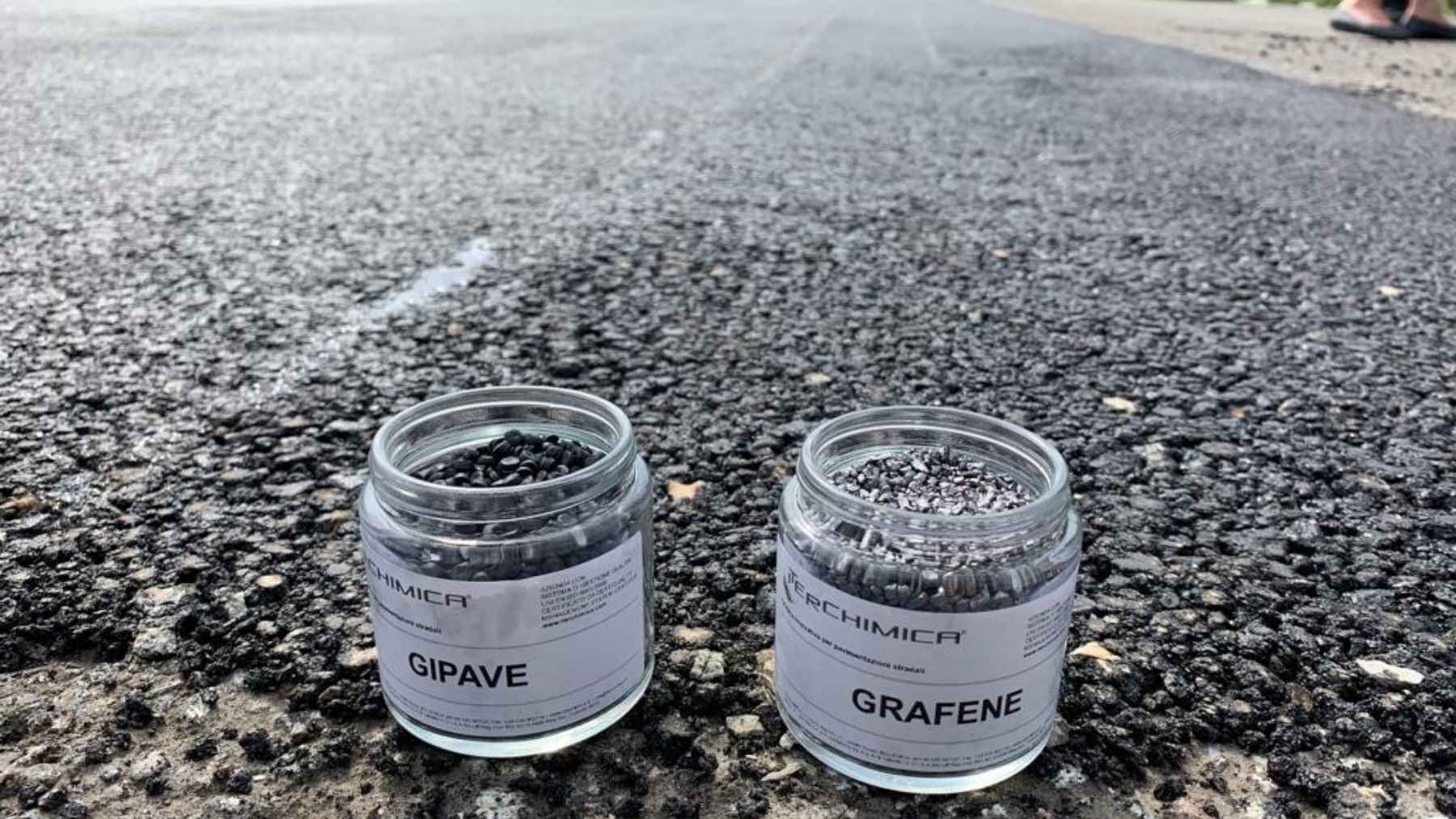

Italian engineers have been measuring asphalt fatigue improvements on the order of 250 percent. British highway authorities are measuring lifespan extensions of around 165 percent. The additive doing the work in both cases is the same: a graphene-enhanced polymer called Gipave, developed by Italian asphalt producer Iterchimica and graphene specialist Directa Plus, and mixed into the bitumen film that holds road surfaces together. After roughly six years of quiet trials on short stretches of UK and Italian pavement, the data is starting to converge on a single point: graphene-modified asphalt fails more slowly than the conventional kind. By a lot.
That number — 165 percent forecast lifespan extension — is the one British road engineers keep coming back to. It came out of a 725-metre trial on North Street in Middle Barton, Oxfordshire, a village near Chipping Norton, where the county council laid Gipave on one section and conventional high-performance asphalt on the adjacent section so the two could be compared in real-world conditions. The forecast, published by Highways Magazine in the UK, also calculated a corresponding 40 percent carbon saving over a 20-year service life.
For an American reader the math should land harder than it does, because American pavement is now under structural loads it was not designed for, and that question is bleeding directly into how cars get taxed.
What Gipave actually is
Gipave is not a road surface in itself. It is a graphene-plus polymeric additive that gets blended into the bitumen film coating the aggregate in standard hot-mix or warm-mix asphalt. Graphene, the carbon-based two-dimensional material discovered at the University of Manchester in 2004, is between 100 and 300 times stronger than steel, depending on which testing protocol is being applied. Inside an asphalt mix, the graphene-polymer composite reinforces the bitumen, raises the stiffness modulus at high temperatures, and slows the propagation of fatigue cracks under repeated loading.
The Italian trial that produced the +250 percent fatigue resistance number was Iterchimica and Directa Plus’s first commercial test of the Gipave concept, on a one-kilometre section of Italian road. The independent lab that monitored it also recorded a 35 percent gain in indirect tensile strength, a 46 percent improvement in stiffness modulus at 40°C, and a 35 percent reduction in rutting at 60°C, according to results published by ABC Magazine in Europe. Those four numbers are what every later European pilot has been trying to reproduce in different climates and traffic loads.
Outside Italy, Gipave has now been laid on the new San Giorgio bridge in Genoa, the Treviso Airport runway, taxiways at Edinburgh and Rome Fiumicino Airports, the F1 circuit at Imola, and stretches of the A4 Turin-Milan and A4 Brescia-Padua motorways in northern Italy. The UK trials have been smaller in scale but more public: Curbridge in 2019, three miles of the A1 northbound in Northumberland in autumn 2021, Marsh Lane in Oxford in March 2022, the Middle Barton section that produced the 165 percent forecast, and a 1-kilometre stretch of the A12 northbound between Hatfield Peverel and Witham in Essex laid in August 2024.
That A12 section was National Highways’ first official use of Gipave on the strategic road network, and it included 40 percent reclaimed asphalt, the highest share ever used in a UK trial with a graphene-enhanced polymeric modifier. AtkinsRéalis is leading the analysis against a control section of standard polymer-modified bitumen, with lab testing by the University of Nottingham. Eurovia UK laid the surface; Jean Lefebvre UK ran the mix design.
Why this matters more now than it did five years ago
The first generation of road pavement design in the United States was calibrated against the AASHO Road Test, which ran in Illinois from 1958 to 1960 and produced the relationship that highway engineers still use today: the stress a vehicle puts on the pavement increases roughly with the fourth power of axle load. Double the load on an axle, the pavement damage goes up by a factor of sixteen. Heavy commercial trucks remain the dominant source of structural pavement wear in any modern road network, by a long margin.
The wrinkle is what has happened to the light-duty fleet since around 2020. A typical American gasoline-powered SUV in 2010 weighed somewhere between 4,000 and 4,500 pounds. The 2026 GMC Hummer EV weighs more than 9,000 pounds, classed by federal regulators as something other than a passenger vehicle. The Cadillac Escalade IQ rolls on a battery pack north of 200 kWh and tips the scales close to the Hummer figure. A Chevy Silverado EV with the long-range pack is in the same conversation. A Rivian R1T sits closer to 7,000 pounds. A University of Leeds study of 15 popular UK battery EVs found the average BEV is 312 kg, or 688 pounds, heavier than its closest petrol equivalent.
Those weight increases do not destroy pavement on their own, because passenger vehicles still sit well below the AASHO loading threshold where structural fatigue kicks in. But two things have changed. The first is that the U.S. heavy-duty fleet is starting to convert: Tesla began series production of the Tesla Semi on April 29, 2026, and California’s truck fleet is shifting toward natural gas, electric, and fuel-cell platforms with heavier axle loads than the diesel trucks they replace. The second is that American highway barriers and pavement, designed against an assumed light-duty mass that no longer holds, are showing up in the political conversation faster than the engineering one.
The House Transportation and Infrastructure Committee is now pushing a $250 annual federal fee on EV owners, against $88 a year that gas car drivers pay in federal fuel taxes, on the argument that heavier electric vehicles are contributing to road damage. AutoNotion covered the fee proposal in April. The engineering view from University of Wisconsin-Milwaukee’s Institute for Physical Infrastructure and Transportation is that “load-related damage to pavement and bridges is caused almost exclusively by heavy trucks,” in the words of Mark Gottlieb, an engineer at the institute. Both things can be true at once: passenger EVs are not the main cause of pavement wear, and an aging road network was not built for the current weight distribution.
The American backlog
The 46,876-mile Interstate System carries roughly a quarter of all American vehicle miles traveled and is, on average, well past its design life. The Pew Charitable Trusts calculated that state and local governments combined fell short of the spending needed to maintain the roadway capital stock by about $105 billion between 1999 and 2023. Federal Highway Trust Fund authorizations were $56.8 billion in FY2024, against $43.2 billion in identified annual repair needs for the federal-aid system, according to Transportation For America. The Infrastructure Investment and Jobs Act has pushed roughly $60 billion a year into roads and bridges since 2022, but the share of federal-aid-eligible pavement rated “poor” between 2018 and 2024 fell by only three percentage points despite that historic investment.
That is the gap a graphene additive is supposed to start closing. Gipave runs roughly 10 to 15 percent more expensive than conventional polymer-modified asphalt at the point of installation, based on the Oxfordshire procurement figures from Middle Barton. If the 165 percent lifespan forecast holds up over the next decade of monitoring, the whole-life cost math swings hard the other way. Stretches of pavement that get resurfaced every 12 to 15 years today would, in theory, last 25 to 30 years on the same wearing course, with a corresponding reduction in lane-closure days and asphalt manufacturing emissions.
The US is mostly still watching
There is no comparable American trial running on a federal-aid highway today. Argo Graphene Solutions began cold-weather testing of a graphene-infused asphalt mix in a Saskatchewan lab in January 2026, aimed at the cracking and freeze-thaw problems that destroy roads in the upper Midwest. The Federal Highway Administration’s published research on graphene-modified bitumen, hosted on the Department of Transportation’s research portal, has so far framed the technology as promising but cost-sensitive: high-grade graphene oxide additives can outweigh the durability benefit at current price points.
Cost is exactly what the European pilots have been trying to grind down. Gipave’s polymer base uses waste plastics that are not normally recyclable, which lowers the additive cost and folds in a separate sustainability story. The asphalt mixes containing Gipave are themselves fully recyclable on subsequent resurfacings, according to Oxfordshire County Council, which means the material does not lock the carbon savings into a single pavement life.
What is not yet settled
The 165 percent figure is a forecast based on accelerated testing data, not a measured outcome from a finished 20-year service life. The Middle Barton trial laid the surface in 2023; the A12 trial laid it in 2024; the National Highways follow-up was laid in summer 2025 and is still under multi-year monitoring by AtkinsRéalis. The Italian airport and motorway trials have longer service histories but did not run with control sections built to the same standard as the UK National Highways comparison, which limits how cleanly the numbers can be ported across climates and load profiles. The five-year ECOPAVE field test in southern Rome, published in the Infrastructure journal in February 2024, confirmed higher stiffness and better fatigue behavior without producing a single headline figure for lifespan extension.
The other open question is whether a U.S. departments of transportation, working under American Society for Testing and Materials specifications and the FHWA’s own pavement testing protocols, would generate the same numbers as British and Italian agencies working under European standards. ASTM has not yet published a standard specification for graphene-modified asphalt binders. Until it does, any American pilot is going to be a one-off research project, not a procurement-ready material.
What the European pilots have done is move the case for graphene-enhanced asphalt out of the lab and onto roads that drivers actually use. A British highway authority is now publicly forecasting that a stretch of road in Oxfordshire will last more than two and a half times longer than the asphalt next to it. The next question is whether anyone in Washington wants to put that math against a $105 billion maintenance backlog and a federal vehicle fleet that gets heavier every model year.
 S DRIVER5 months ago