
Space-based solar power is one of those ideas that has lived on conference slides for half a century without ever quite walking off them. The pitch never changes. Park solar panels in orbit where the sun never sets, convert the sunlight to microwaves, beam it down to a receiver, and you get clean power that ignores clouds, nightfall, and seasons. It sounds like science fiction, and for 50 years it has mostly behaved like science fiction. But Japan has now built the hardware, booked a rocket, and put a date on the one part nobody has managed yet: not just picking up a faint signal from orbit, but turning beamed sunlight into electricity you can actually use on the ground.
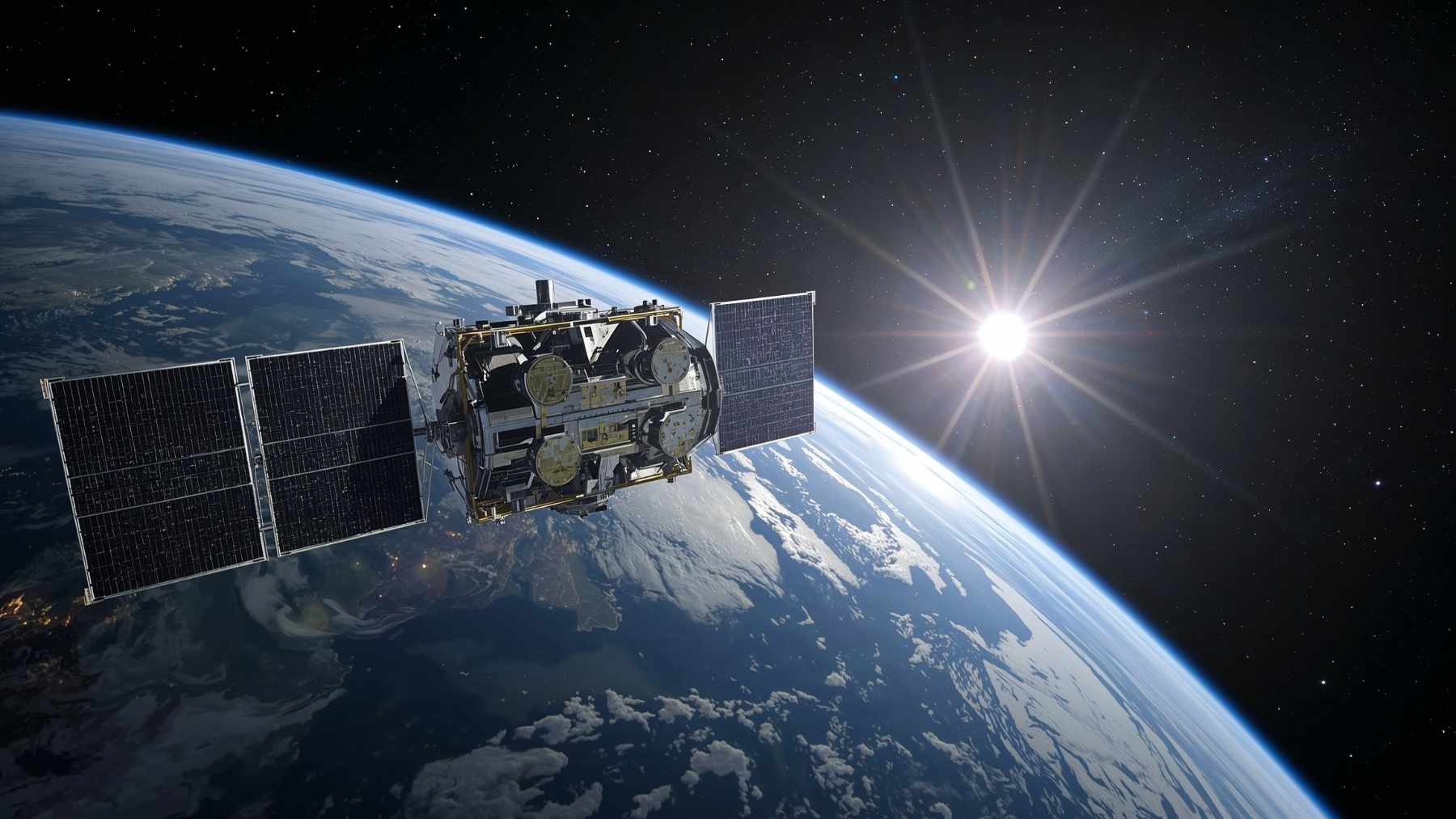
The satellite is called OHISAMA, Japanese for “the sun,” and it is roughly the size of a washing machine. It was built by the nonprofit research foundation Japan Space Systems under a contract from the country’s Ministry of Economy, Trade and Industry, it weighs about 180 kilograms, and it is slated to fly during Japan’s fiscal 2026. The entire near-term goal of the mission is to light one LED. That sounds anticlimactic right up until you realize the LED is not the point. The aiming is.
A washing-machine satellite with a coffee maker’s worth of power
Here is what OHISAMA actually carries. One integrated panel, 70 centimeters by 2 meters, with solar cells on one face and a microwave transmitter on the other. Peak output is around 720 watts, which is about what a household coffee maker pulls when it is brewing. So the satellite generates roughly enough power to make your morning coffee, and that is the figure everyone fixates on, and it is the wrong figure to fixate on.
Once it reaches an orbit about 450 kilometers up, call it 280 miles, the sequence is simple to state and brutal to execute. Sunlight becomes DC current, the current is converted into microwaves at 5.8 GHz, and the beam is pointed at one specific target on the ground: the 64-meter parabolic dish at JAXA’s Usuda Deep Space Center, in Nagano Prefecture. If everything lines up, the energy that arrives lights the LED. Small confirmation, large implication.
The beam is the whole game
The aiming works through a two-way handshake the engineers call retrodirective beam control. A station on the ground sends a pilot signal up to the satellite. OHISAMA locks onto that signal and routes its microwave beam back down along the exact same path. On a bench in a lab, this is tractable. From orbit it is not, because the transmitter is moving at orbital velocity, the target is a fixed dish on a rotating planet, and the beam has to punch through the ionosphere and a harder vacuum than anything the program has tested so far.
This is also where OHISAMA tries to clear a bar that has tripped everyone else. In 2023, Caltech’s Space Solar Power Project flew a demonstrator that beamed power in space and directed a detectable beam down to a receiver on a rooftop in Pasadena, which was a genuine first. What it did not do was deliver usable electricity on the ground. Detecting that a beam arrived, and converting that beam back into current you can actually run something with, are two different problems. OHISAMA is built to take on the second one.
Japan has been at this since 1983
None of this is a sudden idea, in Japan least of all. The country ran its first microwave power transmission from space back in 1983, on a rocket experiment called MINIX put together by Kyoto University, Kobe University, and what was then the Institute of Space and Astronautical Science. The distance record has been creeping up ever since. A 2015 ground test in Hyogo Prefecture pushed about 340 watts across 54 meters at that same 5.8 GHz band. A 2019 experiment beamed power straight up to a hovering multicopter and, more usefully, proved the beam could chase a moving receiver by tracking its pilot signal. In 2024, researchers bolted a transmitter to an aircraft at 7 kilometers and put microwave energy onto a ground receiver. Every step added distance, motion, or both, and 450 kilometers adds all of it at once.
The concept underneath is older still, and it is not originally Japanese. An American engineer named Peter Glaser proposed the solar power satellite in 1968 and patented it in 1973. The United States studied it seriously through the 1970s, then froze the work in 1980 because the construction costs and the resulting price of the power simply did not close. That gap, between a thing that obviously works in physics and a thing that pays for itself, is most of why this has stayed a slideshow for 50 years.
The catch is the rocket
There is an awkward detail sitting between OHISAMA and orbit. It is manifested on Kairos, a small solid-fuel rocket from the Japanese company Space One, and Kairos has not had a good run of it. The first flight exploded about five seconds after liftoff in March 2024. The second failed in December 2025. The third, in March 2026, was terminated roughly two minutes after launch, as Space.com reported. That is three flights and three failures. OHISAMA is booked on the rocket’s fifth flight, currently targeted for fiscal 2026, which means that before the satellite gets its shot at the LED, Space One has to produce a Kairos that reaches orbit in one piece.
A two-kilometer dream, and why it is still expensive
The LED is the near-term goal. The far goal is a power station. Japan Space Systems’ own reference model describes a generating-and-transmitting array roughly two kilometers on a side, parked in geostationary orbit about 36,000 kilometers up, beaming down to a ground antenna around four kilometers across. One unit like that would put out about a gigawatt, which the organization reckons is north of 10 percent of Tokyo’s annual electricity, with commercialization pointed somewhere into the 2040s.
The physics has never been the holdup here. The money is. A 2021 NASA study put the likely cost of space solar at up to ten times terrestrial solar or wind, once you add the launch, the construction, the maintenance, and the energy bled off at every conversion in the chain. And the scale gap is hard to ignore while you wait. OHISAMA is chasing 720 watts now and a gigawatt in twenty-odd years, while China is already pouring gigawatts onto the ground: the Talatan complex in Qinghai sprawls across 609 square kilometers, an area the size of Chicago. Other frontier solar ideas keep arriving too, from German teams testing whether a big enough desert array can nudge its own rainfall to demonstrators chipping away at the same baseload gap space solar promises to erase, like Japan’s recent osmotic power plant. The orbital pitch rests entirely on that last point: power that shows up at 3 a.m. as reliably as it does at noon.
OHISAMA is not going to power anything. Seven hundred and twenty watts is a coffee maker, and it is aimed at a single bulb. What it would prove, if the beam holds its lock and the ground hardware turns those microwaves back into usable current, is the one step that has separated this idea from reality since Glaser sketched it in 1968: you can aim. Hold the lock, close the loop, light the LED. The two-kilometer array, the gigawatt, the power bill that ignores the weather, all of it is engineering and money stacked on top of that single demonstration. First the rocket has to fly.