
Molten salt is the standard answer to the oldest problem in solar power, which is that the sun goes down. Mirrors heat the salt all day, the hot salt sits in a tank, and a turbine runs off it after dark. Almost every commercial solar tower on the planet works that way.
The catch is right there in the name. It has to stay molten.
In September 2017 a storm knocked out power at Sandia National Laboratories in Albuquerque. The heaters went cold, and the nitrate salt inside what Sandia calls the world’s largest molten salt research and development test loop set solid.
Technicians could not drain it, pump it or purge it, because everything you would use to move the salt was full of salt. The facility has been offline ever since. Sandia’s own page now says the restart work is expected to be complete in August 2026, which is this month.
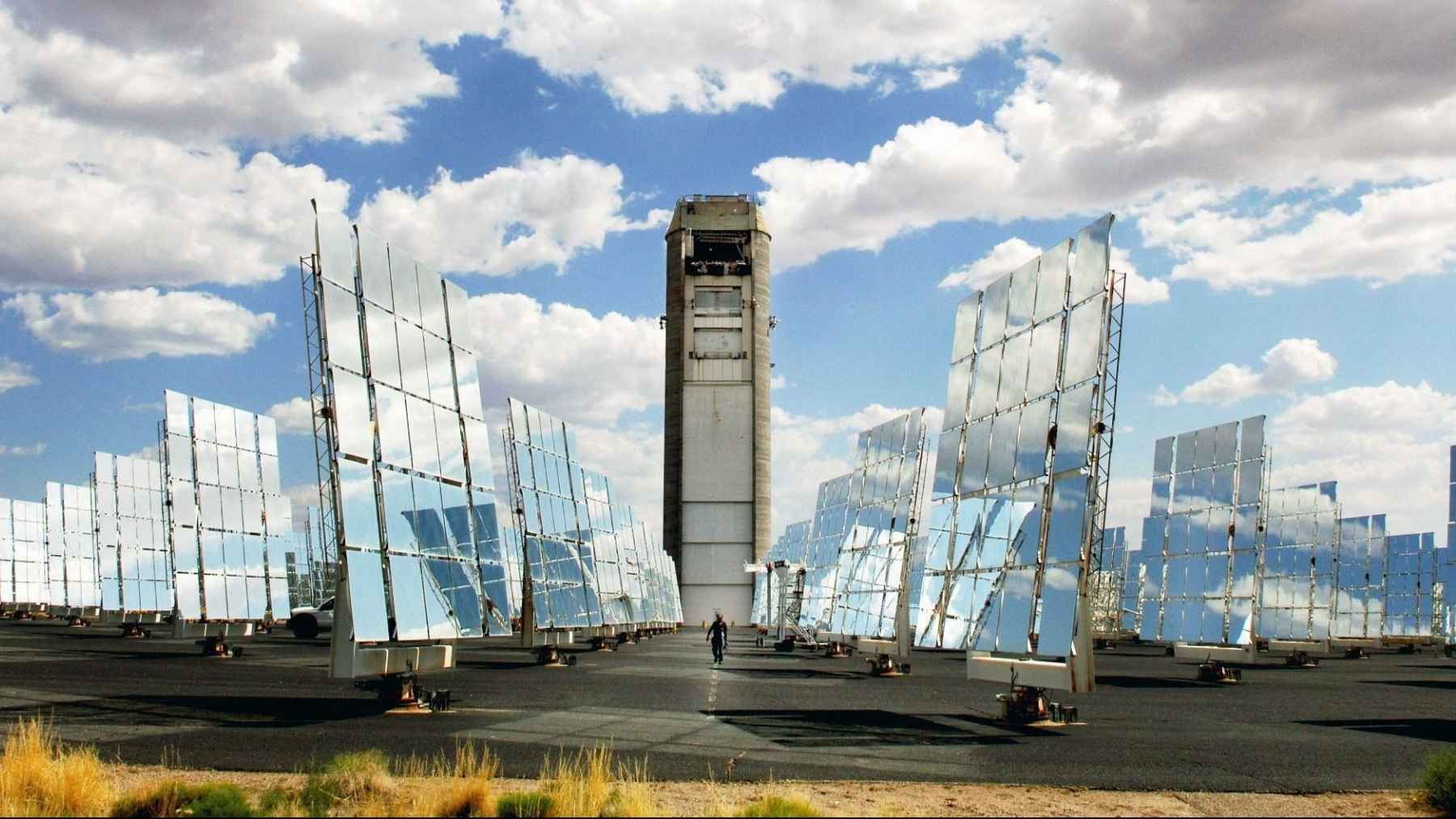
On the same test site, alongside the same 200-foot tower that has been standing there since 1978, the lab has spent most of those years building something that stores its heat in a material that cannot freeze at any temperature you would ever see in New Mexico. It drops sand through the sunlight.
Salt that stops moving is an extremely expensive brick
The Molten Salt Test Loop is not a beaker on a bench. Sandia lists three test stands, a mix of 60% sodium nitrate and 40% potassium nitrate, a flow rate of 400 gallons a minute, a maximum salt pressure of 40 bar and the ability to pull off up to 1.4 megawatts of heat. Sandia’s Lab News puts the tank at more than 7,000 gallons, plumbed with 6-inch schedule 80 pipe.
The working range is the part that matters here. Sandia gives it as 572 to 1,085 degrees Fahrenheit, or 300 to 585 Celsius. That bottom number is not a performance target. It is a floor. Below it, the working fluid is not a fluid.
The Department of Energy’s Solar Energy Technologies Office put up $2.5 million in May 2025 to bring the loop back, with Ken Armijo as principal investigator, and even that came after a forensics assessment to work out what the freeze had actually done to the tank and the pump. American solar hardware has gotten fairly good at seeing bad weather coming and getting out of the way. A storm that takes out a heat trace is a different category of problem, and it cost this facility the better part of a decade.
Sand does not freeze, and that is most of the pitch
In 2018 the DOE ran a competition to pick the heat transfer route for the next generation of tower solar. Liquid, gas or solid. NREL went after the liquid pathway, Brayton Energy competed on gas, and Sandia entered solids.
Sandia won it. In the spring of 2021 the DOE announced a Phase III award of $25 million to build and operate the Gen 3 Particle Pilot Plant, part of a $70 million multiyear Gen3 CSP program. Ground was broken in February 2023.
The material is sintered bauxite, the same hard ceramic bead the fracking industry pumps underground to prop rocks apart. DOE’s project write-up states plainly that the particles will not freeze or decompose above 1,832 degrees Fahrenheit, which is 1,000 Celsius. The best operating molten salt towers top out at 1,049 degrees Fahrenheit, or 565 Celsius.
Picking the grain took real work. Sandia researcher Jeremy Sment told SolarPACES the team weighed six properties at once: “We considered absorptivity, reflectivity, reactivity, sintering temperature, dust attrition and erosion.”
Bauxite is not free. SolarPACES puts it at roughly $2 a kilogram, about four times what untreated white desert sand costs, and Saudi collaborators are testing exactly that cheaper option. Sment’s point in the same interview was that nobody has run the two side by side yet, so the durability premium is still an argument rather than a result.
The grains fall through the beam with nothing in between
A conventional receiver runs its fluid through metal tubes and lets the tubes take the flux. The falling particle receiver deletes the tubes. A hopper at the top releases a curtain of grains down through an open cavity, and the beam hits the bauxite directly.
Sandia describes these curtains as roughly 10 meters wide and 6 centimeters thick, so about 33 feet across and two and a half inches deep. There is no alloy sitting at the hottest point in the system, so there is nothing there to corrode, creep or spring a leak.
Sment gave the tower’s dimensions as 53 meters tall and 10 by 13 meters across, so roughly 174 feet high, low enough that it avoids the extra air traffic rules that come with tall structures. Around 175 heliostats are aimed at it for about 2.2 megawatts of heat.
The receiver itself is rated at up to 2 megawatts of concentrated radiative energy, double the previous one Sandia built. It carries a metal catch-and-release trough that grabs the grains partway down and overfills at the leading edge, which slows them and keeps the curtain even.
Sandia tested it on the ground in 2024 before hoisting it, flowing batches of particles through the cavity at realistic rates while the tower was still going up. “Until now, these metrics had been demonstrated using numerical models only,” said Brantley Mills, then acting principal investigator, in Sandia’s Lab News.
Downstream, the hot grains drop into an insulated bin sized for at least six hours of storage, then pass through a heat exchanger that pushes supercritical carbon dioxide toward 1,319 degrees Fahrenheit at 20 to 25 megapascals. A bucket lift hauls the cooled sand back to the top. The whole bet is on thermal storage rather than chemistry, which puts it in the same family as the 400-ton concrete sphere being sunk off Long Beach, just with heat instead of water pressure.
Sandia has not said the whole plant has run on sunlight yet
This is where the story gets quieter than the technology deserves.
In February 2025 Sandia said cold-flow testing was coming in the next quarter and on-sun testing that summer. In June 2025 Sment told SolarPACES the team was preparing to be fully operational by the end of the summer, expected to start sharing data in early September, and planned to run for six months as continuously as it could manage.
Sandia’s own G3P3 page, refreshed this April, still describes the December 2024 state of play: receiver ground tested cold, storage bins installed, sCO2 loop assembled in the tower. No public Sandia statement confirms the integrated plant heating particles under the heliostat field.
What is on the record is narrower and more recent. The DOE’s facility listing, updated on June 30, 2026, describes the 6-megawatt central receiver test facility and its 200-plus heliostats as currently being utilized for particle receiver development and testing. The mirrors are pointed at particles. How far the integrated loop has gotten is not something Sandia has published.
There is a mundane reason the updates are thin. The test site sits on Kirtland Air Force Base, which tightens what gets shared and means visitors need base access that Sment warned can take weeks or months to arrange.
France is making the same bet with powder instead of a curtain
Sandia is not the only group betting that hot grains beat hot liquid. At the Themis tower in Targasonne, in the French Pyrenees, the European Powder2Power consortium moved into commissioning in June 2026 with a fluidised particle design aiming at 1,382 degrees Fahrenheit, or 750 Celsius.
The rebuild reads like a lesson in what these systems weigh. The team hauled roughly 50 tonnes of power block, including the hot storage tank, heat exchanger and turbine, from the top of the tower down to ground level, which meant first removing about 12 tonnes of particles and repouring the concrete slab at the base.
Their conveyance answer is different from Sandia’s. Instead of bucket elevators, a pneumatic system built by KU Leuven, EPPT and PROMES-CNRS is designed to blow up to 16 tonnes of cooled particles an hour back up 90 meters to the receiver. They have also fitted 40 individually controlled mass flow meters to steady the flow through the receiver tubes, plus a 250-kilowatt electric heater in the hot tank so the thing can run on surplus grid power when the sky is bad.
Targasonne is a few miles from the Odeillo solar furnace that has been melting tungsten since 1969, so the region has been doing this longer than almost anyone.
The number that decides this is not the peak temperature
Everyone already knows ceramic beads can get hotter than salt. The open questions are how fast the grains grind themselves into dust, how much of that dust clouds the curtain and steals the light, and how often the lifts and valves handling abrasive sand at 1,472 degrees Fahrenheit need pulling apart. Sandia is running a separate project to flow particles at that temperature for hundreds of hours specifically to find out.
Sment has said the plan is to publish the raw operating data so outsiders can judge it, which would be a refreshing change from demonstration plants that release a photograph and a temperature.
The tidy part is that the lab is about to be running both bets on the same patch of desert. The salt loop comes back this month, almost nine years after it turned into a solid. The tower next door was built on the premise that this was never going to stop being a problem.