
An ambulance is built around one job: getting a person from wherever they collapsed to the nearest building with doctors in it. The siren, the gurney, the engine burning fuel, all of it serves that single trip. A student team in Eindhoven spent the past year building one designed to do the opposite.
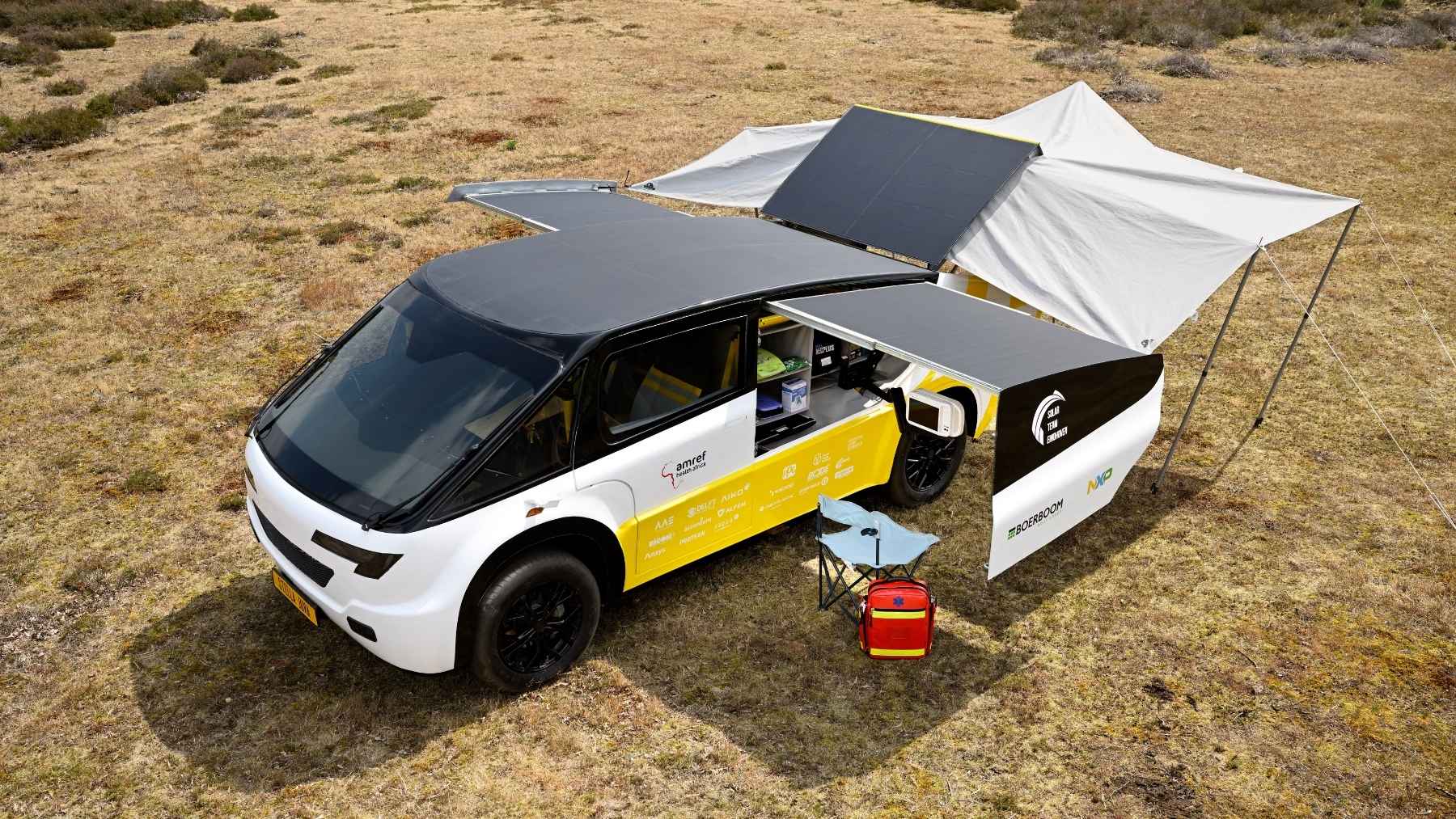
Stella Juva was unveiled on July 21 at a vehicle test center in Barneveld, in the central Netherlands. It runs on sunlight, and so does everything inside it: the X-ray machine, the ultrasound scanner, the vaccine cooler, the defibrillator. No generator on board, no socket to hunt for, and roughly 444 miles of range on a sunny day.
It was built by Solar Team Eindhoven, 23 students from Eindhoven University of Technology who paused their degrees for a year to do it. The team calls it the world’s first ambulance that both drives and runs its medical equipment on solar power.
The inversion is the point here, more than the solar panels are. A conventional ambulance is transport. Stella Juva is meant to be the destination, a place where healthcare workers run blood tests, screen for tuberculosis and malaria, give vaccinations and perform pregnancy ultrasounds on site, in villages sitting well past the last power line.
In August it goes to Kenya.
542 solar cells doing two jobs at once
The roof carries 326 cells. Another 216 sit on extendable panels, which is how a vehicle this size gets enough collecting area to be worth the trouble.
Behind them is a 50 kWh battery and an inverter the team developed itself, rated at 97% efficiency, according to pv magazine.
The cells are ABC units from Chinese manufacturer AIKO, a partnership announced back in April. All Back Contact means the metal contacts sit on the rear of the cell instead of shading the front, so more of the light hitting the surface actually gets converted.
The metallization is silver-free, which the team says lowers the risk of microcracks. On a vehicle that will spend its working life being shaken over unpaved roads, that matters at least as much as the efficiency headline does.
Solar Team Eindhoven photovoltaics engineer David Komdeur told PV Tech the team picked AIKO for efficiency and proven reliability, “both critical for a vehicle that must operate independently under varying conditions.”
Squeezing usable power out of a surface roughly the size of a van roof is the entire game in solar mobility. It’s why teams keep chasing cell architectures that get more out of limited area, from back-contact silicon like this to the flexible cells Australia’s science agency prints onto plastic film.
444 miles is a sunny-day number, and the team keeps saying so
The 715-kilometer figure everyone is quoting is the paved-road, good-weather ceiling. Off-road, the team’s own average is about 224 miles, and it moves with the terrain.
That caveat isn’t buried in a footnote. Solar Team Eindhoven published the off-road number alongside the headline range, which is more disclosure than most solar range claims arrive with.
The 50 kWh pack is what makes the rest of it work. It banks daylight so the X-ray machine and the vaccine cooler keep running after dark and under cloud, which is the difference between a solar vehicle and a solar demonstration.
Asked how a sun-powered vehicle copes in one of Europe’s cloudiest countries, team manager Mathijs van Gerven told DutchNews: “The Dutch weather, to say the least, is not Kenya’s.”
It’s the trade every solar vehicle makes. The Finnish builder whose solar yacht crossed Europe without buying a drop of fuel covers around 100 nautical miles on a normal day and closer to 40 when the sky closes in. Solar range isn’t a spec. It’s a weather report.
The most honest object on the vehicle is a shovel
When AFP visited the unveiling, Van Gerven showed off the spare tires and the shovels stowed on board in case the vehicle has to be dug out. That’s a prototype team telling you plainly what they expect the roads to do to it.
He told the agency that driving off-road, “where the healthcare really needs to be delivered,” is what forces the robustness question. It’s also the part the launch didn’t answer: the AFP reporter who rode in it did so on the flat concrete of the Barneveld test track.
The physical numbers give some sense of what it’s working with. It measures about 16 feet long and just over 6 feet wide, weighs 1,350 kg (roughly 2,980 pounds) and tops out at 75 mph.
It’s a two-seater. The dashboard shows speed and battery state, and the medical equipment is packed into the rear.
The equipment list is the actual product
Strip out the solar story and what’s left is a mobile clinic with integrated power outlets. On board: a vaccine and medicine cooler, a portable X-ray machine, an ultrasound device, a blood pressure monitor, a thermometer, an automated external defibrillator and first-aid supplies.
That list is why the vehicle can be parked in a village instead of driven back to a hospital. Tuberculosis screening, malaria screening, vaccinations and pregnancy ultrasounds all happen at the vehicle, and the power to run them comes off the same array that turns the wheels.
The medical side of the design came out of work with Amref Health Africa, the organization formerly known as the Flying Doctors, which has been operating for close to 70 years.
“Access to care shouldn’t depend on whether there’s access to electricity or fuel,” said Femke Maurits, partnerships manager for Amref Health Africa in the Netherlands, in the launch statement.
15% of sub-Saharan Africa’s health facilities have no electricity at all
That’s the WHO number, and it’s why the energy argument here isn’t decoration. The organization’s database on health-care facility electrification puts roughly 15% of facilities in sub-Saharan Africa at no electricity access whatsoever, with a sharp split between urban and rural sites.
Its wider estimate is that about a billion people are served by health facilities that either have no power or can’t count on the power they have. Vaccines need cold storage. Diagnostics need current. Neither one negotiates.
The incumbent answer to that gap is a diesel generator, which works right up until the fuel truck doesn’t arrive. The same calculation is playing out in other off-grid corners: a salmon farm above the Arctic Circle now runs most of the year on floating solar with its round-the-clock generator sitting idle, and Hyundai has signed on to cut the diesel burn at South Korea’s Antarctic research stations with a solar-fed hydrogen loop.
Stella Juva applies the same logic to a much smaller box. Put the generation on the thing that needs the power, and stop depending on a supply chain that ends well short of where the patients are.
Kenya in August, then a search for someone to build it properly
The trip starts with a kick-off at Amref International University in Nairobi, attended by Dutch embassy officials and Kenyan diplomats, according to DutchNews.
From there the vehicle goes to two field locations, where healthcare scenarios including tuberculosis treatment will be simulated. The team expects to cover hundreds of kilometers on solar power alone while it’s there. Three team members have been picked to drive.
After Kenya, the plan is a tour of events in the Netherlands and possibly elsewhere in Europe, aimed squarely at the companies and healthcare providers who might take the concept further.
Which is the open question. Stella Juva is a prototype built by students who are going back to their degrees, and there is no assembly line waiting behind it.
Van Gerven’s pitch to industry is blunt. Twenty-three of them did this in a year, so a company with real engineering resources should be able to do it faster and better, and he used the launch to invite technical partners to come talk about scaling it up.
It’s an easy line to deliver at a launch event on smooth concrete, with the panels catching a Dutch summer afternoon. It gets a lot harder to wave off if the vehicle comes back from Nairobi with the X-ray machine still working and the shovels unused.
Twenty-three students built a working solar clinic on wheels in twelve months, which was supposed to be the hard part. It wasn’t. The hard part is finding somebody with a factory who thinks the second one is worth making.