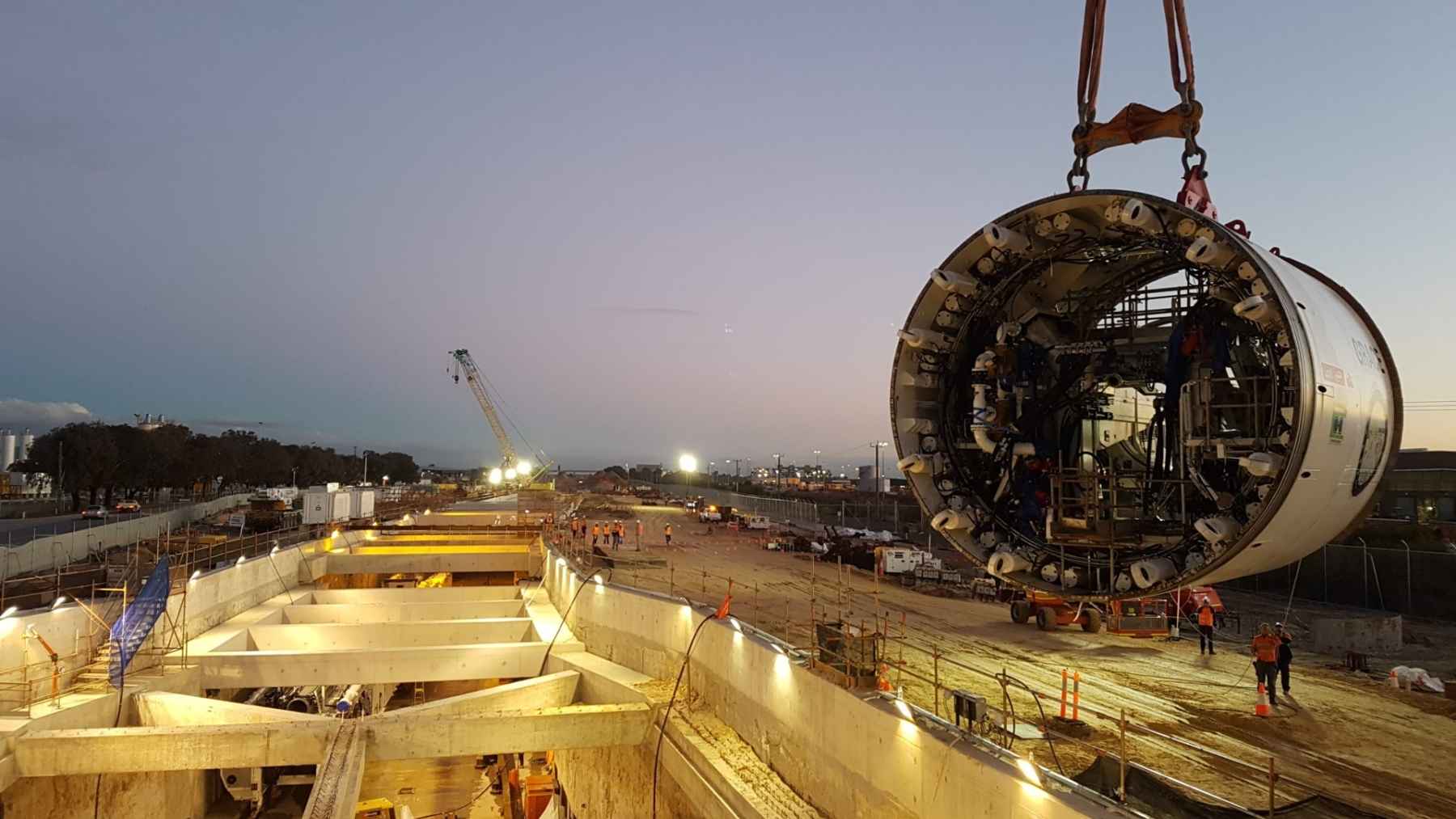

Tunnel boring machines get sorted by what they are fighting. Gripper machines for hard rock, earth pressure balance shields for soft ground, slurry machines for anything wet and unstable enough to collapse into the face. Pick wrong and you get a Bertha situation under downtown Seattle. The pair that dug Perth’s airport rail line got ordered because the ground under Western Australia’s capital would not pick a category.
Perth sits on the Swan Coastal Plain, a stack of sands, gravels and shelly limestone with groundwater running through most of it. So the Public Transport Authority specified two Herrenknecht Variable Density machines, a design that can change how it supports the tunnel face without being rebuilt to do it.
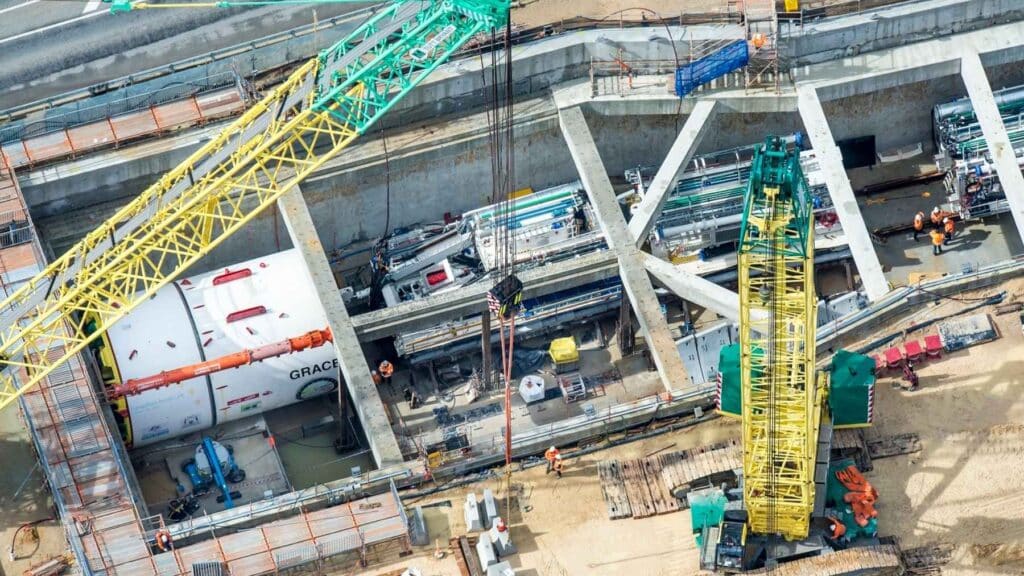
They worked. Grace and Sandy bored 15,210 meters between them, about 9.4 miles, and both reached the far end. The one stretch of tunnel that ended up permanently out of shape was a section neither machine was anywhere near.
That distinction matters more than usual this month. On July 14, National Highways confirmed that Herrenknecht will build the largest Variable Density machine ever made, for the Lower Thames Crossing between Kent and Essex, and it will be doing under the Thames roughly what Grace and Sandy did under the Swan River.
Grace and Sandy could change modes without anyone entering the chamber
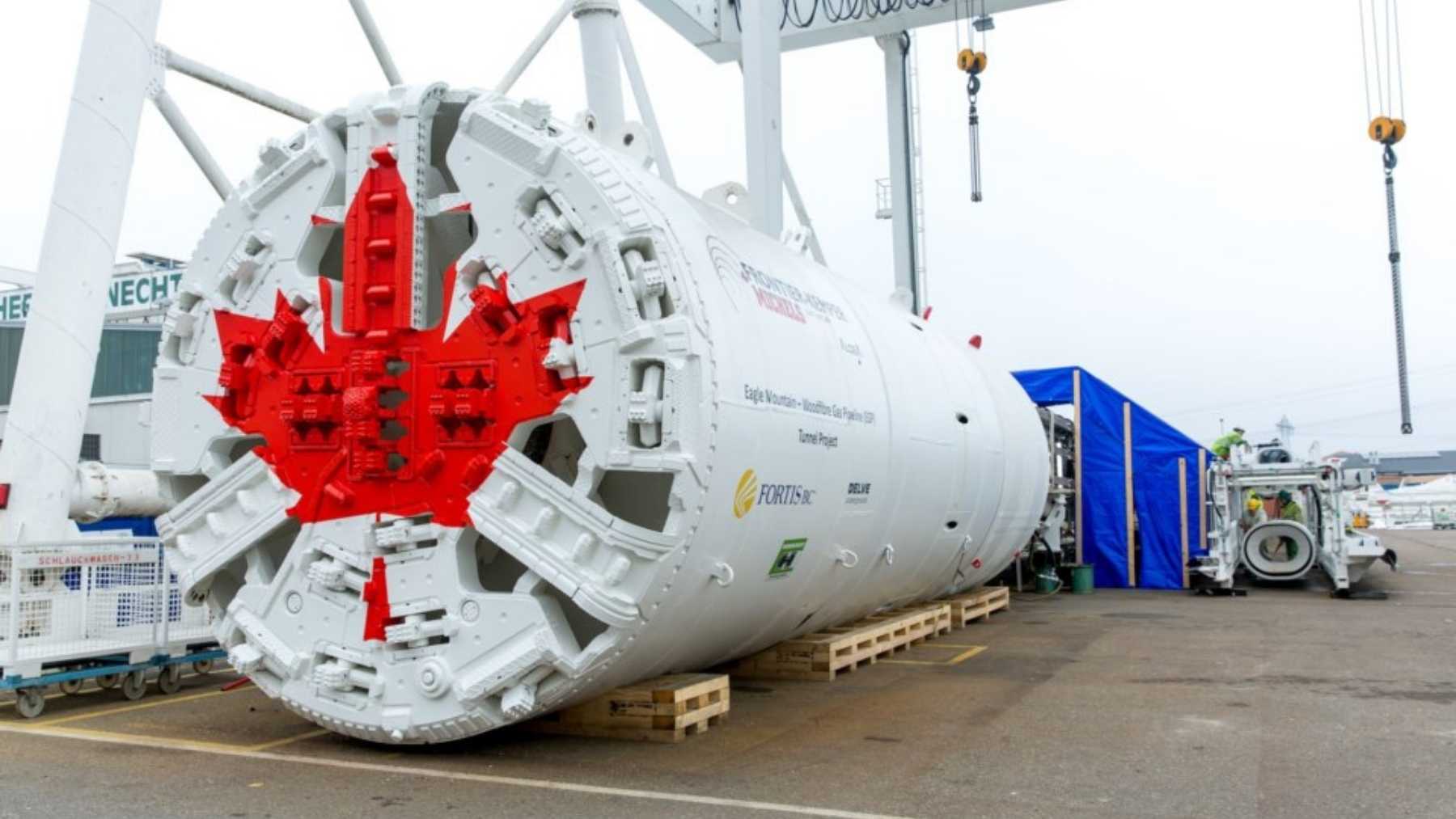
A Variable Density TBM runs in four modes, according to Herrenknecht’s technical description of the machine type. Slurry support with ordinary bentonite. Closed earth pressure balance mode with bentonite added. Classic closed EPB. And slurry support with a high-density medium loaded with extra filler.
The point is the switching. On a conventional machine, going from slurry to EPB means serious mechanical modification and days of downtime. On this design the changeover happens in the tunnel with the face pressure held the whole time, and crews never have to go into the excavation chamber to do it.
Eric Hudson-Smith, geotechnical and tunnelling manager at the Public Transport Authority of Western Australia, told New Civil Engineer that the specification came down to voids. Investigations suggested small cavities in the Ascot Formation associated with calcarenite, and the team wanted the ability to push thick slurry at the face fast enough to plug one before face pressure dropped away.
What the authority ended up specifying, in Hudson-Smith’s words, was “two dual-mode EPB-slurry TBMs with variable density technology”.
The hardware was not enormous by tunnelling standards. Herrenknecht’s data sheet lists a cutting diameter of 7,050 mm, a shade over 23 feet, and 1,400 kW at the cutterhead, roughly 1,880 horsepower. Both were built at the company’s plant in Guangzhou, China. The borer Australia later assembled under a cricket ground to cross Sydney Harbour is more than twice that diameter.
One contract condition is worth knowing about. For the half of the drive inside the Perth Airport footprint, the machines had to run in slurry mode using the high-density medium. Nobody wanted a settlement event under a live runway.
Perth sand pipes, and the project knew it going in
The alignment ran through the Guildford Formation, the Gnangara Sands and the Ascot Formation, which is sand, sandy gravel and gravelly sand full of shell fragments. Under all of it sat the Osborne Formation, more than 150 meters of silt and clay with an unconfined compressive strength of 1 to 2 megapascals.
Hudson-Smith also flagged the local behavior that ended up defining the project. Perth sands will flow, or pipe, into a deep excavation under very low hydraulic gradients, and that process is how sinkholes start here.
It showed up early. On February 14, 2018, the lead machine stopped under airport property after ground disturbance produced surface depressions of up to a meter above the cutterhead, according to trade outlet TunnelTalk. The second machine, running about 40 meters behind, stopped on March 28.
Both were down roughly eight weeks. The restart came with changed excavation chamber pressures, continuous operation with no weekend stoppages, and a reformulated bentonite slurry to cut losses into the loose granular ground.
In May 2018 Sandy was paused after a slurry spill. In early 2019 Grace’s screw conveyor failed, the second machine was inspected and found to have a similar defect, and both got new conveyors at the Redcliffe station box. Neither of those repairs happened under the airfield, which Hudson-Smith described as fortunate.
The tunnel that flooded was the one nobody was boring
Twin bore projects need connections between the two tubes so people can escape from one into the other. Perth’s alignment had 12 of them, and they are not machine work. They get cut by conventional excavation behind a block of ground stiffened with jet grout.
On the afternoon of September 22, 2018, crews were finishing the first one, Cross Passage Dundas, about 200 meters north of the Forrestfield launch site. A leak developed inside the jet grout block during the late stages of the dig.
Water and silt came into Tunnel One at up to 60 liters a second, around 950 gallons a minute, and kept coming through the night. About 200 cubic meters of soil, roughly 260 cubic yards, washed in with it.
The ground loss worked its way to the surface, and a sinkhole opened alongside and partly beneath Dundas Road. The road was closed.
Five prisms had been installed in the tunnel to measure convergence. According to the Public Transport Authority’s final report on the Cross Passage Dundas rectification works, they read 1 mm of inward movement during normal excavation, 7 mm once the event began, and a peak of 133 mm on September 29. That is 5.2 inches of finished concrete tunnel moving.
The report attributes the outcome to groundwater pressure and the associated loss of support, which caused “permanent localised distortion to the tunnel shape and movement of the segments” over a 26-meter length of Tunnel One. Sixteen rings.
Grace and Sandy were about 3 kilometers and 2.5 kilometers further along at the time. They stopped anyway, because the flooded passage sat on the supply route the service vehicles used to reach them.
The permanent fix was cast iron, borrowed from the London Underground
The immediate response was temporary steel framing to hold the damaged rings. The permanent fix took longer to settle on, and the shortlist included rebuilding the section from the surface down.
What they went with was hydrodemolition of the damaged concrete and a new lining of spheroidal graphite iron segments across the length. SGI is a ductile cast iron, and the technique is not exotic. London’s Northern line extension used SGI rings at its step plate junctions for the same reason, to stop a tunnel closing in on itself.
The PTA report accepted the contractor’s solution along with its specification departures, on the basis that the 120-year asset design life survived. The authority also ran a quantitative risk assessment on whether swapping concrete for iron changed the odds of a catastrophic fire in the tunnel, and concluded the change was insignificant.
The work was finished in May 2021. Airport Line trains using that bore now run through 16 rings of cast iron without anybody on board noticing.
The line has been open since 2022 and is still short of forecast
In December 2018 the Western Australian government moved the opening from late 2020 to the second half of 2021. Transport Minister Rita Saffioti’s framing at the time was that “this project is being built to last 120 years,” and the added schedule was a small price.
Grace broke through at Bayswater on February 18, 2020, after 934 days. Sandy arrived on April 20. The deepest point of the drive was 26 meters under the Swan River, about 85 feet, according to Herrenknecht’s project record, which lists the breakthrough dates and the segment count and never mentions the sinkhole.
The Airport Line opened on October 9, 2022, about two years late, with stations at Redcliffe, Airport Central and High Wycombe. The third was called Forrestfield until residents voted on a new name.
It is being used. The PTA reported a record 5.6 million boardings on the Airport Line in 2024-25, up 15 percent year on year, inside a Transperth network that cleared 151.7 million boardings in calendar 2025. It is also running below the 20,000 daily trips the state and federal governments projected for year one, though boardings and trips are not counted the same way.
The wider program is finished. METRONET closed out on February 22, 2026 with the new Midland Station, after nine years, 72 kilometers of rail and 23 stations. Australia’s heavy tunnelling has moved east, to the 4,400-ton machines working under Melbourne.
The Thames tunnel has 26 cross passages
The machine National Highways confirmed on July 14 is a different size of problem. It is 16.4 meters across, about 54 feet, 120 meters long and over 5,000 metric tons, making it the largest TBM ever used in Europe and the third largest built anywhere. It reaches Tilbury by sea in sections in 2028.
Herrenknecht head of project management Frédéric Battistoni called it “the largest Variable Density TBM ever,” fitted with the biggest accessible cutting wheel the company has produced.
One machine bores both 4.2-kilometer tubes. After the first drive it gets turned around in an engineered U-turn and sent back, which saves the cost and the embodied carbon of a second machine.
It will work through the water table, London Clay and chalk down to about 60 meters below the river. That mix is the reason the variable density design was chosen.
The part Perth speaks to is not the main drive. It is the 26 cross passages the twin tubes will need, which New Civil Engineer reported in December 2024 the Bouygues Travaux Publics Murphy joint venture intends to drive with a mini TBM from one tunnel into the other, using a method the contractor has already run in Hong Kong.
Perth’s twin bores came in more or less clean. The one place the water won was the short connection between them, cut the traditional way. If the Thames team is putting a machine on that job too, the Australian file explains why.