
A tunnel boring machine gets built for one hole. The diameter is fixed before anyone breaks ground, the cutterhead is specified for the rock it will meet, and the thing is assembled in a pit at one end of the job and taken apart at the other. Which makes a used one a strange item to go shopping for.
Brisbane went shopping anyway. The two machines that dug the twin rail tunnels under the Brisbane River and the city center had already spent a working life under Sydney, and Queensland has never been coy about it. The project files it under sustainability on its own guide to tunnelling: both machines came off Sydney Metro, moved north, and were rebuilt in Brisbane for a second career.
They bored 2.4 miles each. They passed 138 feet under the river, dropped to 190 feet below Kangaroo Point, and came back out at the far end in pieces. Neither one was left down there, which is where borers sometimes end up when hauling them back to the surface costs more than walking away.
Both machines had already dug Sydney Metro
They arrived in Queensland in August 2020, on trucks, in parts, headed for a Herrenknecht yard at Pinkenba on Brisbane’s north side. Herrenknecht is the German manufacturer that took on the rebuild, and it already had a long history in the city: the Clem Jones Tunnel, Airport Link and Legacy Way all ran on its machines.
The refit was not cosmetic. New shields had to be built for the Cross River Rail alignment and were shipped in from China. The back-up gantries, the long trailing section where most of the crew actually works, were repurposed from Sydney Metro.
Queensland put 16 workers on the job at Pinkenba to start, 14 of them local and two specialists flown in from Germany, rising to around 35 at peak. More than 100 local companies picked up over $10 million in work getting the pair ready.
Then Herrenknecht took them apart again. Each machine was rebuilt at Pinkenba, tested, disassembled, and trucked across town to the Woolloongabba station box, where a 280-metric-ton gantry crane lowered the parts into the ground for a third assembly. Sydney, by comparison, later ordered a brand new 4,350-ton machine from China for its harbour crossing and assembled it in a cavern under a cricket ground.
The Brisbane pair also got new names. Borers have been named after women since the 1500s, when miners prayed to Saint Barbara before going underground, and the tradition is still running on job sites from Melbourne to Adelaide. Queensland picked Else Shepherd, one of the first two women to graduate in electrical engineering in the state, in 1965, and later chair of Powerlink Queensland for 17 years. And Merle Thornton, who in March of that same year chained her ankle to the front bar of the Regatta Hotel alongside Rosalie Bogner, protesting a law that kept women out of Queensland public bars.
Thornton, who died in August 2024 at 93, took the honor in good humor. “I wouldn’t say I’ve had a ‘boring’ life,” she told the project, before noting that cutting through things had been the whole point of her career.
294 days, 138 feet under a river
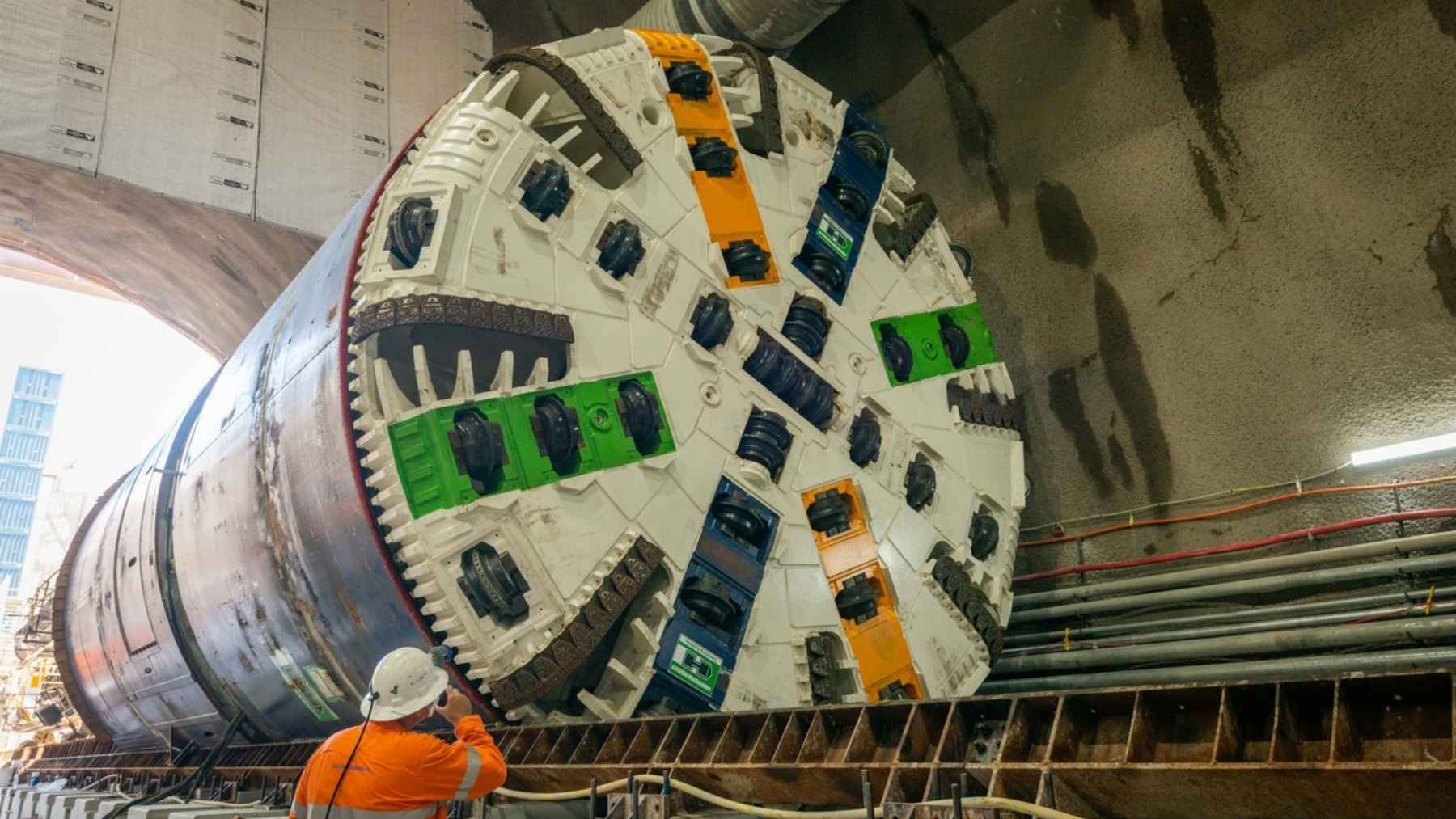
Each machine weighs 1,350 metric tons, about 1,490 US tons, which the project renders as roughly four Boeing 747s. Each is 541 feet long. The cutterhead at the front measures 23.6 feet across and weighs about 132 tons by itself.
TBM Else started tunnelling in February 2021 and Merle followed in March. Both ran 24 hours a day, seven days a week, with a crew of up to 15 inside at any one time, averaging 66 to 98 feet a day.
They are self-contained enough that Cross River Rail lists kitchen facilities, offices and toilets in the standard fit-out. Nobody hikes a mile back to daylight for lunch.
Behind the cutterhead, the machine builds the tunnel it is standing in. Six curved concrete segments make one ring, each segment weighing about 4.6 tons and running roughly 11 inches thick. The twin tunnels needed 4,157 of those rings, cast at a plant in Wacol turning out 140 segments a day.
Else finished first. Her drive ran 294 days and generated 155,000 cubic meters of spoil, which the project translates as 62 Olympic swimming pools.
The deepest hole in Brisbane’s history is a station box
North of the river, the machines punched into the cavern for Albert Street, which will be the first train station in Brisbane’s central business district in more than 120 years.
That station box bottoms out 164 feet down. When excavation finished in April 2022, Queensland called it the deepest dig in the city’s history, close to double the 85-foot record set during the Queen’s Wharf build. The platform itself sits about 102 feet below street level, and the extra depth is for ventilation fans and plant rooms.
Albert Street is also where the project met what it describes as Brisbane’s notoriously hard Neranleigh-Fernvale rock beds. Crews used controlled blasting for the station box and let the borers take a share of the cavern as they came through. That sent more than 24,000 cubic meters of rock out on the machines’ own conveyors rather than through the city, which the project counted as 2,000 truck movements that never happened.
Roma Street was the odder problem. The cavern there runs about 920 feet long and 50 feet high, with roughly 91,000 cubic meters cut out of it before either machine showed up. A borer pushes itself forward by shoving against the tunnel it has just built, so it cannot drive across an empty room. Both machines had to be skidded the length of that cavern, which then-transport minister Mark Bailey put at about four weeks.
A 220-million-year-old tree came out with the spoil
In a cross passage between the two tunnels under Kangaroo Point, crews hit a petrified tree trunk sitting in tuff, the rock that forms when volcanic ash settles and hardens. The project nicknamed it Jurassic Bark. Queensland Museum put it at up to 220 million years old, late Triassic, from something resembling a conifer.
Andrew Rozefelds, the museum’s head of geosciences and principal curator of palaeobotany, said “Brisbane 220 million years ago was a pretty exciting place to be”, and then explained that he meant active volcanoes. He described the spot as South East Queensland’s answer to Pompeii, with early dinosaurs rather than Romans in the path of the ash.
The trunk went to the museum for study. The tunnel carried on.
Neither machine is buried under Brisbane
Else came out at the northern portal near Normanby, with the project announcing the first finished tunnel on December 15, 2021. Merle came through before Christmas, closing out what Cross River Rail had been calling its year of tunnelling.
The extraction box waiting for them was 39 feet deep, at the end of a portal 1,329 feet long, dug by a 40-strong crew working around the clock. Each machine was pulled apart and cleaned inside that box, then lifted out piece by piece by the same 280-metric-ton gantry crane that had lowered Else into Woolloongabba at the start of the year.
From there the parts went to a storage area on site and onto oversized trucks. Sydney has since done much the same thing with its own retired Metro machines, cutting them into sections and hauling them up a shaft overnight.
Cross River Rail said at the time that the two were expected to be re-used on other tunnelling projects. Which projects has not been published. For a pair that arrived secondhand and left on flatbeds, an unlisted destination is at least consistent.
The tunnels have been finished since 2021. Passengers get them in 2029.
The twin bores have been complete for nearly five years. No passenger has ridden through them.
Queensland’s original commitment was A$5.4 billion and a 2024 opening. In October 2025 the state set the final figure at A$19.041 billion, and the project’s own FAQ breaks that down: A$12.4 billion covers designing, building and maintaining the twin tunnels and the four underground stations, and the balance covers stabling yards, accessibility upgrades at surface stations, new stations, European Train Control System signalling and integration with the existing network. Lining the two totals up side by side compares different things.
The schedule is the part still moving. In March 2026 the delivery authority laid out its testing and commissioning plan: four phases, ending with passenger services phased in gradually across six to nine months, and the whole sequence expected to take about two years. The authority puts that in the same bracket as Sydney Metro, Melbourne’s Metro Tunnel and Crossrail in London. None of those three were quick.
Which means the machines that dug the thing will have been gone close to eight years before anyone rides through their work. They were secondhand when they got here, they were pulled back out for somebody else to use, and the hole they left is the only part of the arrangement still waiting to start its job.