
Every battery pack you have ever seen has a box around it. Your phone, your laptop, the slab bolted under an electric crossover, all of it sits inside something rigid whose entire job is keeping the outside world out. On land that instinct is completely correct.
Take it two kilometers down into the ocean and the box becomes the worst thing about your vehicle.
Seawater pushes back with roughly 10 megapascals for every 1,000 meters of depth, about 1,450 psi, and it never lets up. At 6,000 meters you are asking a metal can to hold back something near 8,700 psi across its whole surface, permanently, with nobody around to check on it.
So the can gets thicker. The thicker can gets heavier. The heavier can needs buoyancy foam to keep the vehicle neutral, the foam adds volume, the volume adds drag, and the extra batteries you fitted to fix your range problem end up spending their charge hauling their own packaging around.
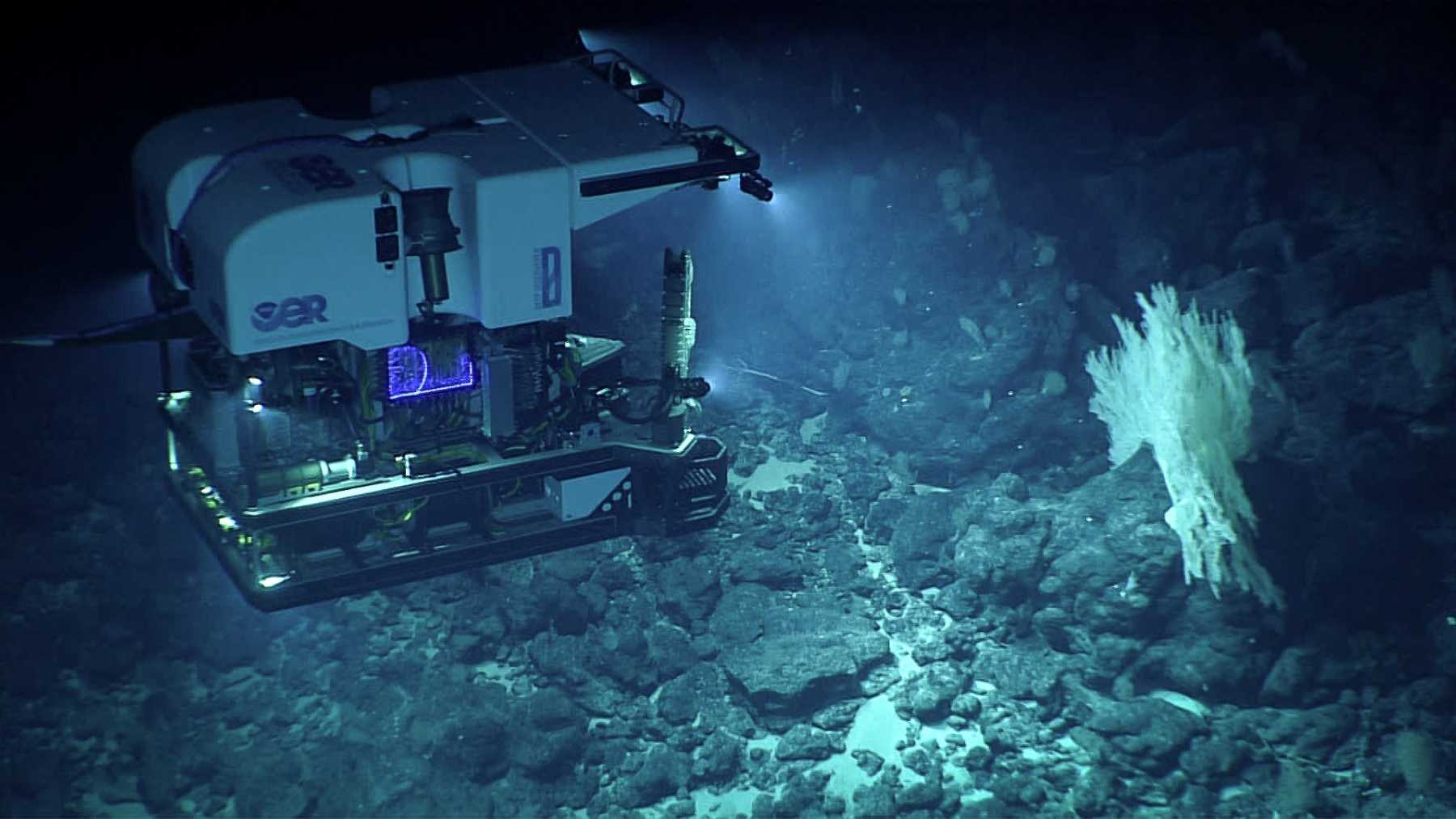
A large part of the industry has stopped fighting that. The subsea battery packs winning defense orders right now have no pressure housing at all. The cells go straight into the water.
Two thousand meters is where the pressure hull stops paying for itself
That number comes out of a review of underwater vehicle energy systems published in January by a team from Northwestern Polytechnical University in the open-access journal Energies. Below roughly 2,000 meters, about 6,560 feet, the wall thickness needed to survive starts to dominate the mass of the entire system.
The paper has a name for the trap: the non-linear weight amplification effect. Add cells, add structure, add foam, add drag, watch the gains eat themselves.
It shows up in the spec sheets. A lithium-ion cell that looks respectable on its own drops to somewhere in the 100 to 150 Wh/kg range once you count the pressure packaging, the management electronics and the buoyancy compensation it forces you to carry.
Strip the rigid hull out and swap in a pressure-balanced design and the review cites work by Li et al. putting the saving at roughly 18.3 percent of system weight at 6,000 meters. In a vehicle that has to float exactly right to move efficiently, 18 percent of the power system is an enormous amount of budget to hand back.
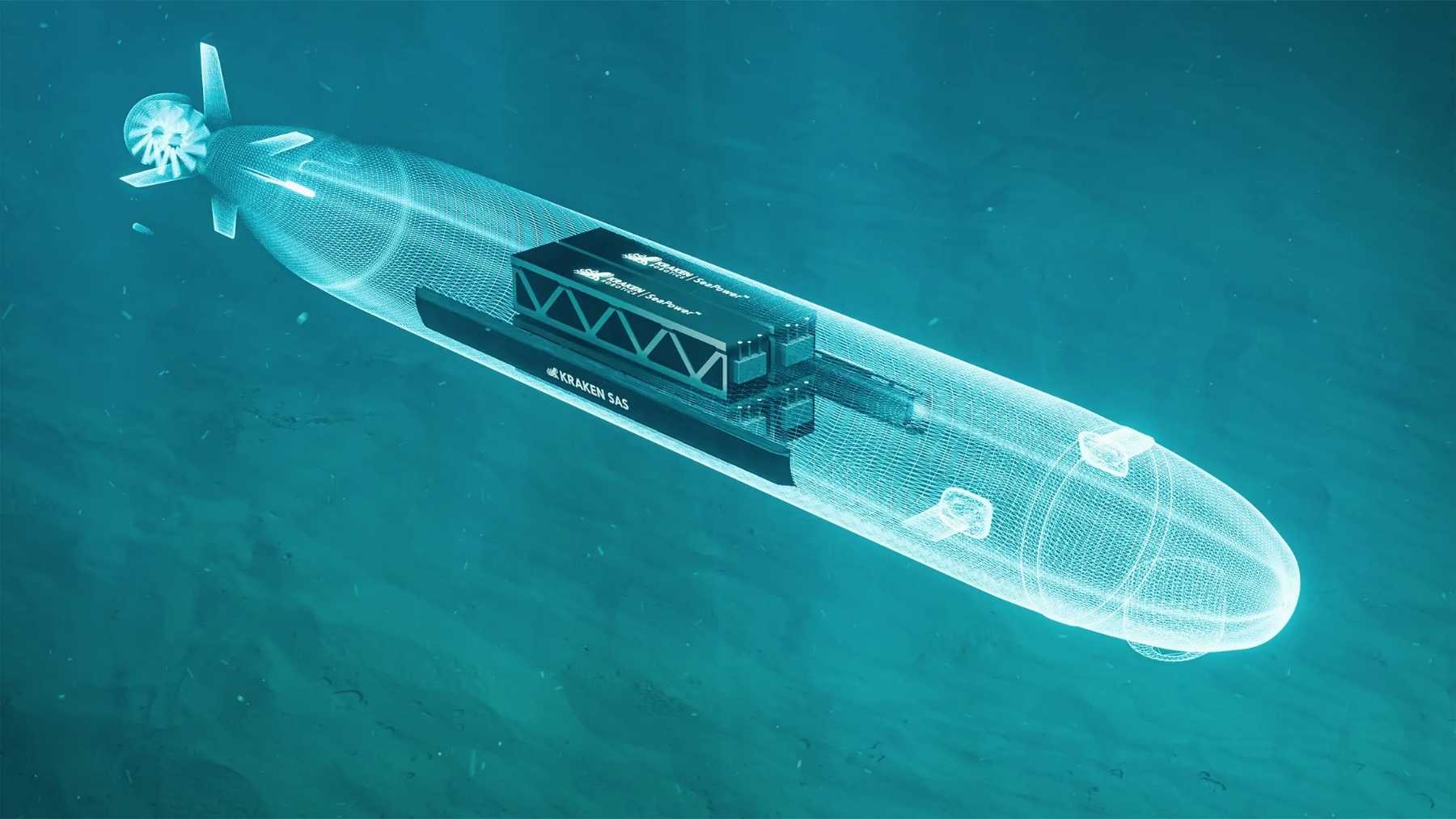
Kraken’s pack has no housing and no oil in it
The usual way to build a housing-free subsea battery is to flood the whole assembly with dielectric oil. The liquid will not compress, so it transmits the outside pressure evenly through the pack and nothing gets crushed unevenly. It works, and it has been the default for years.
Kraken Robotics, a Canadian marine technology company headquartered in St. John’s, Newfoundland, went a different way with its SeaPower line. The cells and electronics get cast into a proprietary silicon polymer matrix instead. No housing, no oil, no compensator bladder. Kraken pressure-tests the result to 660 bar, which it equates to 6,000 meters of depth.
The company markets the encapsulation as delivering 200 percent greater energy density and 46 percent less weight per kWh than oil-compensated or pressure-housed batteries. Kraken does not publish which specific product it measured that against, so treat those two figures as a vendor claim rather than a benchmark.
What is harder to wave away is who is buying. In a business update published July 20, Kraken said it had added multiple new defense customers for SeaPower during 2026 across North America, the UK, Europe and Asia Pacific, and that several AUV builders had switched to it from other battery suppliers.
The same release put combined product orders announced so far in 2026 at $327 million, though that figure covers Kraken and Covelya Group together across sonar, navigation and monitoring hardware as well as batteries, not batteries alone. Kraken says its equipment is integrated or being integrated on more than 30 AUV platforms worldwide.
It is not the only outfit doing this. General Dynamics Mission Systems sells a 1.5 kWh Bluefin subsea battery built on pressure-tolerant lithium-polymer cells, rated for direct submergence in any orientation with no pressure vessel required, and says hundreds of the things are already in the field.
Letting the ocean squeeze the cells costs you something
Removing the hull does not delete the pressure. It just moves it onto the chemistry, and the chemistry notices.
Under sustained hydrostatic load the polymer separators and porous electrodes inside a cell “undergo creep and compressive deformation, leading to a significant reduction in porosity,” according to the Energies review team summarizing work by Zhao et al. Less porosity means ions have to take a longer, more tortuous path, which shows up as internal resistance climbing in a way that is not proportional to anything convenient.
There is a second failure mode underneath that one. Keep loading the active material particles cycle after cycle and they distort and eventually crush, which wrecks the protective film on the electrode surface and accelerates capacity fade.
The oddity is that pressure is not purely an enemy at first. The review notes that high pressure can initially improve lithium-ion diffusion kinetics. The gain has a hard expiry date, and past it the mechanical damage takes over.
Oil-filled packs carry their own tax on top of all this. The dielectric fluid that keeps the cells intact is thick, and anything that has to rotate inside it burns extra energy pushing through the stuff. Solving your weight problem with oil hands part of the winnings straight back to viscous drag.
The cold does more damage than the pressure
Deep ocean sits at a steady 0 to 4 degrees Celsius, and the electrolyte in a lithium cell gets noticeably thicker at those temperatures. The Energies review puts the potential hit at over 50 percent of usable capacity.
Then the opposite problem shows up in the same vehicle. Push a drone submarine hard, running sonar and sprinting, and the heat has nowhere to go because the compartment is effectively insulated by design. One simulation cited in the review has internal temperatures climbing above 60 degrees Celsius under high-power operation.
That is a genuinely awkward pair of constraints. The machine is sitting in near-freezing water it cannot use to cool itself, losing capacity to the cold on the outside while cooking on the inside.
One finding in the review runs the other direction, and it is the most interesting thing in the paper. Work by Fini found that elevated hydrostatic pressure improves how phase-change materials melt and move heat, which raises the possibility of coupling a heat sink to the pressure interface and letting the depth do some of the cooling. The thing crushing the battery would be helping keep it alive.
The biggest American robot submarine still carries a diesel generator
All of the above explains something that looks embarrassing on paper. Boeing’s Orca, the extra-large uncrewed submarine the Navy has committed to buying 16 of, cruises quietly on lithium-ion and then surfaces to run a marine diesel and recharge.
For a vehicle that size, at those ranges, the batteries are a buffer rather than a fuel tank. Nobody has found a way around that with cells alone.
The alternative bet is to stop storing electricity and start carrying fuel. Cellula Robotics ran its Envoy AUV for 385 hours and 2,023 kilometers fully submerged on a hydrogen fuel cell earlier this year, and the Pentagon’s follow-on program for large uncrewed submarines currently has teams pursuing fuel cells and teams pursuing batteries at the same time with no down-select announced.
Both camps still need power on demand for sprints, maneuvering and sonar. That job belongs to a battery, and if the vehicle is going deep, it increasingly belongs to a battery with nothing around it.
The endgame the Energies authors point at is stranger than either. Solid electrolytes are mechanically stiff enough to resist deep-sea pressure on their own, which in principle lets the battery become a load-bearing part of the hull rather than cargo the hull has to protect. That is a long way from a shipping product. Until it arrives, the best answer anybody has is to stop building a fortress around the cells and let the water in.