
Say “solar train” out loud and most people picture panels bolted to the roof, quietly feeding a battery while the thing rolls along. That is roughly how the Australian one works, and it has a Guinness certificate to prove it.
The train climbing a UNESCO-listed gorge in northern Argentina does not work that way at all. It carries no solar panels. What is bolted to its roof is the battery.
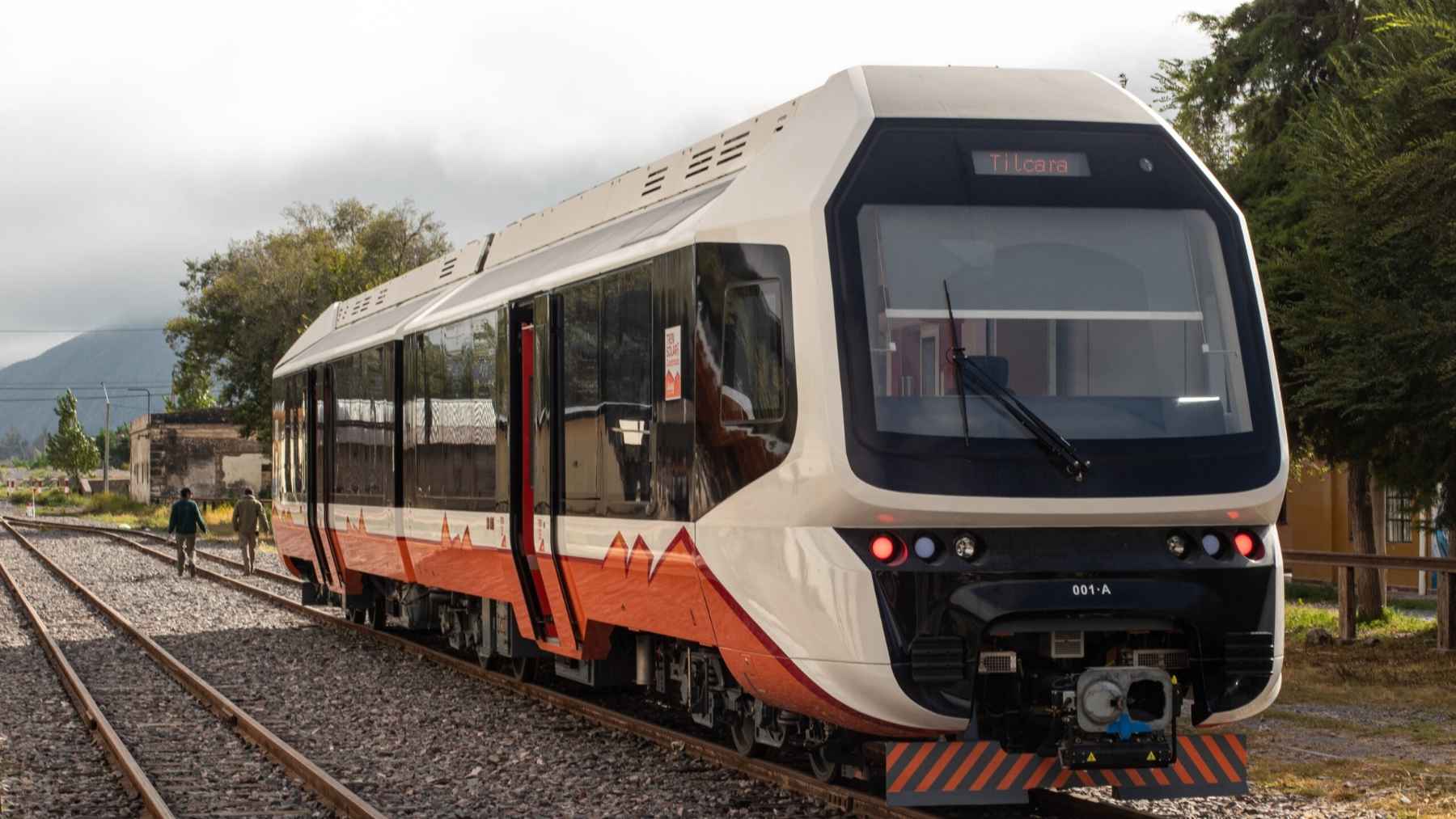
The Tren Solar de la Quebrada runs 26 miles (42 km) of meter-gauge track between Volcán and Tilcara in Jujuy province, on a branch of the old Belgrano Railway that sat dead for about three decades. When the batteries run low it pulls into a station and plugs in, the same routine as a road trip in an EV.
The electricity behind that socket comes off a grid fed by Jujuy’s own solar farms, and the province owns one of the biggest solar plants in South America. Nothing on the train itself generates a watt.
It also just posted the best month of its two-year life. The provincial government’s July balance, published July 31, put 7,340 passengers on the two main tours across the month at an average 97 percent occupancy, up 17.4 percent from the 6,255 who rode in July 2025.
What is on the roof is 352 kilowatt-hours of battery
The two railcars were built by CRRC Tangshan under a contract signed with Jujuy in May 2022, and they were the first Chinese light rail trains ever exported to Argentina. Each one is a six-axle articulated two-section unit with a driving cab at both ends, so it never has to be turned around.
CRRC’s own figures, released when the first unit rolled off the line in Tangshan in June 2023, put the traction supply at two lithium iron phosphate packs totaling 352 kilowatt-hours, mounted on top of the carriages. That is more battery than five typical electric cars carry between them.
There would be nowhere to put a panel even if anyone wanted one. Large sections of the roof are glazed, along with the side windows, because the scenery is the entire product. Passengers sit in seats that swivel 180 degrees and look up at things like the Hill of Seven Colors, which sits directly above the Purmamarca stop.
Design top speed is 37 mph (60 km/h), which the service never gets near. La Nación put the average at around 16 mph, with the original 22-mile run taking about 90 minutes. A club cyclist holds that pace without much drama, though not up this valley.
Jujuy has never actually claimed otherwise
The label came from the province, and so did the correction. Speaking to La Nación the week the service opened in June 2024, Jujuy tourism secretary Diego Valdecantos said the power is 100 percent green and comes from the Cauchari solar plant, then added the part most coverage drops: the train has no panels on the roof and plugs in to recharge.
The operator’s own technical page says the same thing in different words. It lists six lithium batteries plus an auxiliary backup, a range of 62 to 75 miles (100 to 120 km), and fast-charging points at the Volcán, Purmamarca and Tilcara stations. Twenty-five minutes on the plug is enough for a full charge.
Cauchari is why any of this counts as solar at all. The plant runs 300 MW of panels above 13,000 feet on the Puna plateau, and the Jujuy government puts its output at roughly 660 gigawatt-hours a year, avoiding around 325,000 tons of carbon dioxide.
Cauchari sells into Argentina’s national grid rather than running a private wire up the gorge, so the cleanest direct link is smaller and closer. Railway Gazette reported before the line opened that the project included a dedicated 6 MW solar farm and storage facility at one of the stations.
The honest description, then, is a battery railcar charged at a platform on a grid full of Andean sunlight. Less catchy than “solar train,” and the harder engineering problem of the two.
Australia got there first, and that one really does carry panels
The Byron Bay Railroad Company put a converted 1949 heritage railcar back on 1.9 miles of coastal track in New South Wales in December 2017. Guinness World Records recognizes it as the first solar-powered train in scheduled service.
One of its two diesel engines came out to make room for a 77 kWh battery bank. Curved thin-film panels went onto the carriage roofs, rated at 6.5 kW combined, backed by a 30 kW array on the storage shed roof for topping up. Most days the train uses a fraction of what the shed generates and the rest goes to the grid.
So that is 6.5 kilowatts of generation riding on a train, against 352 kilowatt-hours of storage on the Argentine one and no generation whatsoever. Both are electric, both are charged by sunlight, and only one of them makes any of its own.
Jujuy’s officials have been straight about the ranking from the start. Back in 2018, then-governor Gerardo Morales told Télam at the Madrid tourism fair that the project would be the first solar tourist train in Latin America and the second in the world, after the Australian one inaugurated that December. “First in Latin America” survives scrutiny. “First in the world” never did.
July was the best month the service has had
The two headline products are the Experiencia 360, a full guided circuit with stops in each village, and the shorter 180. Between April and June this year they ran at 80 to 90 percent occupancy. Over the July 9 to 12 long weekend they sold out every departure, 1,123 passengers in four days, peaking at 284 on July 11.
The full month closed at 97 percent. Cielo en Movimiento, the night astro-tourism run that uses the glass roof for sky watching, finished July at 99 percent, and the operator has scheduled an August 27 departure timed to a partial lunar eclipse visible from the gorge.
A wine train debuted on July 26, linking Volcán and Tilcara through high-altitude vineyards, and sold out its first departure. It runs Saturdays through November.
The cumulative figure says more than any single month. The service passed 90,000 passengers on its second anniversary in June, and the province says roughly one in three of those rode through its social responsibility program, which puts schools, community groups and local institutions on board.
Stringing wire through this gorge was never the smart move
Electrifying a railway the conventional way means overhead catenary, substations and permanent steel hardware every few hundred feet. Through a valley UNESCO listed in 2003 for its cultural landscape, on a line stripped and washed out since the last regular service ran in 1993, that math was never going to close.
A battery railcar skips all of it. Jujuy rebuilt track, embankments and bridges, dropped chargers at three stations, and left the generating to panels already sitting in a desert where the sun is brutal and nobody minds the glass.
Which makes Byron Bay the wrong comparison. The interesting question is what railways do with sunlight they did not generate themselves.
Switzerland is laying removable panels between the rails of a working line. France buried them in a road in Normandy and dug the whole thing back up eight years later. Dutch students, meanwhile, have built an ambulance that genuinely runs off its own roof. Jujuy picked the least glamorous version and it is the one carrying paying passengers every week.
The specs Jujuy still hasn’t published
Traction power in kilowatts and the maximum gradient on the climb are not in any public document, and working them out from town elevations would be guesswork. Two capacity figures also float around: CRRC rates the unit at 72 seated and up to 388 with standees in multiple formation, while the service that actually runs sells 70 seats plus one wheelchair space.
Phase two, another 30 miles up to Humahuaca for a total of about 56 miles, is not built. Phase three to La Quiaca on the Bolivian border is a line on a map. Anything you read about this train eventually connecting to Machu Picchu would involve crossing Bolivia and can be ignored.
None of that changes what is running today. A Chinese-built battery railcar charged with Andean sunlight at a platform in a mountain village is a genuinely good piece of engineering. It just isn’t a solar train, and the label is doing PR work the machine does not need.