
American nuclear is having a fast year. Four brand-new reactors reached criticality in the space of a month, the last of them at 12:20 in the morning on the Fourth of July, and Aalo Atomics says the Idaho machine that got it there went from groundbreaking to a sustained chain reaction in under eight months. World Nuclear News counted it as the fourth to clear the Department of Energy’s deadline. Slovakia spent the same week finishing something it started in 1987.
Crews at the Mochovce plant lowered the last of 349 fuel assemblies into unit 4 on Friday, July 3. The IAEA logs the reactor’s construction start as January 27, 1987, which puts the gap at 39 years and five months. The first concrete was poured by Czechoslovakia, a country that stopped existing in 1993.
Slovenské elektrárne, the utility that owns the plant, says nuclear will cover 77.5% of Slovakia’s electricity consumption once unit 4 reaches full power. No country anywhere is higher. The uranium making that possible is contracted from Russia.
The reactor is older than the country it sits in
Mochovce sits in southern Slovakia, between the towns of Nitra and Levice. Czechoslovakia started the first two units in 1982 and broke ground on the second pair four years later, in 1986, though the IAEA logs unit 4’s official construction start the following January. Then the money ran out and the government it belonged to came apart. Work stopped in 1992, Czechoslovakia split the following January, and units 1 and 2 were eventually finished and started up in 1998 and 1999. Units 3 and 4 sat there.
Slovenské elektrárne says work on completing them resumed in 2008, with both scheduled to run by 2012 or 2013. Post-Fukushima safety retrofits ate years. So did a problem you would never guess at from the outside: according to Nuclear Engineering International, modern cabling is thicker than the Soviet drawings allowed room for, and crews had to find somewhere to put it.
The company itself changed hands mid-build, and the reactor was written into the paperwork. Enel, the Italian utility, controlled Slovenské elektrárne when the completion work restarted, and under the 2015 agreement to sell its stake to Czech group EPH, the second half of the deal was tied to Mochovce 3 and 4 clearing their operating permits. Enel did not wait. A 2020 amendment handed EPH an early call option, EPH used it, and the buyout closed on May 23, 2025, more than a year before unit 4 saw a gram of fuel.
Unit 3 crossed the line first, reaching criticality in October 2022 and entering commercial operation in October 2023. Unit 4 has trailed it by roughly two years at every step.
349 assemblies, 42 tons of uranium, five days of work
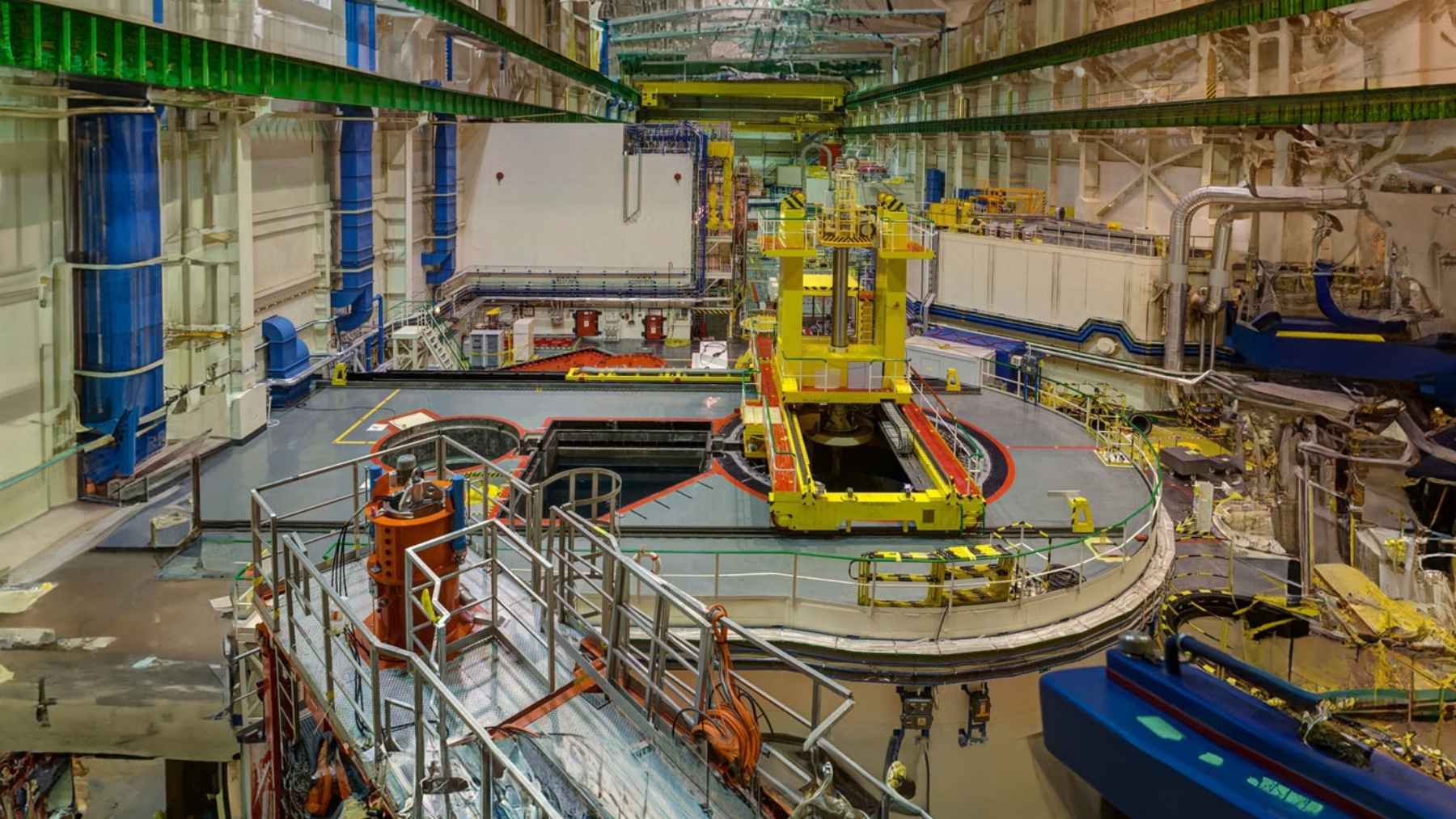
Slovakia’s nuclear regulator, the ÚJD SR, issued notice of its commissioning permission on May 22 and confirmed it on June 24, once the window for appeals had closed. The first fuel assembly went into the reactor on June 29 at 3:45pm local time. Five days later it was done.
The core holds 349 assemblies, and only 312 of them are fuel. The other 37 are control assemblies. Each fuel assembly carries 126 fuel rods, which works out to 39,312 rods packed with ceramic uranium dioxide pellets weighing roughly 5 grams apiece. Divide 42 metric tons (46 US tons) of fuel by 5 grams and you land somewhere around eight million pellets, all of which will sit in that vessel for about five years before anyone opens it up.
Martin Mráz, project director for Mochovce at Slovenské elektrárne, called the load “another significant step on the way to completing the Mochovce project,” in a statement carried by World Nuclear News. Marta Žiaková, who chairs the ÚJD SR, was noticeably more careful, telling Nuclear Engineering International that “a high level of nuclear safety remains an absolute priority” through the start-up tests still to come.
Only one reactor has ever taken longer to build
Slovakia does not hold the record for this. Tennessee does.
The Tennessee Valley Authority started Watts Bar 2 in 1973 and stopped in 1985. Its board did not authorize finishing the job until 2007, by which point the unit was about 60% complete with $1.7 billion already spent, according to the Energy Information Administration. It entered commercial operation in October 2016, roughly 43 years after the first shovel, and cost $4.7 billion.
Next on the list is Bushehr 1 in Iran, begun in May 1975 by West Germany’s Kraftwerk Union, a Siemens subsidiary, and abandoned after the 1979 revolution. Russia finished it. NucNet, citing IAEA data, records commercial operation in September 2013: 38 years and four months.
Mochovce 4 lands between those two, and its number will keep climbing until the unit is commercially operating. All three got there the same way. Somebody started them, politics or money stopped them, and somebody else came back for the wreckage twenty or thirty years later.
Slovakia’s 77.5% and France’s 67% do not measure the same thing
Slovenské elektrárne says that with unit 4 running, nuclear will account for 77.5% of Slovakia’s electricity consumption, putting the country ahead of France at 67%. World Nuclear News carried the same number and framed it carefully, as an equivalent share of what Slovakia uses.
Consumption and generation are not the same number. The standard measure, the one the statistical agencies publish, is nuclear output as a share of the electricity a country actually produces. On that basis Eurostat had France at 67.3% in 2024 and Slovakia at 61.6%.
The two figures come apart because of exports. Nuclear Engineering International reports that Mochovce 4 cements Slovakia’s position as a net electricity exporter, meaning the country will generate more than it uses. Divide nuclear output by the smaller of those two numbers and the share goes up. Divide it by the bigger one, the way Eurostat and the IAEA do, and it does not go up as far.
That does not make 77.5% a made-up number. Each Mochovce unit really does cover around 13% of Slovak demand, and NEI puts units 3 and 4 together at roughly 26% of national consumption. But you cannot stand 77.5% next to France’s 67% and call the result a league table, because the two are answering different questions.
The fuel still comes from Russia, and the EU has not banned it
Every reactor in Slovakia runs on the same design, the VVER-440. That is the five already operating plus this one, and for decades Slovakia has bought fuel for all of them from TVEL, the fuel arm of Russia’s Rosatom.
The World Nuclear Association’s Slovakia profile states the current position in one line: “Currently, all fuel supply is contracted from TVEL in Russia.” That contract was signed in Moscow in 2019, covers deliveries from 2022 through 2026 with an option to run to 2030, and explicitly included the two unfinished Mochovce units.
Slovenské elektrárne has not said publicly who supplied unit 4’s first core, and it is under no obligation to. What is on the record is the contract. Nothing in EU law forbids it. Brussels turned its Russian gas phase-out into binding law that entered into force on February 3, 2026. Nuclear fuel was left out of that regulation and pushed into a separate proposal, and the Commission’s own accounting puts EU imports of Russian uranium, in enriched or fuel form, at almost 2,900 tonnes in 2025 on preliminary figures. The first new European enrichment plants are not expected before 2027.
The alternatives exist, and they are slow. Westinghouse signed a long-term agreement with Slovenské elektrárne in August 2023 to license and supply VVER-440 fuel from its plant in Västerås, Sweden, and that fuel still has to pass Slovak licensing before a single assembly ships. Framatome brought Slovenské elektrárne and three other European utilities into a VVER-440 fuel development deal in April 2026, and its own estimate for regular deliveries is the early 2030s.
So the country about to run on a higher proportion of nuclear power than anywhere on Earth will keep buying its uranium from Moscow for the rest of this decade. Turkey took the same deal when it hired Rosatom to build its first reactor at Akkuyu.
A 144-hour run at full power is the last gate
A loaded core is still a long way from a power plant. Pre-criticality tests come next, then the first controlled fission reaction, then a slow climb in output with the regulator clearing each step before the operator takes the next one. The final checkpoint is a demonstration run of 144 straight hours at full power.
Only after that does unit 4 count as commercially operating, and Slovenské elektrárne has not published a date. Unit 3 took about a year to walk the same distance, from first criticality in October 2022 to commercial operation the following October, which is the closest thing to a schedule anyone has.
Nothing about the machine itself is impressive. A VVER-440/V-213 is a 1970s Soviet pressurized water reactor, 471 megawatts gross, the same design already turning in the three units next door and two more at Bohunice. Whatever Slovakia proved this week, reactor technology had nothing to do with it.
The interesting part is the money. Finishing units 3 and 4 ran to about €6.7 billion ($7.6 billion) against a 2008 completion budget of €2.8 billion. South Carolina is about to find out whether its own pair of reactors, abandoned in 2017 with the vessel heads still in climate-controlled storage, can be brought back for less. Poland is starting three from scratch on the Baltic coast with a 2036 target its own industry minister has already talked past. Slovakia got there first, 39 years late, and it still has to buy the uranium from Moscow.