
Germany’s breakup with nuclear power was not a quiet one. The country switched off its last three reactors in April 2023, and by last October it was dynamiting the leftovers: the two 160-meter (525-foot) cooling towers of the long-shuttered Gundremmingen plant in Bavaria came down one after the other, about 15 seconds apart, in front of roughly 30,000 spectators. Local pubs threw viewing parties.
Four months later, on February 26, 2026, four heavyweight signatures landed on a plan to build what’s intended to be the world’s first commercial stellarator fusion power plant. The chosen site? Gundremmingen. Same plot of land, minus the towers.
The signatures belong to Proxima Fusion, a Munich startup spun out of the Max Planck Institute for Plasma Physics in 2023; the Free State of Bavaria; utility giant RWE, which owns the site and is currently taking the old plant apart; and the Max Planck IPP itself. The plant is called Stellaris. And if you’ve never heard of a stellarator, you’re about to, because the machine behind all this spent 2025 quietly embarrassing its more famous rivals.
Everyone builds tokamaks. Germany bet on the twisted one
Most fusion machines you’ve read about are tokamaks: symmetrical donuts that pin a 100-million-degree plasma in place with magnetic fields, partly generated by driving a huge electric current through the plasma itself. ITER in France is a tokamak. So is the compact reactor Commonwealth Fusion Systems is assembling outside Boston, and so is Japan’s JT-60SA, the largest fusion machine running anywhere today.
That plasma current does double duty, and that’s the problem. It helps confine the fuel, but it can also collapse without warning in events called disruptions, which dump enormous energy into the reactor walls in milliseconds. An exciting property for a lab experiment. A genuinely terrible one for a power plant.
A stellarator skips the plasma current entirely. All the confinement comes from external coils twisted into shapes that look like a donut that lost an argument with a taffy puller. Those shapes were essentially impossible to calculate by hand, which is why the concept sat on the shelf for decades after its invention in the 1950s. Supercomputers changed that.
The payoff is a machine that runs continuously and can’t disrupt, because there’s no current to lose. The price is coils so geometrically cursed that building them was long considered impractical. Germany built them anyway.
Wendelstein 7-X, completed by the IPP in Greifswald in 2015 after a decade of assembly, is the most advanced stellarator on the planet. Fifty superconducting coils, each about 3.5 meters tall, chilled to around minus 270 degrees Celsius. On May 22, 2025, it delivered the receipt: a world record for the triple product, fusion’s key performance number combining density, temperature and confinement time, sustained for 43 seconds.
That run beat every tokamak result for long plasma durations, according to the IPP. It did so in a plasma volume roughly three times smaller than the previous long-pulse record holder, the UK’s now-retired JET, with five times less heating power. Tokamaks still own the records for short pulses. But power plants don’t run in short pulses.
“Elevating the triple product to tokamak levels during long plasma pulses marks another important milestone on the way toward a power-plant-capable stellarator,” said Thomas Klinger, who heads operations at W7-X.
A $2.3 billion warm-up act comes first
The February deal is a memorandum of understanding, which is exactly what it sounds like: everyone agreeing, in writing, that they’d like this to happen. Nobody has poured concrete. What the MoU does is lay out a two-step roadmap and put every relevant player on the same page, which in German energy politics is not a small trick.
Step one is Alpha, a demonstration stellarator to be built in Garching, right next to the IPP’s campus near Munich. Its job is to become the first stellarator to show net energy gain, meaning the plasma gives back more energy than was pumped in to sustain it. Proxima is targeting the early 2030s, with the machine’s cost put at roughly €2 billion, about $2.3 billion.
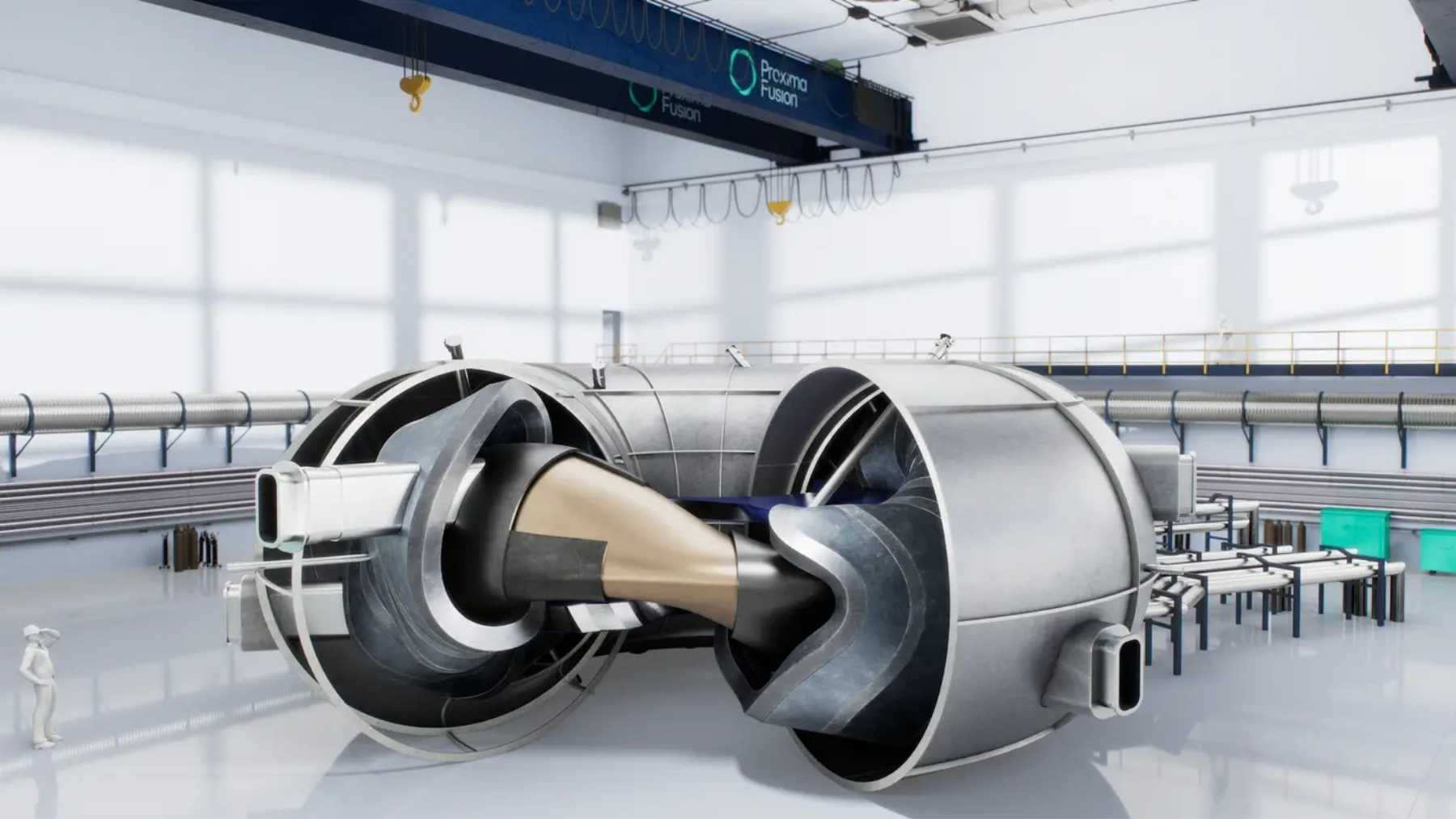
Step two is Stellaris, the commercial plant planned for Gundremmingen in the late 2030s. Proxima published the Stellaris design in the journal Fusion Engineering and Design in February 2025. It’s the first peer-reviewed stellarator power plant concept to fold the electromagnetic, structural, thermal and neutron simulations into one coherent machine, using high-temperature superconducting magnets to shrink the whole thing down.
The division of labor is straightforward. The IPP leads the plasma physics. Proxima, whose engineers come from the IPP, MIT, SpaceX, Tesla and McLaren, handles engineering, tenders and construction. RWE brings decades of experience running big power plants, plus the small matter of owning the land.
Money-wise, Bavaria has signaled it could cover 20 percent of the costs, contingent on federal funding, and Proxima plans to raise about 20 percent from private investors. The company closed a €130 million Series A in June 2025, the largest private fusion round in Europe at the time.
An industrial base is forming behind it too. More than 30 companies have joined an “Alpha Alliance” to deliver the demonstrator, Proxima convened an Industrial Development Board of European energy heavyweights this May, and the company says a planned magnet factory could create up to 1,000 jobs. Berlin adopted a Fusion Action Plan last fall committing more than €2 billion through 2029, with the stated national goal of hosting the world’s first fusion power plant.
The site comes with the wires already attached
Gundremmingen is not a random field. Unit A was Germany’s first large nuclear power plant. Unit B ran for 33 years before shutting down at the end of 2017, and Unit C powered down on December 31, 2021, closing the site for good. The dismantling job runs well into the 2030s.
October’s demolition was the photogenic part. About 600 kilograms of explosives packed into 1,800 boreholes brought down roughly 56,000 tonnes of concrete, which is being crushed into recycled gravel. The first of three blasts that day was fired purely to scare off the local wildlife. Germans plan everything.
What’s left is the boring stuff fusion developers dream about. A grid connection built for gigawatt-class output. Cooling water from the Danube. Roads, switchyards, land already zoned for making electricity, and a region that has worked in power generation for six decades. RWE had already penciled in battery storage, a solar plant and a gas-fired station for the site before the fusion deal came along.
“With Alpha in Garching and Stellaris in Gundremmingen, we are, for the first time in Europe, connecting world-class research, privately financed and publicly supported high-tech innovation, and its industrial implementation at a single location,” Proxima co-founder and CEO Francesco Sciortino said when the deal was announced.
Then there’s the symbolism, which nobody involved is pretending not to notice. The country that walked away from splitting atoms wants to be first to make money joining them, on the exact ground where the old technology is being carted off in gravel trucks.
America is already inside this machine
If you’re reading this in the US and wondering why a Bavarian donut concerns you, start with the record itself. The 43-second run was fueled by a one-of-a-kind pellet injector built by Oak Ridge National Laboratory in Tennessee, which fired about 90 frozen hydrogen pellets into the plasma while microwaves heated it past 20 million degrees Celsius. No Tennessee hardware, no record.
Washington then doubled down. In late April 2026, the Department of Energy signed a 10-year agreement with the Max Planck IPP to keep American researchers working on W7-X, the first project under a new US-European Commission framework for fusion collaboration. “The collaboration between the United States and IPP on W7-X has been extraordinarily productive for more than 20 years already, and this agreement pushes us forward into the next decade and beyond,” said Jean Paul Allain, who runs the DOE’s Office of Fusion.
The stellarator race has an American horse, too. Type One Energy, working with the Tennessee Valley Authority, is developing its own stellarator plant concept aimed at the grid in the mid-2030s. And Helion already holds the world’s first regulatory licenses for a fusion power plant, for a very different kind of machine in Washington State. Whoever gets there first, fusion has officially entered its paperwork era.
What has to go right before Gundremmingen glows again
The honest caveats: an MoU is intent, not steel. Alpha has to get financed, built and then actually hit net energy gain before anyone in Gundremmingen sees a fusion plant. The federal funding that Bavaria’s 20 percent depends on is still being sorted under Germany’s High-Tech Agenda. Fusion timelines have a rich tradition of slipping, and “late 2030s” leaves this one plenty of room to join the tradition.
But the machine that started it all isn’t waiting around. W7-X is currently in a year-long maintenance shutdown, and the IPP says it will fire back up in September 2026 with the explicit goal of breaking more records.
So the scoreboard, as of today: RWE is still grinding 56,000 tonnes of cooling tower into gravel. And in Munich, the machine meant to rise in its place already exists on paper, peer review and all.