
Big construction projects run on part numbers. Every bolt, every valve, every length of pipe gets a code on a drawing, and nuclear plants push that logic further than most, because one numbered item on the list can be an entire room that weighs a thousand tons.
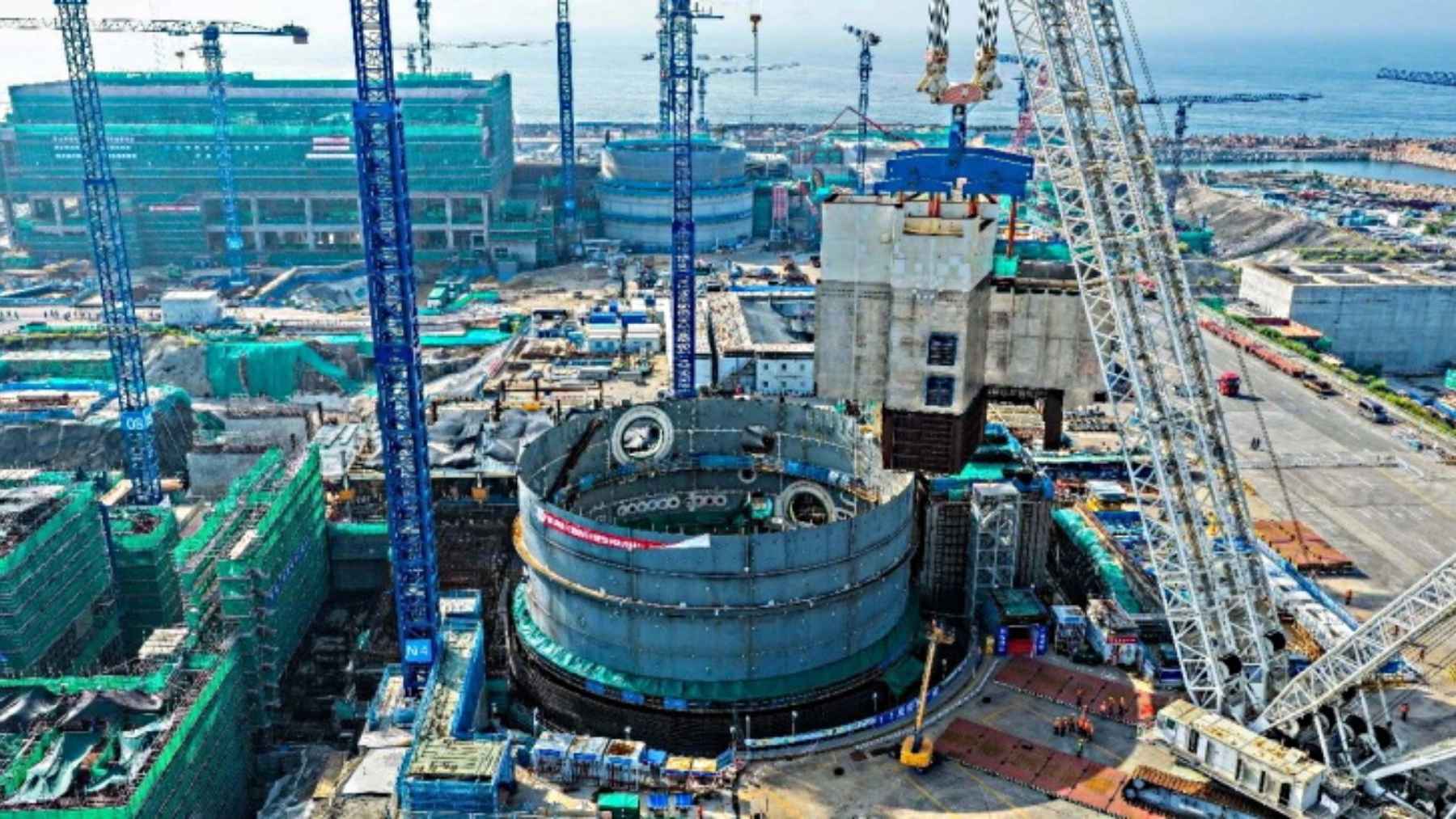
One of those numbered items is called CA01. On July 21 a crew in Guangdong province lowered one into the reactor building of Lufeng unit 2, and China General Nuclear put the hoisting weight at more than 950 metric tons, roughly 2.1 million pounds.
The United States has set three CA01s. Two of them are running in Georgia today. The third went into a reactor in South Carolina in July 2015 and has been sitting inside an unfinished building ever since.
A room too big to put on a truck
CA01 is not a component the way a pump or a valve is a component. It is the structural box that sits inside the containment and holds the reactor pressure vessel, the steam generators and much of the plumbing that ties them together.
The one installed at Lufeng measures more than 85 feet long, 95 feet wide and 75 feet tall, and it was put together from 47 separate sub-modules. World Nuclear News reported the installation on July 23, citing CGN.
CGN calls it a super module for a plain reason: at that size it cannot travel by road or rail, so it gets assembled on the site instead of in a factory somewhere else. Nobody was ever going to drive a 95-foot-wide steel room down a highway.
Lufeng runs the CAP1000, the Chinese localization of Westinghouse’s AP1000. Units 1 and 2 are rated at 1,250 MWe apiece and are scheduled to start up in 2030, which is a schedule and not a result. Unit 1 got its own CA01 in September 2025.
The first American CA01 went in eleven years ago this month
On July 23, 2015, South Carolina Electric & Gas set a 2.4-million-pound CA01 into unit 2 at the V.C. Summer site in Fairfield County. It was the first module of its type installed at any of the four AP1000s then under construction in the United States.
Sixteen days later Georgia Power placed the CA01 for Vogtle unit 3. That one weighed 2.28 million pounds, stood 70 feet tall and 80 feet wide, and was assembled on site before being moved to the nuclear island in one piece. Vogtle unit 4 got its own on November 21, 2016: more than 2 million pounds, 70 feet tall, 95 feet wide, 80 feet long.
Both American sites used the same tool for the pick, a heavy lift derrick standing 560 feet tall. CGN has not said what lifted the Lufeng module. Britain used the largest land-based crane on Earth to drop a 500-ton reactor vessel into Hinkley Point C in May, which tells you how specialized this corner of the crane market has become.
The dimensions are the part worth staring at. Vogtle 4’s CA01: 95 feet wide, 80 feet long, 70 feet tall. Lufeng 2’s: 95 feet wide, 85 feet long, 75 feet tall. Same drawing, ten years and one ocean apart. Georgia Power described its module as made entirely of steel; CGN describes the Chinese one as steel and concrete.
The factory was the part that broke
Modular construction was the whole sales pitch for the AP1000. Build the complicated pieces indoors on a flat floor with good light, ship them out, then bolt the plant together from big chunks instead of pouring and welding everything in the weather.
The plan had a specific address. Shaw and Westinghouse built a $100 million, 600,000-square-foot fabrication plant at the Port of Lake Charles, Louisiana, to feed sub-modules to both construction sites.
It did not go that way. In 2013 the Vogtle project’s independent construction monitor, William Jacobs, told Georgia officials the plant “has not demonstrated the ability to fabricate high-quality CA20 submodules” at the rate the schedule required, and ENR reported that an NRC investigation found 27 percent of Lake Charles workers feared retaliation for raising quality concerns. Sub-modules arrived at the sites with the wrong welds and had to be reworked in the field.
Westinghouse filed for Chapter 11 in March 2017. V.C. Summer stopped that July. Vogtle 3 and 4 did get finished, in July 2023 and April 2024, against an original estimate of $14 billion and a 2017 completion date; the Associated Press put the final cost to the four owners at $31 billion, or near $35 billion once you add the $3.7 billion Westinghouse paid to walk away from the job.
Every CA01 that got built did get placed, on both sites, and the lifts themselves went fine. What failed was the supply chain feeding them.
China’s answer was to stop shipping the pieces
The American teams already worked around that problem by moving assembly on site, into a 12-story module assembly building parked next to the reactors. CGN has pushed the same idea further at Lufeng, and says unit 2’s CA01 involved more pre-assembly at ground level than unit 1’s did, improving “the overall integrity of the assembly compared to unit 1.”
That is CGN describing its own work, and there is no Guangdong equivalent of a state utility commission docket to check it against. Chinese construction costs do not get filed in public rate cases the way Georgia’s did, which is a real limit on any comparison you read on this subject, this one included.
Quality paperwork on nuclear-grade steel is a running story on every continent anyway. The ultrasonic flags stacking up on a British reactor vessel being forged in France are a live reminder that most of this work is documentation, not lifting.
Washington wants ten more of these under construction by 2030
On June 23 the Department of Energy conditionally committed up to $17.5 billion in loans through its Office of Energy Dominance Financing to buy long-lead equipment for as many as 10 AP1000s, spread across up to five two-reactor projects. Westinghouse has signed letters of intent with seven potential partners, and each project has to commit $1 billion of equity before the loan money moves.
The department says the structure can pull three years out of the deployment schedule. Edwin Lyman, director of nuclear power safety at the Union of Concerned Scientists, told Utility Dive the total bill for ten reactors could approach $200 billion, and that “none of these potential projects is backed up with an actual contract for construction.”
The South Carolina units sit inside that same push. Brookfield Asset Management cleared its first feasibility checkpoint on June 26 and moved into phase two, with a decision on whether to commit $2.7 billion expected by March 31, 2028. The full terms of that restart are stranger than the headline suggests, starting with the reactor vessel heads that spent nine years parked dry in a warehouse.
Same drawing, same part number, within a few feet of each other in every dimension. One CA01 is inside a reactor building in Guangdong with a 2030 start date attached to it. Another is inside a building in Fairfield County where work stopped in July 2017 and has not restarted.
The steel did not decide that. Modules were never the hard part of building a reactor, and the lifts were the piece that consistently went right. The hard part is the factory behind them, the schedule around them and the money underneath, which is exactly where the next $17.5 billion is aimed.