
Most of the famous old ships you can go and visit in this country sit in the water, and they stay there until somebody decides they’re done. The battleship Wisconsin got pushed four feet off her pier in Norfolk last month and went right back. The SS United States is tied up in Mobile, Alabama, waiting for a Florida county to sink her as a reef. The Dutch just did something I don’t think I’ve seen done with a ship this size: they pulled one out of the water, drove it up and over a dike, and parked it on a concrete pad where it’ll stay for good.
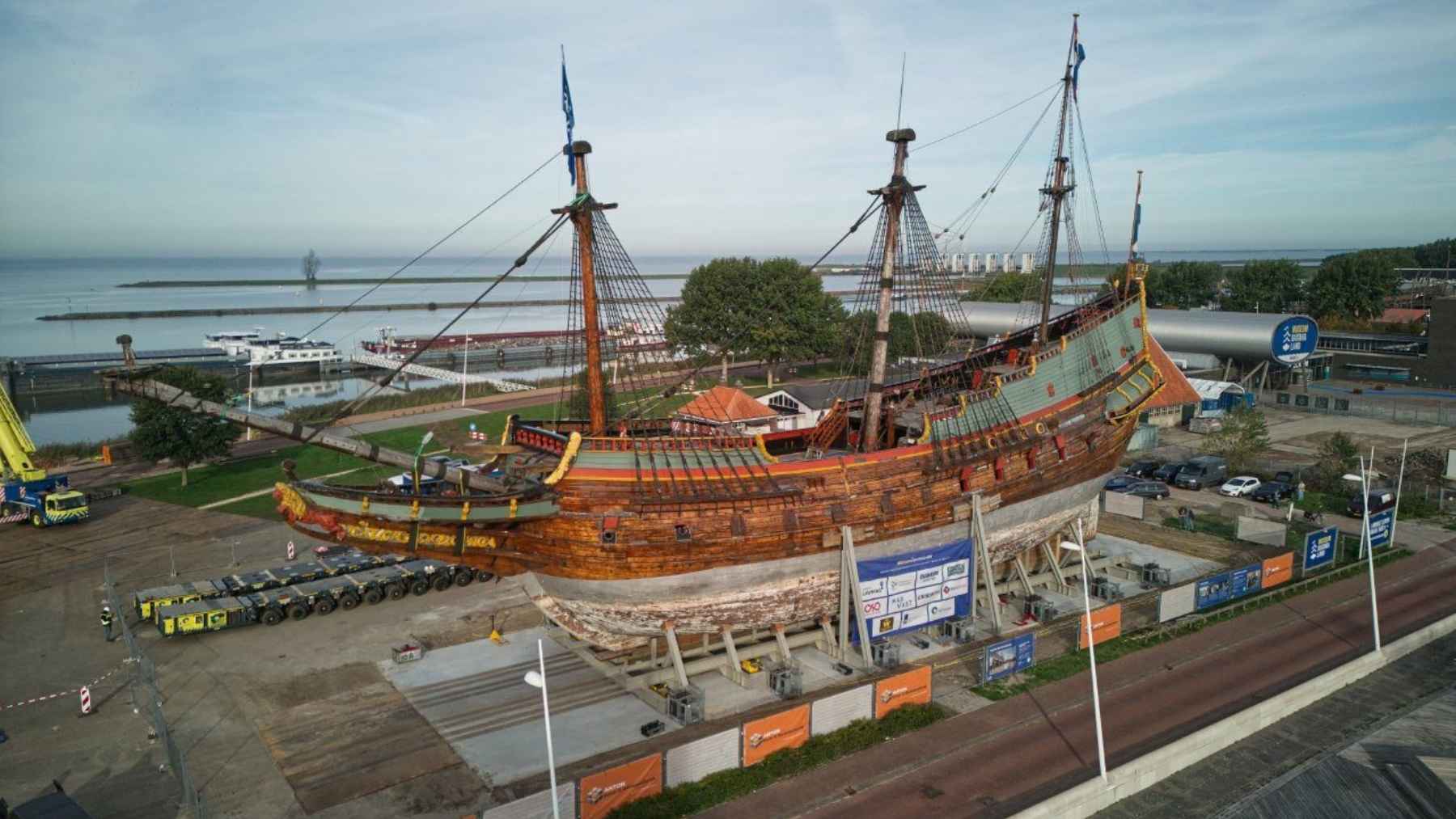
The ship is the Batavia, and she’s a bit of a strange case to begin with. She looks like a 1628 Dutch East India Company trading ship because she’s a full-size copy of one, built in the town of Lelystad between 1985 and 1995 by a shipwright named Willem Vos and more than 600 young people on vocational training placements. She’s 186 feet long, 34 feet wide and 100 feet tall to the top of her masts. Museum Batavialand, which owns her, puts her at 646 metric tons without ballast, which is about 712 tons the way we count them.
She’s also been tied up at the same pier since 1995, and that’s 31 years of lake water soaking into oak. The museum says she’s in fragile shape and needs major work, and the only practical way to dry out a hull that size and get at all of it is on land.
So out she came.
So how do you get a 712-ton wooden ship out of a lake?
Slowly, and in two trips. On the morning of September 19, two tugboats from a Dutch towing company took her out of Lelystad with her masts still standing, across the Markermeer and down the IJ into Amsterdam, a 31-mile run that took about six hours. She floated the whole way on her own hull. The engineers looked at carrying her on a pontoon for that leg and decided her hull wasn’t built to take the loads, so she went like a ship one last time, past the Amsterdam waterfront and into dry dock 4 at the Damen Shiprepair yard. That’s the same dock she floated out of in 1995, which is the kind of detail a museum isn’t going to let you miss.
Here’s where it gets interesting. A ship floating in water has the water pushing back on every square inch of her hull at once, which is why a wooden design from 1628 can still hold together. Set her on land and she’s resting on a handful of points instead, and oak that’s been wet for three decades doesn’t love that. So before any of this happened, the museum had her measured and weighed, had a load model built over ten months to figure out where the hull is strong enough to take a support, and had a steel cradle made to those points: 130 feet long, 51 feet wide, 96 tons of steel plus about 15 tons of timber packing.
In the dock, the cradle went onto a submerged pontoon, two small tugs nudged the Batavia over it, and the water was pumped out until she settled onto her supports. Then the gaps between hull and steel got packed with wood, a job Boating New Zealand reported was expected to take two days. The cannons had already come off, along with most of her ballast, and temporary steel bracing went into the hold and across the decks so nothing moved that wasn’t supposed to. Nobody’s published the exact day she went into the dock, somewhere between September 19 and 22, which is a slightly odd thing to leave out of a story that’s otherwise timed to the hour.
Paul van de Craats, commercial manager at the Damen yard, trained as a young man while the Batavia was being built. “Dutch maritime history came into dock 4 in 1995 and it is back now,” he told Boating New Zealand.
56 axle lines for a ship that doesn’t weigh all that much
On October 1 she left Amsterdam again at 8 a.m., this time sitting in her cradle on a pontoon, and was back in Lelystad that afternoon. The next morning is what everyone turned out to watch.
If you’ve never seen a self-propelled modular transporter, picture a flat steel deck on rows of wheels, where every row steers on its own and rides up or down on hydraulics, and one person drives the whole thing with a remote. That’s an SPMT, and it’s how you move a transformer, a bridge section or a rocket stage. A Dutch heavy-haul company put two of them under the Batavia’s cradle, 28 axle lines each, 56 in all, lifted ship and cradle together, and drove her backwards off the pontoon, up a ramp built extra long to keep the angle shallow, and over the dike that holds the Markermeer back from land that sits below sea level. Then 820 feet into the museum grounds, with the light poles pulled out ahead of her and steel mats laid over the walkway so the ground could take it.
So why 56 axle lines for 824 tons of ship and cradle? Because the number wasn’t about the weight. Crane & Transport Briefing, which covered the job, says the count was set by stiffness: 56 lines spread the load far enough along and across the cradle that the frame couldn’t flex under the hull. At that point you’re not really hauling a ship. You’re hauling a very long, very expensive wooden box that can’t be allowed to bend, and the trailers are just the way to keep it flat.
Ard Suvaal of Trans Global Projects, the firm that handled the project management, permits and public safety, summed it up for the magazine in one line: “if you drive over a pipeline you didn’t know was there, you have a problem.” His team had the route checked for ground pressure, soil and buried pipes, and he says several hundred hours went into planning and permits before a wheel turned.
The drive itself took one to two hours. The next day, October 3, the hydraulics let her down onto a concrete foundation, and she now stands more than 26 feet higher than she did at her old pier, which from the looks of things makes her visible from a fair chunk of Lelystad.
Why she’s worth the trouble
The original Batavia didn’t last two years. Built in Amsterdam in 1628 as the flagship of that year’s fleet to the East Indies, she hit a reef in the Houtman Abrolhos islands, off Western Australia, on June 4, 1629, on her first voyage. What happened to the survivors is one of the uglier stories in maritime history: a merchant took control of the castaways and he and his followers killed more than 100 people before a rescue ship got back. What’s left of the wreck is in a museum in Fremantle.
The copy in Lelystad is, as far as I can tell, the biggest reconstruction of a 17th-century ship anywhere, and the museum says about five million people have walked her decks since 1995. She went to Sydney for the 2000 Olympics. Vos, now in his mid-80s, was on the pier on September 19 to watch her leave.
Is hauling a ship out of the water and parking it on concrete the right call? I’d argue yes, frankly, and for a pretty unromantic reason: wet oak rots from the inside, and you can’t fix what you can’t reach. The one thing I’d keep an eye on is the roof. Crane & Transport Briefing reports the museum still needs funding for a shelter to keep the weather off her, and a 186-foot wooden ship standing uncovered through a few Dutch winters isn’t a long-term plan.
Museum Batavialand says it hopes to have visitors back on board in early 2027, with the restoration work going on around them, and the rebuilt museum with the ship as its centerpiece is scheduled to open at the end of 2028.