
If you’ve driven I-15 through the north end of Salt Lake City, you’ve crossed a set of sewer pipes that got there without a single lane closure. That’s not how these jobs usually go. Replacing a major sewer line normally means an open trench, a detour and a few months of everyone hating the utility company. Salt Lake City got its new crossing a different way: crews sank pits off to the side and hammered steel casings straight through the ground, under the freeway and under a live rail yard, with a 10,580-pound pneumatic rammer.
The pipe being replaced is a 60-inch concrete sewer trunk laid in 1960, back when Eisenhower was still in office. It moves 23 million gallons of wastewater a day out of downtown Salt Lake City, and the city had been looking to replace and reroute it since 2016. For a sewer system, that trunk’s pretty much the main artery. You don’t get to unplug it, and you really don’t get to spill it.
The replacement plan splits that flow into several 24-inch pipes and sends them across the one corridor in the area you can’t dig up: a rail yard with twelve sets of tracks running right alongside Interstate 15. As part of the 1800 North Sewer Realignment, Salt Lake City’s Department of Public Utilities brought in Claude H. Nix Construction, a trenchless contractor out of Ogden, to install six 36-inch steel casings for the new crossing. Four went under the tracks, which carry Union Pacific freight and Utah Transit Authority commuter trains, and two went under I-15. Every casing had to slip beneath railroad ties and past petroleum and gas facilities with only a few vertical feet of clearance, which company owner Stephanie Nix-Thomas called “threading the needle.”
So how do you land a 370-foot steel pipe under twelve live tracks without anybody up top noticing?
So why not just dig a trench?
Two reasons, and the first one is the trains. The tracks stayed live for the entire job, freight and commuter service included, because you can’t exactly ask Union Pacific to pull its schedule while a sewer goes in. The rails and the freeway got monitored for settlement the whole way through. Crews have pulled this kind of thing off before, including a bore threaded under live tracks in London that we covered, but it never stops being a nervy way to spend a shift.
The second reason is the slope. This is a gravity sewer, which means exactly what it sounds like: there aren’t any pumps. The wastewater moves because the pipe tilts downhill, and the tilt here is 0.4 percent, less than five inches of drop across a hundred feet of pipe. The pipes had to run exactly parallel at that grade, through ground where the water table at one spot was artesian, meaning it had enough pressure to push water up and out of the soil on its own. Get the slope a little wrong and your sewer turns into a very expensive storage tank.
How do you aim a 10,580-pound hammer?
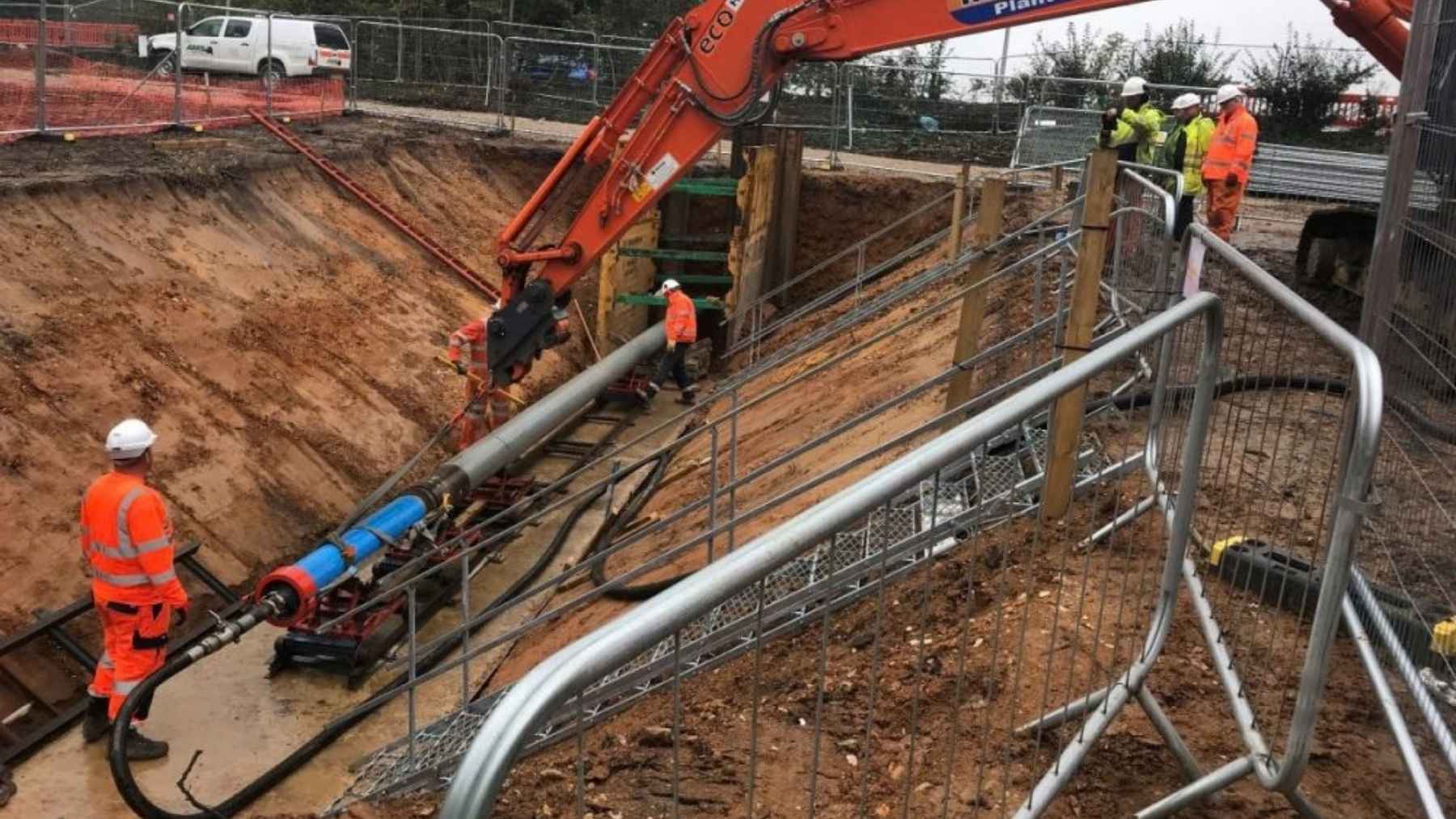
The rammer Nix used is a Grundoram Taurus, built by trenchless equipment maker TT Technologies. It’s 24 inches across, about 12 feet long, and hits 180 blows a minute, going by the manufacturer’s spec sheet rather than anything measured on this particular job. The tool clamps onto the back end of a steel casing and beats it through the soil like a nail, and whatever dirt sits in the way gets swallowed into the casing, to be blown out later with compressed air. Unlike a tunnel boring machine, which carves material out of the ground, a rammer displaces it, so there’s no void forming under the tracks. Railroads tolerate the method largely because of that.
A rammer on its own is a blunt instrument, though. It goes where the soil lets it. Here’s where the pilot tubes come in, and honestly it’s a clever bit of sequencing.
Before any ramming started, crews worked from the center pit and jacked slim pilot tubes out toward the outer pits, steering them on line and grade with an optical guidance system. Each pilot run took about two days. The ground was wet enough that leaving those tubes sitting in it for long wasn’t a good idea, so a 4-inch pipe pushed each string of pilots out the far side and then stayed in the ground to hold the alignment. Then everything reversed: from the outside pits, the Taurus rammed a 20-inch casing home in 40-foot sections along the path of the 4-inch pipe, an adapter linked the next size up, and the 36-inch casing followed the 20-inch one in.
Each 36-inch casing traveled more than 370 feet and had to arrive inside a 48-inch opening, with 3 inches of tolerance either way. For something you steer by hitting it very hard from behind, that’s frankly absurd accuracy. TT’s account doesn’t say what the final deviation on each casing turned out to be, so I can’t tell you whether the crews beat that number or just met it. According to TT, every casing arrived on target.
The pits had to stay flooded on purpose
My favorite part of this whole job is the concrete. The three launch and receiving pits sat in ground so waterlogged that draining them before pouring the floors would’ve backfired. Groundwater pushing up from below can float a fresh slab like a boat hull, so Nix crews left the water in, dug the pits underwater with GPS-guided excavators, and pumped concrete down through a tremie tube, filling from the bottom up until each pit had a 5-foot-thick floor. The digging happened 12 to 17 feet below the water surface, essentially by instruments.
Two of the pits were big secant-pile boxes, 45 by 60 feet and 35 by 45 feet, built from overlapping drilled concrete columns, and the third was sheet pile. Before each pour, a crew lowered a concrete grinder on an excavator arm into the water and cut a notch along the secant walls so the new slab would key into them instead of relying on its own weight. Underwater carpentry, basically. All told, the three pits soaked up north of 3,000 cubic yards of concrete, columns and floor slabs combined.
The original design didn’t include a dewatering system at all. One got added during construction because trouble under the rail yard would’ve cost far more than the pumps, and once running it pumped out more than a million gallons of groundwater a day. Perry Seal, the Nix precision manager who ran the trenchless work, said the ramming itself went smoothly apart from a few stops to clean swelling clay out of the casings. Even so, smooth meant at least six weeks of around-the-clock work, running two 12-hour shifts a day until everything sat in the ground.
Once the casings were cleaned out, crews slid the 24-inch HOBAS fiberglass carrier pipes and HDPE lines inside them, and that closed out Phase 1 of the realignment.
So when did all this actually happen?
Something I’ve got to be straight with you about: this isn’t last week’s news. The casings went in during Phase 1 of the project, which the city lists as complete, and TT Technologies published the full account, crew interviews included, in October 2025. The tooling hasn’t gone anywhere, though. The Taurus is still in TT’s Grundoram lineup, and pilot tube ramming remains the way contractors put a casing exactly where a gravity sewer needs it.
Salt Lake City’s utility, meanwhile, kept going. The city’s project page lists three phases in total, and I couldn’t find a completion date for the third one. Phase 2 carried the new trunk line west of I-15 through Rosewood Park, and ENR named that stretch its Mountain States Best Water/Environment Project for 2025.