
- 5 MONTHS AGO · INDUSTRYA 135-foot ship with nobody on board just sailed out of San Diego inside a US carrier strike group, a 142-ton trimaran fueled with 14,000 gallons of diesel to run for months without a human touching it — the first drone ship of its kind deployed as a working piece of the formation
- 4 MONTHS AGO · INDUSTRYA 70-pound French box flies a drone off an 11.6-ton boat with nobody aboard and keeps it up for 24 hours without landing once, fed by a 230-foot cable that carries current up and video back down at 100 megabits a second
- 4 MONTHS AGO · INDUSTRYWhile seven American drone warships finish Navy sea trials this October, the 14-ton boat promised to hold 50 knots through 20-foot seas on Palantir software has yet to touch the water, and its own deadline runs out in five months
- 3 MONTHS AGO · INDUSTRYA 24-foot drone boat that makes its own power from sun, wind and waves will tow a cable of microphones from a winch inside its keel, listening for submarines off Australia for months without refueling, and 40 of them are getting American arrays picked over four rivals
- TODAY · THIS ARTICLEA 40-foot drone boat ran 38 days and more than 4,600 miles without stopping, refueling or anyone touching it, 230 miles out in the Gulf, holding 4.5 knots through gales and 12-foot seas while it dropped eight drifters into the Loop Current
Back in May, a Florida company called Maritime Tactical Systems, or MARTAC, put out a press release about its T38 Devil Ray drone boat. The Navy’s Point Mugu Sea Range had run the boat off the coast of California for 192 hours straight, which works out to eight days, and MARTAC called it a record-setting mission.
Eight days alone at sea is pretty impressive for a drone boat. I’m not knocking it. But a 40-foot one in the Gulf had already done 38 of them, and it finished months before that press release went out.
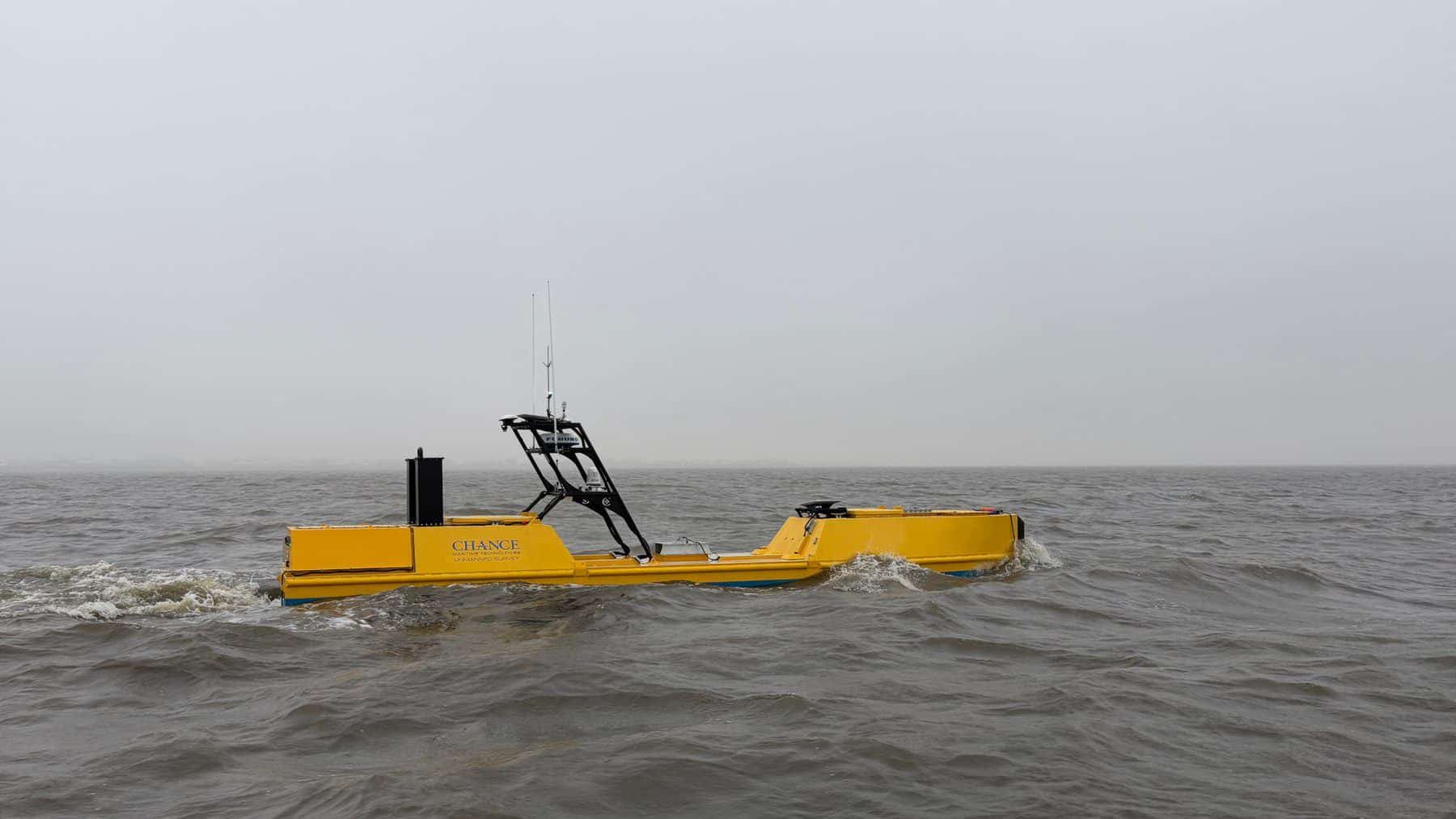
That boat is the Chance MC40, built by Chance Maritime Technologies in Lafayette, Louisiana. Woods Hole Group, an ocean consulting firm based in Bourne, Massachusetts, loaded it with current-measuring gear and sent it out to watch the Loop Current for an offshore energy client, as far as 230 miles off the coast. The two companies announced in mid-January that the boat had run nonstop for 38 days on the diesel it left with. They didn’t give the exact dates of the trip.
It covered more than 4,000 nautical miles in that time. A nautical mile is a bit longer than the mile on your car’s odometer (about 1.15 of them), so that’s a little over 4,600 of the miles you’re used to.
The MC40 held about 4.5 knots for the whole trip, which is just over 5 mph, or roughly the pace of a decent jogger. That isn’t exactly speedboat territory. I checked it myself, and that speed around the clock for five and a half weeks comes to about 4,100 nautical miles, so the companies’ figure checks out. According to Woods Hole Group, the boat kept that speed through seas over 12 feet and gale-force winds. If you’ve ever spent an afternoon on a fishing charter in choppy water regretting your breakfast, you can probably imagine what seas like that do to a boat this size. It just kept chugging along.
So what’s the Loop Current?
The short version is that it’s a river of warm water running through the Gulf (officially the Gulf of America on federal maps these days). It flows in from the Caribbean through the gap between Mexico’s Yucatán Peninsula and Cuba, curves around and leaves through the Straits of Florida, and NOAA says it eventually joins the Gulf Stream.
It’s also pretty unpredictable. Sometimes it barely pokes into the Gulf before heading for the Atlantic, and other times it pushes almost all the way to the Louisiana coast. When it stretches out like that, it tends to pinch off huge spinning eddies that drift west across the Gulf for weeks.
So why would an energy company pay somebody to babysit that for five weeks?
Because it’s a real headache if you’ve got rigs, pipelines and supply boats out there. Strong currents shove vessels around and make subsea installation work harder, according to CLS, the company that owns Woods Hole Group. So offshore operators pay for early warning when one of those eddies is forming or picking up strength, and that’s basically what this outfit sells. The partners told Offshore magazine the work was for an offshore energy operator, but they haven’t said which one.
There’s a lot of gear on a 40-foot boat
The main instruments on board were two Teledyne acoustic Doppler current profilers, or ADCPs, which make up Woods Hole Group’s FAST Eddy system. An ADCP basically fires pulses of sound into the water and listens to how the echoes shift as they bounce off tiny particles drifting with the current. It’s the same Doppler effect that makes an ambulance siren change pitch as it goes past you. And it lets the boat measure how fast the water is moving, and in which direction, at different depths instead of just at the surface.
One unit runs at 75 kHz and the other at 300 kHz. As a general rule, the lower frequency sees deeper and the higher one picks up finer detail closer to the surface. The boat processed the data as it went and beamed it to shore by satellite, where analysts on both sides could follow it live on a web portal.
Then you have the drifters. Chance built a separate payload that dropped FAR Horizon drifter buoys at spots the client picked, and the MC40 put eight of them in the water during the trip. Those buoys ride the current and they’ll report their position by satellite, so forecasters get a trail to follow. CLS says the boat has room for as many as 18, so this run didn’t even use half its capacity.
One thing I couldn’t find is how much the MC40 weighs. Chance doesn’t publish a displacement figure, which is frankly a bit annoying from a company that’s otherwise pretty happy to share numbers. Its current spec sheet does list a maximum range of 5,400 nautical miles, a bit over 6,200 regular miles, and says it can stay out for over 90 days. And at an electronic warfare exercise called Silent Swarm in Alpena, Michigan, the MC40 hauled more than 1,200 pounds of payload while running four Starlink terminals at once.
Somebody was still keeping an eye on it
Now, the boat didn’t exactly wander around on its own. According to Woods Hole Group, an operator at Chance’s base in Louisiana navigated the MC40 by satellite the whole time. Chance’s team also kept watch around the clock using a live video feed, radar, AIS (the tracking signal ships broadcast) and marine VHF radio.
So what you’ve really got is a five-week remote-control shift with a lot of automation on top. I’d argue that’s the more useful setup for an energy company anyway. You get a person who can react if a tanker wanders into the survey area, and you don’t have to keep that person that far offshore for over a month.
The fuel bill is where it gets really interesting. Current surveys like this have traditionally been done by bigger crewed vessels, and CLS says a single day’s running for a typical offshore supply vessel (the big workboats that haul pipe, fuel and food out to rigs) can use more fuel than the MC40 goes through in 40 days. That’s a pretty brutal comparison if you’re the one paying for the supply boat.
Is 38 days actually a record?
The two companies describe it as a record for diesel-powered drone boats cruising continuously. That’s a pretty carefully worded claim, and diesel is the important word in it.
Woods Hole Group has tried this with sunshine before. A few years ago it teamed up with SeaTrac Systems on a Loop Current mission using the SP-48, a 15-foot solar-powered drone boat, which spent 21 days out there, according to Hydro International. That boat ran into currents of more than 2 knots, which is about as fast as the SP-48 likes to cruise, so it didn’t have much speed to play with. I’d guess that’s a big part of why Woods Hole Group went with a diesel boat this time. Rob Smith, the vice president of its energy and infrastructure business unit, said offering “a truly autonomous FAST Eddy system” had been a long-term goal.
As for the MARTAC boat, it’s a different kind of machine. The T38 is a twin-hull, twin-engine design, and part of its eight-day run was a planned two-day stretch on one engine about 460 miles offshore, to see how much it could extend its time on station. MARTAC described the result as something not previously achieved in its class, which suggests it isn’t really trying to compete with a slow survey boat. Still, line the two up and the diesel boat in the Gulf stayed out 38 days to the T38’s eight.
For a bit more context, the Pioneer drone boat we covered off Plymouth stayed out for more than 100 hours, and Leidos’ Sea Archer is built to watch one patch of ocean for up to 23 days.
The MC40 hasn’t had much time off since
In May, the same boat led the first offshore hydrographic survey Woolpert has run for NOAA without any crew on the water, off Pensacola, Florida. A hydrographic survey is basically a fancy way of saying mapping the seafloor so nautical charts are accurate, and this one also covered deep-sea corals and habitat across about 1,840 square miles. Chance’s smaller MC29 worked the area alongside it.
NOAA Fisheries also hired Chance to take the MC40 up the East Coast. The agency says the boat spent about 30 days in the spring and summer surveying the Mid-Atlantic Bight and Georges Bank, covering roughly 2,800 miles while it looked for the clouds of zooplankton that endangered North Atlantic right whales feed on.
CLS, for its part, was still using the Gulf run as its go-to example in a write-up posted on October 28, which pitches the FAST Eddy setup for jobs lasting as long as roughly 40 days straight. Chance rates the MC40 itself for more than 90 days at sea.
 A 146-year-old narrow-gauge railroad in the Rockies is cut in two places, with 50 feet of track hanging in the air and an 80-foot-deep washout, and crews need more than $5 million and have until Memorial Day to rebuild the grade before its steam trains can run againIndustry · 2 hours ago
 A see-through animal that tows a chain of up to 20 clones of itself has been drifting 920 to 7,200 feet down off California for more than two decades, and after thousands of remote-controlled sub sightings scientists have finally named it the first salp that lives only in the deep seaIndustry · 6 hours ago
 An 81,000-ton concrete box lying in a trench on the Baltic seabed has a damaged rubber seal on its open end, and the next box going down, a 23,000-ton one with a basement and as tall as a four-story building, has to wait until it is fixedIndustry · 10 hours ago