
- 2 MONTHS AGO · MILITARYA 19-foot American drone submarine rated for 19,700 feet sat dead in the water for more than a day at the mouth of the Strait of Hormuz, where the bottom runs 200 to 330 feet, until Iranian naval forces hauled it in, and the man who built it posted “rest in peace, little buddy”
- 2 MONTHS AGO · MILITARYA 110-inch drone boat weighing 455 pounds empty spent two weeks off a California beach hunting mock mines the Marines built for it, and it carries sonar and an infrared camera up to 250 nautical miles on a tank of no more than 30 gallons
- 2 MONTHS AGO · MILITARYA 23-foot American drone sailboat that rides the wind on a 15-foot rigid wing turned up burning in an Iranian video at the mouth of the Strait of Hormuz, and four days later a US drone put two missiles into boats grabbing at another Navy surface drone
- 1 WEEK AGO · MILITARYA 41-foot drone boat ran the Strait of Hormuz with two Coast Guard cutters while an Iranian drone and a Revolutionary Guard attack boat watched it pass, and months later it went through again out in front of a destroyer carrying the region’s top American general
- TODAY · THIS ARTICLEAn 11-foot American mine-hunting drone weighing 600 pounds went on Iranian state TV as the second underwater drone the Revolutionary Guard says it pulled out of the Strait of Hormuz in three weeks, one of more than 90 the Navy has sent to sea
Fishing stories have a habit of getting better every time someone tells them. Iran’s Revolutionary Guard told one in late September, and it changed the name of the fish before the day was over.
On Sunday, September 27, the Guard’s navy said it had caught an American underwater drone in the Strait of Hormuz with what it described as a coordinated intelligence and electronic warfare operation. Its first statement called the vehicle a REMUS 600. Later that same day, IRGC spokesman Second Brigadier General Hossein Mohebbi posted that the catch was actually a Mk 18 Mod 2 Kingfish, a mine-hunting drone the US Navy has been running in the region for well over a decade.
Iranian state broadcaster IRIB put out footage of the vehicle, captioned as the second American underwater drone Iran had taken intact in the strait, according to Militarnyi. Mohebbi went further and pitched it as a prize for Iranian intelligence as much as a piece of hardware.
Washington didn’t buy it. CENTCOM spokesman Capt. Tim Hawkins told Al Jazeera that every operational drone the US has out there is still under its control, and called Iran’s claim “clearly desperate,” Baird Maritime reported.
So who’s telling the truth?
I honestly can’t tell you. Iran has footage and a name, the US has a flat denial, and I haven’t found anything newer from either side in the two months since. But you can learn a fair bit from the drone itself, and the Kingfish is a very different animal from the drone Iran grabbed 19 days earlier.
That earlier catch was a 19-foot Anduril Dive-LD, and CENTCOM didn’t dispute losing it. Hawkins said it had malfunctioned more than a day before Iran announced the capture, and that it was an older model with nothing sensitive aboard. We went through how that Dive-LD ended up in Iranian hands back in September.
So what is a Kingfish?
The Kingfish is basically the Navy’s version of the REMUS 600, an underwater vehicle that started life at the Woods Hole Oceanographic Institution and was built for the fleet by Hydroid in Pocasset, Massachusetts. Hydroid is part of shipbuilder HII these days.
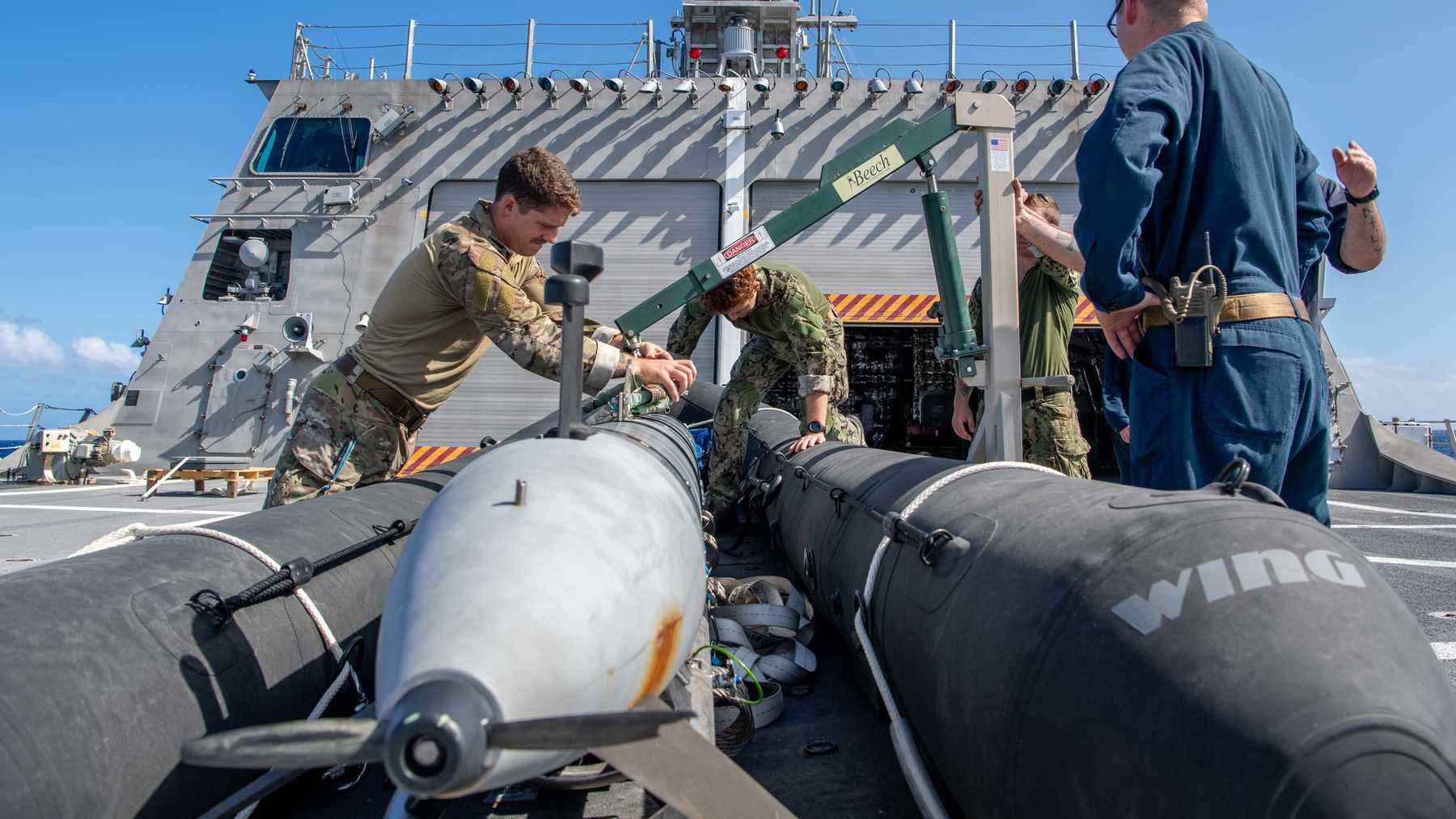
The Navy’s figures put the Kingfish at 11.5 feet long and 12¾ inches across, and it weighs about 600 pounds out of the water. That weight moves around a little depending on which sections are bolted in, since the REMUS 600 is essentially a tube you build out of modules. Shephard puts its maximum operating depth at about 1,970 feet, with missions lasting up to 24 hours.
That’s a pretty modest spec sheet next to the Dive-LD, which is rated to 19,700 feet, ten times deeper. But the Kingfish was never meant to be a deep-ocean explorer. It was meant to be easy to launch from almost anything.
Shephard reports the Mk 18 Mod 2 can go out from a boat as small as a 36-foot rigid-hull inflatable. You don’t need a destroyer to run one. In the early days of its Middle East deployment, civilian contractors were securing Kingfish to the decks of exactly those inflatables. The Navy formally deployed it to the 5th Fleet after about two weeks of test runs in the Gulf of Mexico. Since then, Kingfish have worked from the Persian Gulf to the Philippine Sea, where sailors from the littoral combat ship USS Charleston and Explosive Ordnance Disposal Mobile Unit 5 trained with one.
How does a drone actually hunt mines?
If you’ve never thought much about how a mine hunter works, it’s a lot less dramatic than you’d think. The Kingfish swims back and forth over a patch of seabed in tidy lines, kind of like you’d mow a lawn, while a side-looking sonar builds up pictures of the bottom on either side of it.
It doesn’t decide what’s a mine, either. HII’s own literature for the REMUS 600 says operators pick out mine-like objects in the data after the run is over. So it’s a very patient underwater surveyor that hands its homework to a human.
Which is also why Iran keeps talking about data. Militarnyi reports that Iran said its specialists were pulling the logged routes, the sonar imagery and the navigation settings off the vehicle. If the IRGC really does have a Kingfish, a log of where the US has been looking is arguably worth more to Tehran than the hardware.
I’m a bit skeptical of the electronic warfare explanation, though. Underwater, the Kingfish finds its way with inertial navigation and a Doppler sensor that tracks its speed over the seabed. GPS, satellite links and radio only work once it’s back on the surface, a point Army Recognition raised too when it looked at Iran’s claim. So any jamming would presumably have had to happen while it was surfaced, and Iran hasn’t said how it pulled that off.
As for the name change, Marine Insight noted that Iran never explained why it went from REMUS 600 to Kingfish. To be fair, it’s an easy mix-up. A Kingfish pretty much is a REMUS 600 with a Navy designation and military sensors, so the first label wasn’t exactly wrong. It was just vague.
It wouldn’t be the first REMUS 600 to star in somebody else’s video, either. Almost nine years ago, Houthi fighters off Yemen turned up in a video, in dive gear, crowded around one with the name “Smokey” printed on it, and Navy officials wouldn’t confirm whether it was theirs, USNI News reported at the time.
The Navy stopped buying these a while ago
Iran’s victory lap looks a little funny for another reason. The Navy announced that Mk 18 Mod 2 production was finished almost four years ago, after more than 90 had been delivered to the fleet. In the same release, it named the planned successor: Viperfish, a medium-size underwater drone that Leidos won the contract to design, test and build.
I couldn’t find anything confirming that Viperfish has actually taken over from the Kingfish yet. And the Navy still isn’t done with the Mk 18 family. In May, it signed a $17.4 million deal through Naval Information Warfare Center Pacific to keep those drones running, with part of the work in Bahrain, Defence Blog reported.
On the small end of the family, the Navy is buying Lionfish drones to replace the Mk 18 Mod 1 Swordfish. We dug into that Lionfish order this week.
So if Iran does have a Kingfish, it’s safe to assume it’s got a well-traveled workhorse rather than the Navy’s newest toy. That’s still a nice thing to wave around on TV. It’s just not quite the intelligence coup the caption makes it sound like.
That leaves the score where it stood on September 27. The US admits it lost one drone, the Dive-LD on September 8. Iran says it caught a Kingfish too, and CENTCOM says it never lost control of any of its operational drones.
 A 155-pound underwater drone that two sailors drop over the side to hunt mines with sonar down to 1,000 feet for 30 hours started out with an order for nine, and the Navy now has 175 on order and 50 already in handMilitary · 1 day ago
 An 8,300-ton Navy destroyer lost power on a port visit to Sicily and needed 36 hours to get its critical systems running again and three days to light the whole ship, three months after another destroyer of its class drifted four days in open sea until tugboats towed it inMilitary · 1 day ago
 A 36,000-pound-capacity heavy-lift helicopter carried a retired Navy attack jet about 18 miles on a sling, partly over the Potomac River, from the Virginia test base where the airframe stayed after the type left service in 1997 to a Marine airfield that plans to use it for trainingMilitary · 2 days ago