
- 2 MONTHS AGO · MILITARYA 1,092-foot nuclear aircraft carrier moved from her pier in Norfolk to the shipyard that built her, starting a five-year overhaul where the yard cuts through the hull to swap the reactor cores, the only refueling she gets in a service life built to run past 50 years
- 1 MONTH AGO · MILITARYAn American Liberty ship that has sat on a Thames sandbank for 82 years with about 1,400 tons of munitions in her holds had her three 82-foot steel masts cut off underwater by a remote-controlled diamond-wire saw, one at a time in 15 days, and a 213-foot crane barge lifted them out with no diver in the water for the cut
- 1 WEEK AGO · MILITARYA 97,000-ton nuclear aircraft carrier has now spent 2,022 days at the Virginia shipyard that built her, getting a new mast and work on over 600 tanks, and Navy documents point to one more year of it, with her sister ship already there for a five-year overhaul
- 6 DAYS AGO · MILITARYA 27,100-ton aircraft carrier once moved just 15 feet when six tugboats pulled on her with 30,000 horsepower after 24 years at a Manhattan pier, because her four 16-foot propellers had dug into the river mud, and freeing her took three weeks of dredging nearly 40,000 cubic yards
- TODAY · THIS ARTICLEA 27,100-ton aircraft carrier has sat in 25 feet of Charleston Harbor mud for 51 years and moved only twice, once lifted about 6 feet by a hurricane, while divers patched 35 holes in her hull and more than 1 million gallons of oily water came out of her tanks
Floating is pretty much the most basic thing a ship is expected to do. It’s right there in the job description, just above “don’t sink.” But the USS Yorktown hasn’t really floated since she was parked across the harbor from downtown Charleston, South Carolina, back in 1975.
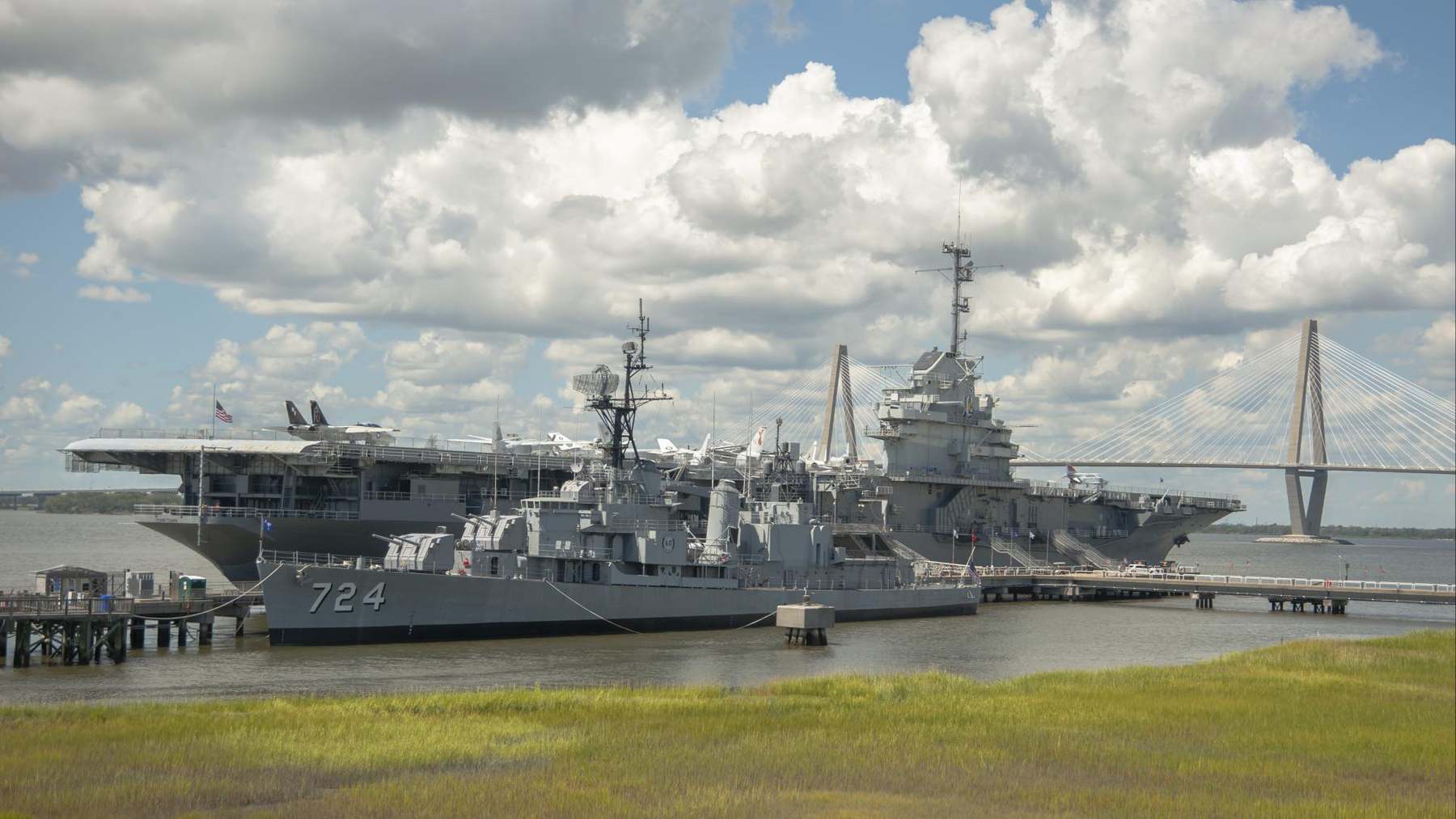
The World War II aircraft carrier is wedged more than 25 feet deep into Charleston Harbor mud, according to Patriots Point Naval & Maritime Museum, which has built itself around her for half a century. The destroyer Laffey, tied up on the same pier, goes up and down with the tide on her mooring lines. The Yorktown doesn’t. She just sits there.
Locals call it pluff mud. If you’re not from the Lowcountry, it’s the soft, dark and famously smelly muck that lines South Carolina’s tidal marshes, and it’ll happily keep your shoe if you step in the wrong spot. Now picture a ship that displaced 27,100 tons when she was built settling into that stuff for five decades, and you’ve got a decent idea of why nobody’s towing her anywhere.
So has she really not moved in 51 years?
Almost. Patriots Point says the Yorktown has moved exactly twice since she was towed in from Bayonne, New Jersey.
The first time was Hurricane Hugo in 1989, which raised the carrier roughly 6 feet, by the museum’s estimate, before she settled back into place. The second was a nor’easter in December 2023 that drove what the museum called a record-setting storm surge into the harbor. That one shifted her about 6 inches in her berth, and Patriots Point shut its gates while engineering firms went over both ships.
I couldn’t find a published version of what those engineers found. But the museum reopened two days after the storm, so it’s safe to assume a 6-inch nudge didn’t do anything too dramatic.
Patriots Point actually considers the carrier about as safe a spot as you’ll find to ride out bad weather, and a small team of its staff stayed aboard when Hurricane Dorian brushed past Charleston. Which is frankly the most reassuring thing I’ve ever heard about being stuck in the mud.
Why not just tow her to a dry dock?
That’s what most museum ships get when their hulls need work. The Laffey’s been to one, and those trips are such a production that Patriots Point plans to move her to the other side of the pier just to make the next one easier. A carrier wedged into the harbor bottom is a different story. Officials told the Associated Press they couldn’t break the Yorktown free of the mud at all.
That turned into a real problem, because the Navy never emptied her. Federal law didn’t require it when she was decommissioned in 1970, the AP reported, so South Carolina got the ship “as is,” hazardous materials included, according to the governor’s office. A 2013 study for Patriots Point put the leftovers at about 1.6 million gallons of toxic waste.
That’s a pretty wild thing to hand somebody along with the keys.
For decades, it wasn’t anyone’s emergency, at least not officially. Patriots Point had been pushing for a cleanup for more than a decade, according to the SC Daily Gazette. State officials had long declined to put money toward it, the AP reported. Then, after close to 50 years sitting in the mud, her outer hull started to corrode, and the risk of all that oil ending up in Charleston Harbor stopped being theoretical. Gov. Henry McMaster signed an executive order telling the state’s Office of Resilience to get it out.
How do you clean out a ship you can’t move?
You do it right where she sits, and you keep selling tickets. The Yorktown stayed open to visitors the whole time, according to the AP. Crews vacuumed the oily sludge out tank by tank, trucked it to holding tanks on shore and sent it off for treatment.
Some of those tanks aren’t small, either. Allison Hunt, Patriots Point’s executive director, told the AP the biggest ones are 32 feet deep and measure 28 feet by 8 feet. That’s about as deep as a three-story building is tall.
The first phase started on the outside of the hull. Divers patched 35 holes in it, which is basically plugging the leaks before you start stirring anything up inside. Then the pumping began, and by the time the state’s contractors finished the second phase, they’d worked through more than 130 tanks.
I’d argue the smartest move was what happened to the tanks once they were empty. Once a structural tank was clean, crews filled it back up with fresh water so the ship would stay stable. Basically, if you pull a couple million gallons of liquid out of a ship, you change how she sits, and nobody wanted to find out what that does to a carrier that’s wedged into the harbor floor.
Add the two phases together and you land at about 2 million gallons, which is also the figure the SC Daily Gazette and Maritime Executive reported. McMaster said the state’s final spending came to $31.6 million, all of it from federal pandemic relief money, and told reporters that’s what it took “to get her clean as a whistle,” Live 5 News reported. That seems like a pretty reasonable price for not having a WWII carrier leak into Charleston Harbor.
One small oddity, though. The state’s own summary puts the asbestos at a little over 9 tons, while its phase-by-phase numbers add up to 13.6. I’ve gone with the phase numbers, since they’re the more detailed ones.
What exactly is sitting in that mud?
The Yorktown is an Essex-class carrier, commissioned in 1943 and named for the earlier Yorktown that was lost at Midway. According to the Naval History and Heritage Command, she was built 872 feet long, with a flight deck 147 feet 6 inches across and a standard displacement of 27,100 tons.
Standard displacement, in case you’re wondering, is roughly what a warship weighs ready for sea but without her fuel or reserve boiler water. Navies use it because it’s a fair way to compare one ship with another.
She didn’t stay at that weight, either. The National Park Service’s landmark file says her tonnage eventually climbed to 45,000 after the 1950s rebuild that gave her an angled flight deck and a hurricane bow. She’s also one of only a handful of Essex-class ships that survived as museums, and her sister Intrepid had her own fight with river mud in New York, which we covered recently.
The Yorktown doesn’t really have to worry about that kind of fight, since she isn’t trying to go anywhere. As far as Patriots Point’s records go, she’s still sitting right where she was parked on June 15, 1975, give or take about 6 inches.
 Crystals had grown over the lids of 68 drums holding more than 9,700 pounds of primer explosive, too dangerous to move or open. The Army blew them up in place at an Iowa plant behind water tanksMilitary · 19 hours ago
 A 2,200-ton warship that never reached the Black Sea it was assigned to is lying capsized at a pier in Libya, after seven Ukrainian drone boats came off a mother ship in the Mediterranean and two of them got through to its hullMilitary · 21 hours ago
 An 8,300-ton Navy destroyer lost power on a port visit to Sicily and needed 36 hours to get its critical systems running again and three days to light the whole ship, three months after another destroyer of its class drifted four days in open sea until tugboats towed it inMilitary · 21 hours ago