
- 5 MONTHS AGO · INDUSTRYSwitzerland just unveiled the first hydrogen train ever built for narrow-gauge track barely three feet wide, an 800-km-range machine that finally opens zero-emission rail to the skinny mountain and mining lines in some 40 countries still stuck on diesel
- 1 MONTH AGO · INDUSTRYA 281-ton German boring machine named Granite Janet has bored out of her pit under a New Hampshire bridge and dug 200 feet, passing under an active railroad with 10 to 12 feet of ground over her, and her 16 gantries won’t all fit inside until the tunnel reaches 580 feet
- 4 WEEKS AGO · INDUSTRYA 116-year-old swing bridge that sometimes needed a hammer to get its rails lined up carried its last train over a New Jersey river, and for five weeks 400 trains a day squeeze over one track on the fixed bridge beside it, 50 feet above the water on three 400-foot steel arches
- 5 DAYS AGO · INDUSTRYA 4.7-mile freight train of 696 empty ore cars ran 535 miles over two days with electric and diesel locomotives spread through it and synced by radio so they pulled and braked as one, and it topped a length record a 4.6-mile ore train had held for a quarter of a century
- TODAY · THIS ARTICLEA 146-year-old narrow-gauge railroad in the Rockies is cut in two places, with 50 feet of track hanging in the air and an 80-foot-deep washout, and crews need more than $5 million and have until Memorial Day to rebuild the grade before its steam trains can run again
Steam railroads have always had a slightly complicated relationship with water. A steam locomotive can’t go anywhere without thousands of gallons of it, and track can’t stay where it’s supposed to when a river decides it wants more room. The Cumbres & Toltec Scenic Railroad got hit with both halves of that problem this fall, nine days apart.
The line covers 64 miles of 3-foot narrow-gauge track between Antonito, Colorado, and Chama, New Mexico, by way of Cumbres Pass. Storms on October 23 and November 1 tore up two separate spots on that line, and they did a number on the railroad’s water supply and its depot in Chama while they were at it.
Ken Bitten, who sits on the two-state commission that runs the railroad, told the Alamosa Citizen that “our line is cut in two places and will be for some time.”
If you’ve never ridden it, narrow gauge just means the rails sit 3 feet apart instead of the 4 feet, 8.5 inches you’ll find under just about every Amtrak and freight train in the country. Narrower track allowed tighter curves and lighter equipment, which made it cheaper to push a railroad through the Rockies. So these little trains are a very different animal from the 4.7-mile ore train a South African railroad ran in October. By the railroad’s own count, this stretch was first built 146 years ago, and today it’s a steam-powered tourist line owned by Colorado and New Mexico.
So where exactly is the line broken?
The first break is on the New Mexico end, at the east approach to the Chama River bridge, milepost 343.5. The October 23 storm washed away part of the fill leading up to the bridge and left the track partly hanging on the north rail. Then November 1 finished the job. The roadbed under roughly 50 feet of track disappeared completely, and the rails were left suspended over the floodwater.
Luckily, the bridge itself seems to have come through fine. Engineers inspected it and didn’t find any problems with the structure, and the railroad says the same about the Cascade and Lobato bridges. Once the river drops, the plan is to place big rocks along the edge of the old roadbed. The railroad says that work could start after Thanksgiving if the water keeps going down, which, if you’re reading this the day it’s published, is basically tomorrow.
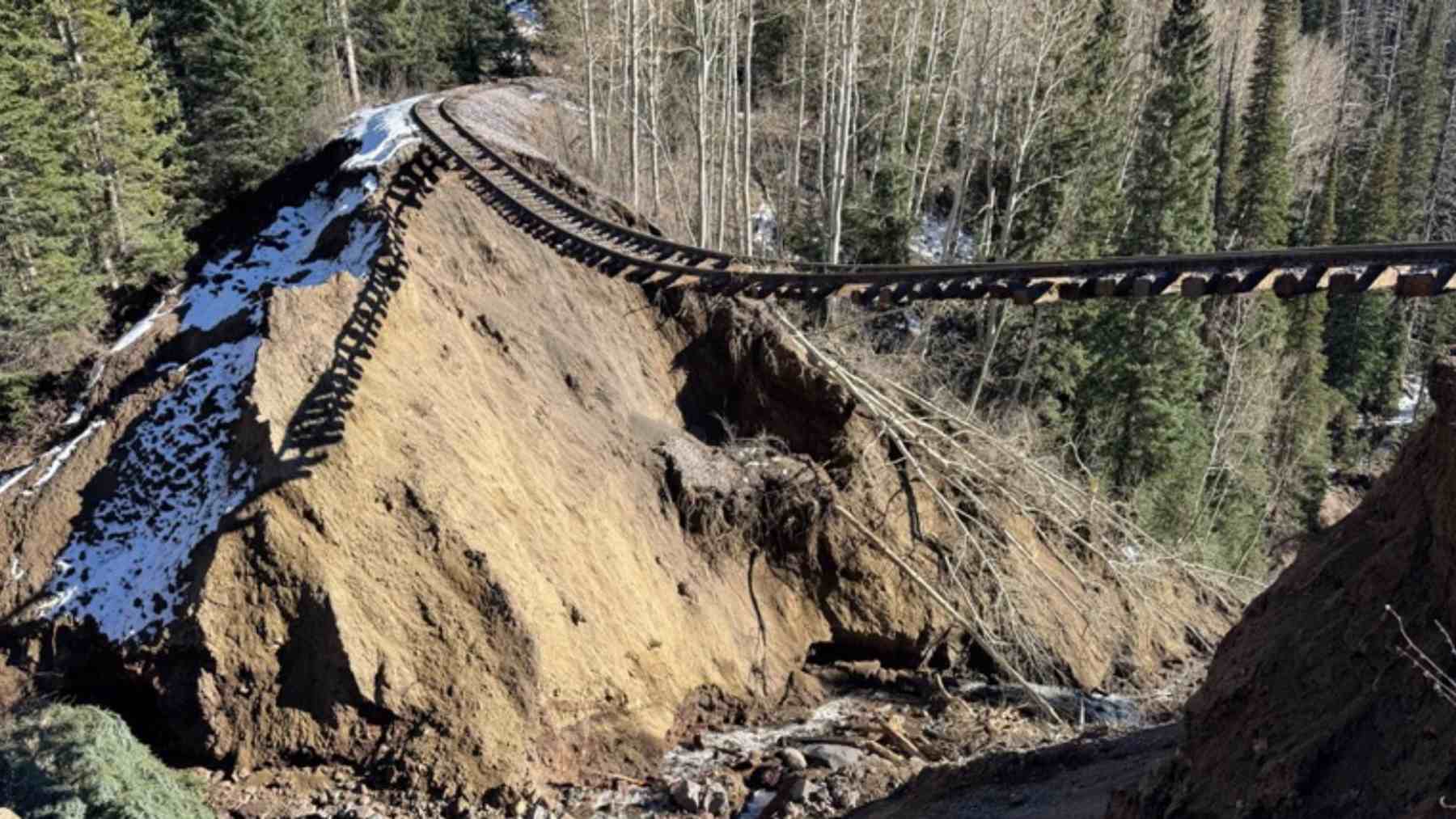
The second break is the scarier one, frankly. It’s at a spot called Coxo, milepost 331.5, near the top of Cumbres Pass on the Colorado side. The flood took out an entire fill there, roughly 100 feet long, 80 feet deep and 100 feet wide. That’s the hole in the photo at the top of this page, with the track still strung across it.
What’s a fill, and how does one just leave?
A fill is pretty much what it sounds like. When railroad builders hit a gully they didn’t want to bridge, they’d pile dirt and rock into it until the track could cross at a steady grade, and they’d leave a culvert at the bottom so the creek could keep running underneath. As long as the culvert keeps up, you’d never know the fill was there. When more water shows up than the culvert can take, it can start eating the fill from below or pour over the top, and a big enough flow can wash the whole thing downhill. I haven’t seen the railroad spell out exactly how Coxo failed, so I’ll stick to what it’s said about putting it back.
According to the damage report, putting Coxo back will need about 15,000 cubic yards of fill, along with new culverts. A typical dump truck hauls something like 10 to 15 cubic yards. By my rough math, that’s somewhere between 1,000 and 1,500 truckloads of dirt and rock for one spot near the top of a mountain pass.
And that’s before you get to the hillside next door. The railroad says much of that slope has to be rebuilt and shored up before a train can cross.
There’s one more wrinkle that’s easy to miss. If I’m reading the mileposts right, the two breaks sit about 12 miles apart, with the Lobato bridge in between, so that stretch of track can’t be reached by rail from either end right now.
The Colorado side of the pass is in much better shape. A smaller washout at Tanglefoot, milepost 330 on the Antonito side of the pass, has already been repaired. The 50 miles from Antonito up to the pass have been inspected and should be ready to go by May.
How much is all of this going to cost?
Bitten told the Alamosa Citizen that preliminary repair estimates come in at more than $5 million. He also put the combined damage down as the worst the line has taken since the two states bought it off the Denver & Rio Grande Western, more than half a century ago. The railroad’s damage report breaks the bill down a bit further:
- $5 million to rebuild the roadbed and track at Coxo and at the Chama River bridge.
- Up to $1 million more for damage at the Chama station.
- No estimate yet for fixing the water supply.
That last item might be the trickiest, and money’s only part of it. The Chama River moved roughly 100 feet during the floods and now runs at a different level, and the headgate the railroad uses to draw water from it is buried in rock several feet deep. In New Mexico, the State Engineer is basically the official in charge of who gets to take water from where. So the railroad can’t just dig a fresh ditch to wherever the river ended up. It has to work out a fix with that office first.
Why does a railroad care this much about a ditch?
A steam locomotive is essentially a big kettle on wheels. It boils water to make the steam that drives its pistons, and it uses that water up as it goes. The Friends of the Cumbres & Toltec say the engines use about 3,500 gallons just getting from Chama up to Cumbres, which is a 14-mile climb. Which means that without the Chama water supply, the railroad’s steam locomotives can’t operate there under normal conditions.
The money to pay for all this isn’t lined up yet, either. At the commission’s November 7 meeting, which happened before anyone had a dollar figure, Bitten said flood recovery reimbursements weren’t a sure thing. Commissioner Kim Smith-Casford said the repairs in Chama hinge on FEMA declaring an emergency, and the minutes note that Colorado had already asked for its own.
Can it really be done by Memorial Day?
Bitten also told the paper the railroad will push to have the repairs done before the 2027 season opens over Memorial Day weekend, assuming there isn’t another catastrophe. The railroad’s website already lists the 2027 season as running from May 29 to October 17. May 29 is the Saturday of that holiday weekend, and Memorial Day itself falls on Monday, May 31.
So the railroad has roughly six months. I’d call that a pretty ambitious schedule, given that one of the two holes sits near the top of a 10,015-foot pass. If you’ve ever been over a pass that high in January, you’ll know winter up there isn’t exactly mild. It’s doable on paper. But I wouldn’t treat Memorial Day as a promise yet, and from the sound of it, neither does the commission.
If you’re keeping score at home, this is also the railroad that pushed its 2026 opening back from May 23 to June 9 because it was too dry and the wildfire risk was too high. It’s been a rough year on the weather front.
What’s still running this winter?
Santa’s Holiday Express is still on, with a revised route in Chama. The Chama trains run December 5 and 6, but they’ll stick to the yard and the railroad’s grounds in town rather than running out to Dalton. The Antonito trains run December 12 and 13. Keeping the Chama trains in the yard seems like a pretty sensible call to me. The town still gets its Santa train, and the train stays on the near side of the river.
The equipment mostly got lucky. The steam locomotives were in the shop for their annual inspections when the floods hit, and the railroad says the engines and the shops came through undamaged. That’s a relief for a steam fleet built between 1883 and 1928, since you can’t exactly pick up a replacement at the dealer.
The 1899 depot in Chama didn’t get off as easily. Water got into its floors and baseboards, and staff told the commission on November 7 that the waiting room, the dispatch office and the safety office all took on about 2 inches of water. As far as I can tell, the railroad hasn’t explained how it’ll keep a steam engine watered in Chama for the December trains with the river supply out of action, and I’m not going to guess.
For anyone already eyeing a summer trip, the Cumbres & Toltec has 2027 tickets on sale, and its schedule still shows the first trains of the season running on May 29, 2027.
 A see-through animal that tows a chain of up to 20 clones of itself has been drifting 920 to 7,200 feet down off California for more than two decades, and after thousands of remote-controlled sub sightings scientists have finally named it the first salp that lives only in the deep seaIndustry · 4 hours ago
 An 81,000-ton concrete box lying in a trench on the Baltic seabed has a damaged rubber seal on its open end, and the next box going down, a 23,000-ton one with a basement and as tall as a four-story building, has to wait until it is fixedIndustry · 8 hours ago
 A dam on the Fox River outside Chicago with a 9-foot spillway and a 50-foot hinged steel gate was hit by an apparent cyberattack, and the state cut off access and kept it holding back an 849-acre pool while state police and federal investigators moved inIndustry · 22 hours ago