
A carrier strike group has looked more or less the same for decades. An aircraft carrier in the middle, a ring of destroyers around it, a submarine somewhere below, and several thousand sailors spread across the formation. The recipe is older than most of the people reading this.
So when the USS Theodore Roosevelt pulled out of San Diego on June 15, the interesting part wasn’t the carrier. It was one of the smallest vessels attached to the group: a 135-foot trimaran called Seahawk, with nobody on board.
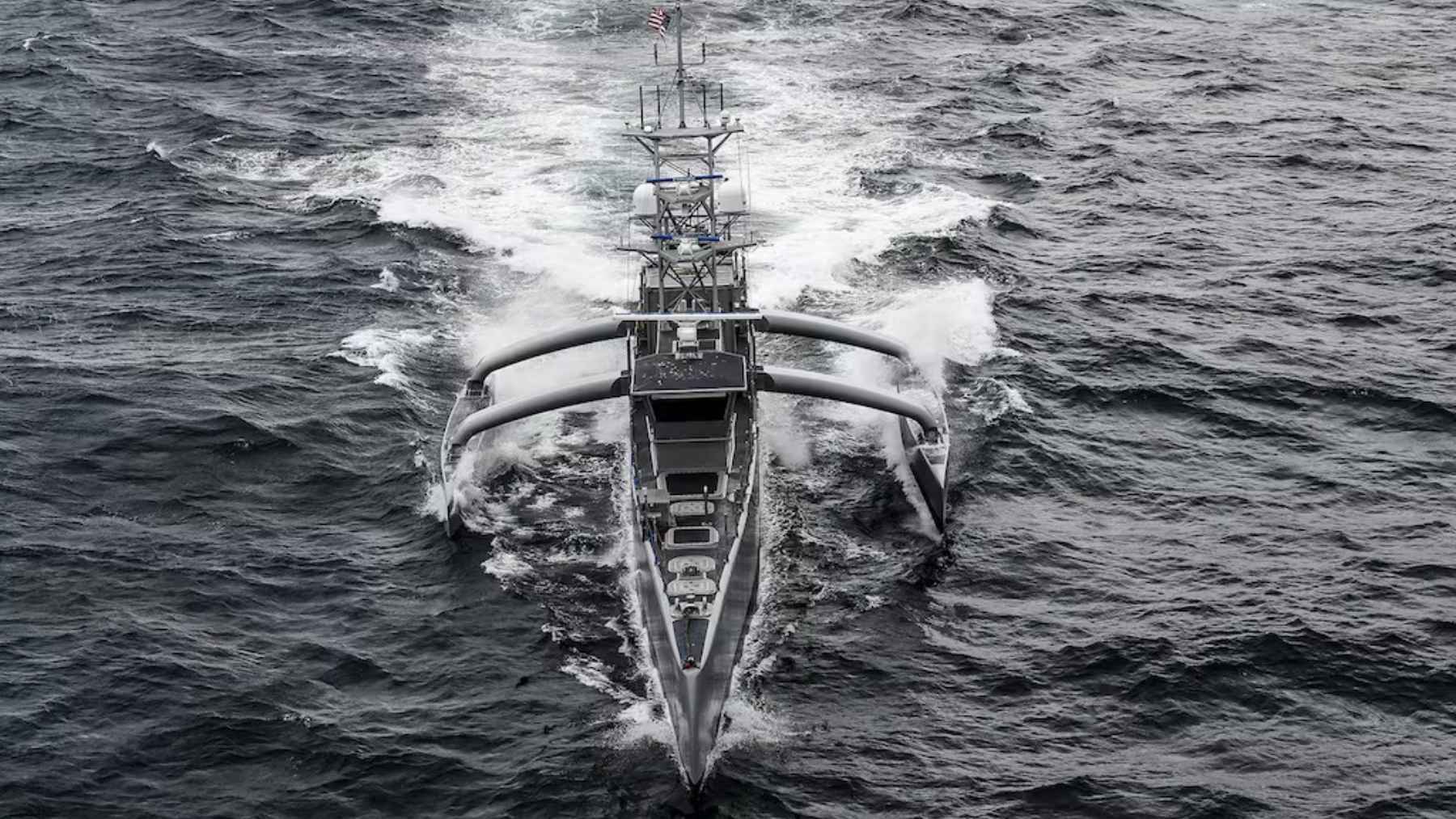
Seahawk is a medium unmanned surface vessel, or MUSV, built by Leidos. And this cruise is a genuine first: no crewless ship of its class has ever gone out as part of a carrier strike group on a regular deployment before. Not tagging along for an exercise. Not running a demo for the cameras. Deployed, as a working piece of the formation.
Bryan Clark, a retired submarine officer and senior fellow at the Hudson Institute, put it plainly to Breaking Defense: this deployment shows these vessels have “progressed from science project to become part of the operational fleet.”
A 135-foot ship with an empty bridge
Seahawk is a composite trimaran, one main hull flanked by two outriggers, roughly 135 feet (41 meters) long and displacing 142.3 metric tons fully loaded. That load includes 14,000 gallons of diesel feeding twin engines, according to Leidos, which is what lets the thing stay out for very long stretches.
There is no galley, no bunks, no coffee maker. Per the company, every mechanical and electrical system aboard was configured to run for months at a time without maintenance or a crew. The bridge-looking structure on top exists for harbor pilots and test personnel, not for anyone sailing it day to day.
The design has DARPA roots. Seahawk is the follow-on to Sea Hunter, the agency’s original submarine-hunting drone ship christened back in 2016, and Leidos folded over 300 lessons learned from that first vessel into this one. The Navy took delivery in April 2021 under a $35.5 million Office of Naval Research contract.
Both ships have logged serious water time since. In 2023 the Navy sent four unmanned vessels, Seahawk and Sea Hunter among them, across the Western Pacific. And the same Leidos autonomy software now runs on a whole family of drone boats, including the crewless attack boat the company has been testing off Australia.
The Navy spent all spring rehearsing this
The deployment did not sneak up on anyone. In February, the Navy’s top officer, Chief of Naval Operations Adm. Daryl Caudle, rolled out a new “Fighting Instructions” framework built around a hedge force strategy: lean on unmanned systems to stretch a fleet that keeps shrinking while the tasking does not.
The service made the Seahawk pairing official at the Sea Air Space exposition in April. When reporters asked Caudle about the Navy’s broader unmanned strategy, he pointed straight at this cruise, and talked up jobs like contested logistics: using crewless vessels to haul food and spare parts between ships so no human has to make the run.
Then came the unglamorous homework. In April, off Southern California, the fleet oiler USNS Guadalupe refueled Seahawk at sea in an astern replenishment, a demonstration Military Sealift Command called “critical” for drone operations alongside carriers, per Naval News. A robot that can’t take fuel underway is a robot that gets left at the pier.
The Roosevelt group worked up off the West Coast with Seahawk in the mix through spring. The carrier departed San Diego on June 15, according to ship spotters tracked by USNI News, and by late June the flagship had pulled into Pearl Harbor, Hawaii, per the same outlet’s fleet tracker.
So what does a robot ship do all day?
The Navy has not published a task list, and it declined to tell Breaking Defense exactly what it wants to test out there. But the analysts who follow this space paint a pretty consistent picture.
Job one is acting as a remote sensor. Clark says the Seahawk’s suite can cover many of the same intelligence, surveillance and reconnaissance jobs as a helicopter, except it never needs to land, can sit much farther out, and carries better communications bandwidth. Park it over the horizon and the strike group sees trouble coming a lot earlier.
Electronic warfare is on the probable list too. So is mine hunting: Stacie Pettyjohn, a senior fellow at the Center for a New American Security, notes the Navy has leaned on allies for minesweeping for years, and recent clearance operations in the Strait of Hormuz were a reminder of how often that job comes up. A drone that handles emergent mine work would earn its fuel.
Weapons are a maybe, later. Bradley Martin, a retired Navy captain who is now a senior policy researcher at RAND, expects the service to study how Seahawk could usefully carry missiles someday, without handing it live kinetic payloads on this run.
And then there is the least glamorous test of all: keeping up. Clark points out that Seahawk has excellent endurance but can’t match a carrier’s speed, so the fleet needs tactics that keep the drone from being stranded during a fast transit. Its predecessor Sea Hunter tops out around 27 knots. A nuclear-powered carrier in a hurry does not wait.
The fleet is stretched thin, and everybody knows it
None of this urgency is mysterious. The carrier Gerald R. Ford came home this spring from a 326-day deployment, a stretch during which it was one of three carrier strike groups operating in the Middle East at once, the first time that has happened since 2003.
Pettyjohn’s read is that unmanned vessels are one of the few levers left to pull: the force keeps shrinking, can’t meet current demand, and runs at a tempo that makes every future requirement harder. One drone ship doesn’t fix that math. Thirty start to.
That is roughly the plan, actually. The fleet anticipates fielding up to 30 MUSVs plus thousands of smaller unmanned craft across the Indo-Pacific by 2030, per Naval News. To get there, the Navy scrapped its old prototype program in March and opened an MUSV marketplace instead: show up with a production-ready vessel that hauls 25 metric tons at 25 knots for 2,500 nautical miles, and you’re in the running.
In May the service picked seven companies to advance to at-sea testing, Leidos among them. Every entrant that passes the demonstrations, due before October, collects $15 million and becomes eligible for production, according to Stars and Stripes. The Navy wants vessels available to lease or buy in fiscal 2027.
It’s not just an American push, either. Australia recently handed the U.S. Navy a containerized drone submarine, and the AUKUS partners just signed a program to field underwater drones guarding the seabed cables that carry the world’s internet. Crewless hulls are landing on procurement lists everywhere you look.
Whatever happens out there changes what the Navy buys
This cruise feeds directly into the shopping list. Clark notes the marketplace deliberately left top-level requirements like speed and endurance loose, so if the deployment shows that refueling a drone strains the group’s vulnerable oilers, the spec sheet changes. Congress is watching too: House lawmakers want proof the Navy has real operating concepts nailed down before it accepts new drone vessels.
Martin doesn’t expect a robot in every strike group right away, though he does think cruises like this one eventually become routine. Which leaves Seahawk in a strange spot for a machine that spent nearly a decade as the Navy’s most photographed experiment. Its job now is to be boring: hold station, take fuel, don’t fall behind, come home with data. For a robot, that’s a promotion.