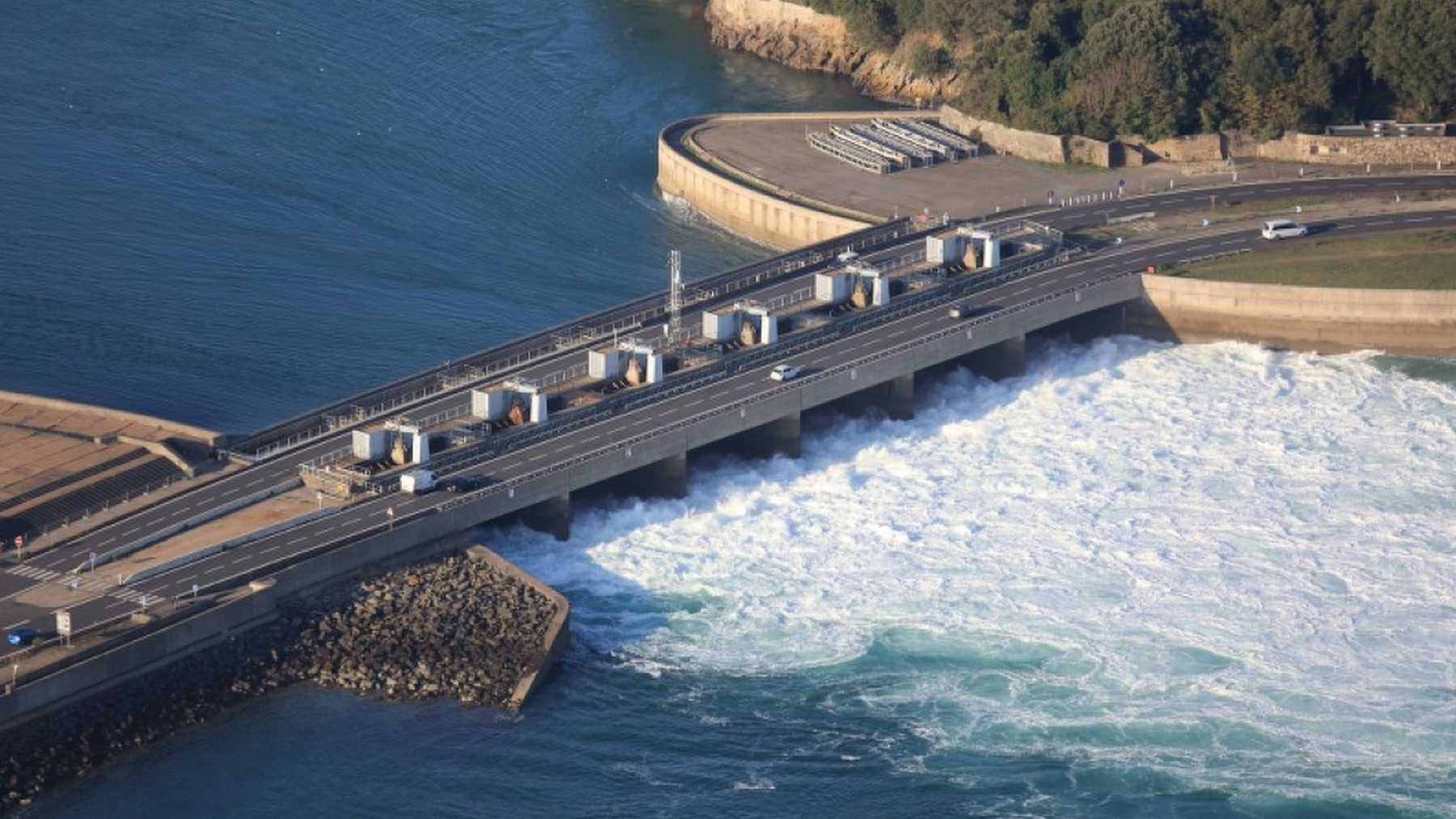
Sixty years ago today, Charles de Gaulle opened a power plant in Brittany that you’d probably drive right over without ever noticing it. That’s because EDF, the French utility that runs it, built the whole thing into a dam across the mouth of the Rance River, between the seaside towns of Dinard and Saint-Malo, and then ran a road across the top.
And plenty of people use that road. EDF’s latest fact sheet on the Rance says about 32,000 vehicles a day cross it on average, with as many as 39,000 in the summer. Down below them, inside a concrete powerhouse 1,280 feet long, 24 turbines sit in the water and wait for the tide.
EDF is throwing the plant a birthday open house on Saturday. It’s also, a little less glamorously, in the middle of taking those turbines apart and putting them back together one at a time, which is pretty much the only way you keep a 60-year-old power plant going.
So how do you make electricity out of a tide?
You need two things, basically. A big tide, and a narrow spot to trap it in.
Brittany’s got the first one covered. EDF says the tidal range in the Rance estuary hits up to 44 feet, which means the water at high tide can sit as much as 44 feet higher than it did at low tide a few hours earlier. That’s roughly the difference between the water lapping at your ankles and the water covering a four-story building.
The plant works a lot like a regular hydroelectric dam that refills itself twice a day. As the tide comes in, EDF opens the gates and lets the estuary fill up behind the dam. Then it shuts everything and waits for the sea outside to drop. Once there’s about 13 feet of difference between the two sides, the water gets let back out through the turbines. That’s where most of the Rance’s electricity comes from.
On the biggest tides, the plant can also generate the other way around, with seawater pouring in through the turbines to fill the estuary. That trick comes down to the machines themselves. EDF calls them bulb units, and the utility says they were designed specifically for the Rance before turning up in hydro plants all over the world.
If you’ve never seen one, picture a steel pod a bit longer than a city bus, parked lengthwise in a big water tunnel. The generator’s sealed inside the pod, and the turbine, which has four adjustable blades, gets spun by the water rushing past. EDF says each unit is 46 feet long, 16 feet across and weighs about 518 tons. Each one’s rated at 10 megawatts, so 24 of them gets you 240 megawatts.
All of that adds up to about 500 gigawatt-hours a year, according to EDF’s page on how the Rance produces power, which the utility says is enough for 225,000 people. If you do the math on 240 megawatts running around the clock, the Rance averages roughly a quarter of what it could make running flat-out all year. That sounds pretty bad until you remember it’s spending a big chunk of every tide just sitting there, waiting for the water on each side to get far enough apart.
What it lacks in output it makes up for in predictability. EDF makes a point of saying the plant’s production is easy to forecast, since the tides are, and that’s arguably the most useful thing about it. As for how much of Brittany it powers, EDF says 8% of the region’s electricity production on one of its pages and 10% on another, so let’s call it somewhere in there.
Why aren’t there more of these?
So if it works, why are there still only two of them running at this scale?
Part of it’s geography. You need a huge tide and an estuary shaped the right way, and there aren’t many places that have both. The Rance was the biggest tidal power plant in the world for 45 years, until South Korea’s Sihwa Lake plant started up with 254 megawatts spread across 10 turbines. EDF now calls its own plant the second largest in the world, and its fact sheet says it’s one of only two that make electricity from the tides on an industrial scale.
The other part is that damming an entire estuary is a pretty big deal. The Rance dam has a lock 213 feet long that handles about 12,500 boats a year, and the road bridge over the lock lifts on the hour, for up to 15 minutes, whenever boats need to get through. Sediment’s enough of an issue in the estuary that EDF has a steering committee for it. So if you’re one of those 32,000 drivers, you’re probably going to end up waiting on a sailboat at some point. On top of a power plant.
We’ve covered a few plans to do something similar elsewhere, like the proposed Mersey tidal barrage with its own wall of turbines and ship locks. They’re all still on paper. The Rance has been doing it since before the moon landing.
EDF is rebuilding the plant one turbine at a time
Six decades of salt water is rough on anything made of steel, and EDF has been working through the plant piece by piece. Its most recent big job was a complete rebuild of one of the 24 units, a machine called E17, on a 19-month schedule that was due to wrap up in May of last year. EDF said E17 was the fifth unit it had fully renovated in a little over a decade.
The whole unit sits underwater, and EDF’s announcement of the work said taking it apart would take six months on its own. The heaviest piece is what EDF calls the “moulinet,” which is more or less the spinning runner assembly. It weighs about 96 tons, and it’s 23 feet long and up to 10.5 feet across. EDF sent it out on a 59-foot convoy for a three-mile trip by road to its own workshop in Dinard to be rebuilt. Sixteen EDF employees worked on the teardown full time, with around 50 outside partners on top of that. The job cost €6.7 million. That’s about $7.5 million.
Here’s where it gets impressive. As far as I can tell, the plant didn’t stop for any of this. With E17 in pieces, EDF said it was hoping to produce 520 gigawatt-hours that year, a little more than its usual 500.
The electrical side got its own overhaul. About eight years ago, the engineering contractor Actemium took on a job renovating all 24 generators, and the plan was to work through them two at a time, in three batches of eight, while the plant stayed online. That’s according to The Agility Effect, a magazine put out by Actemium’s parent company, VINCI Energies.
Then there’s the money. EDF put €30 million (a little under $35 million) into the site over the six years ending this year, and Le Journal des Entreprises reports that budget covered two generating units, a transformer and a dam gate. The same paper reported this year that the plant got another €10 million (around $11 million) last year and has €60 million (close to $70 million) more earmarked through 2032.
What I can’t find is a firm commitment from EDF to give every one of the 24 units the full E17 treatment. I also couldn’t track down an official date for when E17 itself went back into service. There’s money set aside through 2032, but I haven’t seen a published schedule for which unit comes out of the water next.
You can go inside on Saturday
EDF’s been running a whole year of 60th-birthday events under a slogan that translates to “the energy of the Bretons for 60 years,” which is a pretty sweet thing to be able to say about a dam. The plant’s visitor center already pulls in more than 30,000 people a year. We went through more of its history, including the six years it took to build, in our July look at France’s tidal plant and where US tidal power stands.
The open house is this Saturday, Nov. 28, when EDF opens the inside of the plant for free guided visits. You’ll need to register ahead of time, and EDF says visitors have to be at least 8 years old.