
- 4 MONTHS AGO · INDUSTRYA 380-ton German machine 335 feet long threads a steel chain under a live railway, drags the stone out from beneath the crossties like a chainsaw laid flat, washes it and drops it back in behind itself, and never takes the rails apart
- 1 MONTH AGO · INDUSTRYA 200-foot-wide bridge of dirt and grass carries elk and pronghorn over six lanes of a Colorado interstate that 100,000 vehicles cross a day, and in the 10 months since it opened drivers below have hit two animals, on a stretch that logged 32 wildlife crashes a year
- 3 WEEKS AGO · INDUSTRYA 22-foot-wide shaft just hit 5,265 feet straight down through the rock 22 miles west of Sudbury, deep enough to stack more than three Empire State Buildings inside it, and it still has about 840 feet to go at a copper and nickel mine that won’t be finished until the middle of next decade
- 1 DAY AGO · INDUSTRYA 984-foot sunken coral atoll, about 5 million years old, sits 2,950 feet down on a volcanic ridge in the mid-Atlantic, where no atolls exist today, and an underwater drone mapped it before a remote-controlled sub went down to film its top
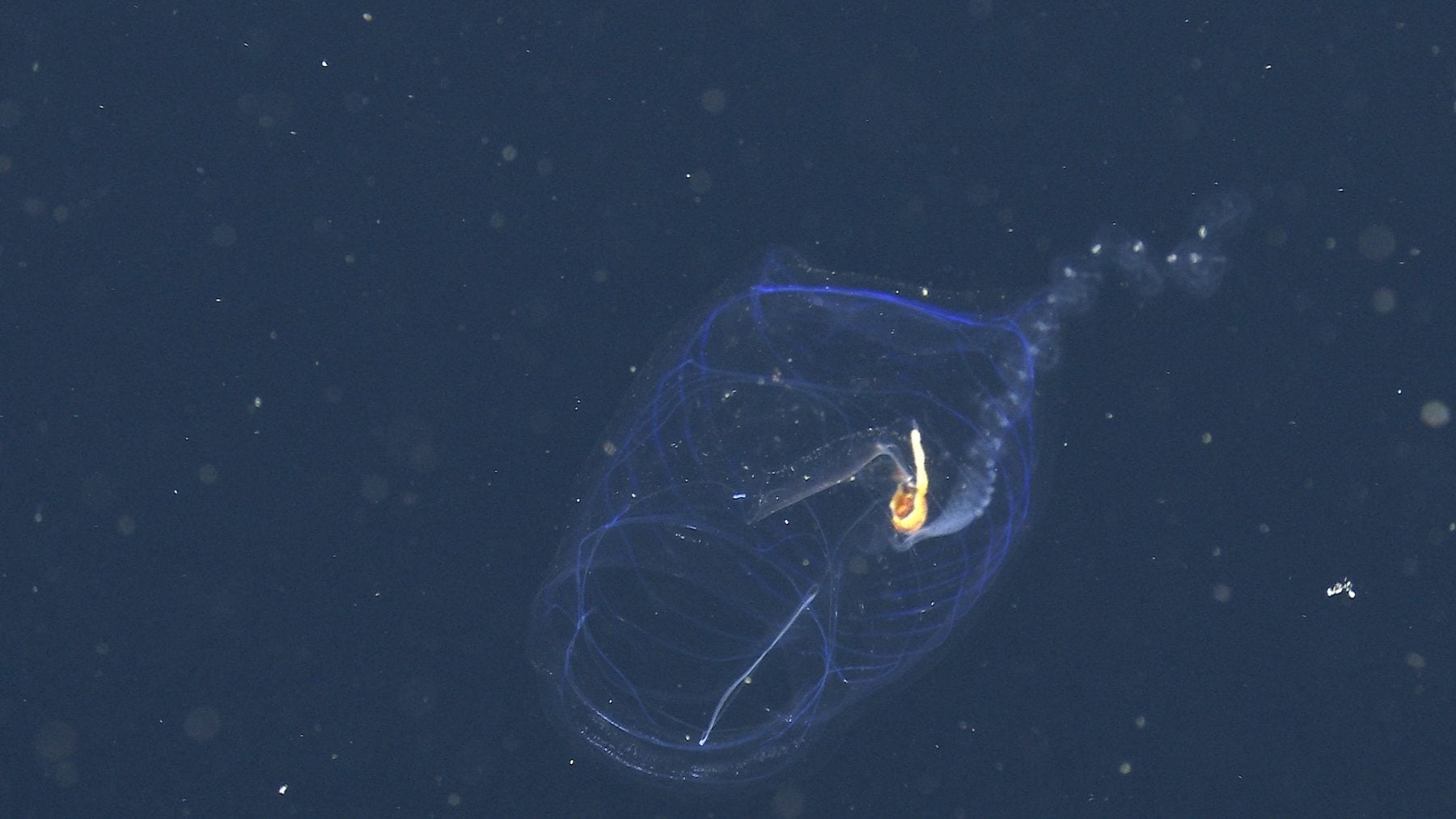
- TODAY · THIS ARTICLEA see-through animal that tows a chain of up to 20 clones of itself has been drifting 920 to 7,200 feet down off California for more than two decades, and after thousands of remote-controlled sub sightings scientists have finally named it the first salp that lives only in the deep sea
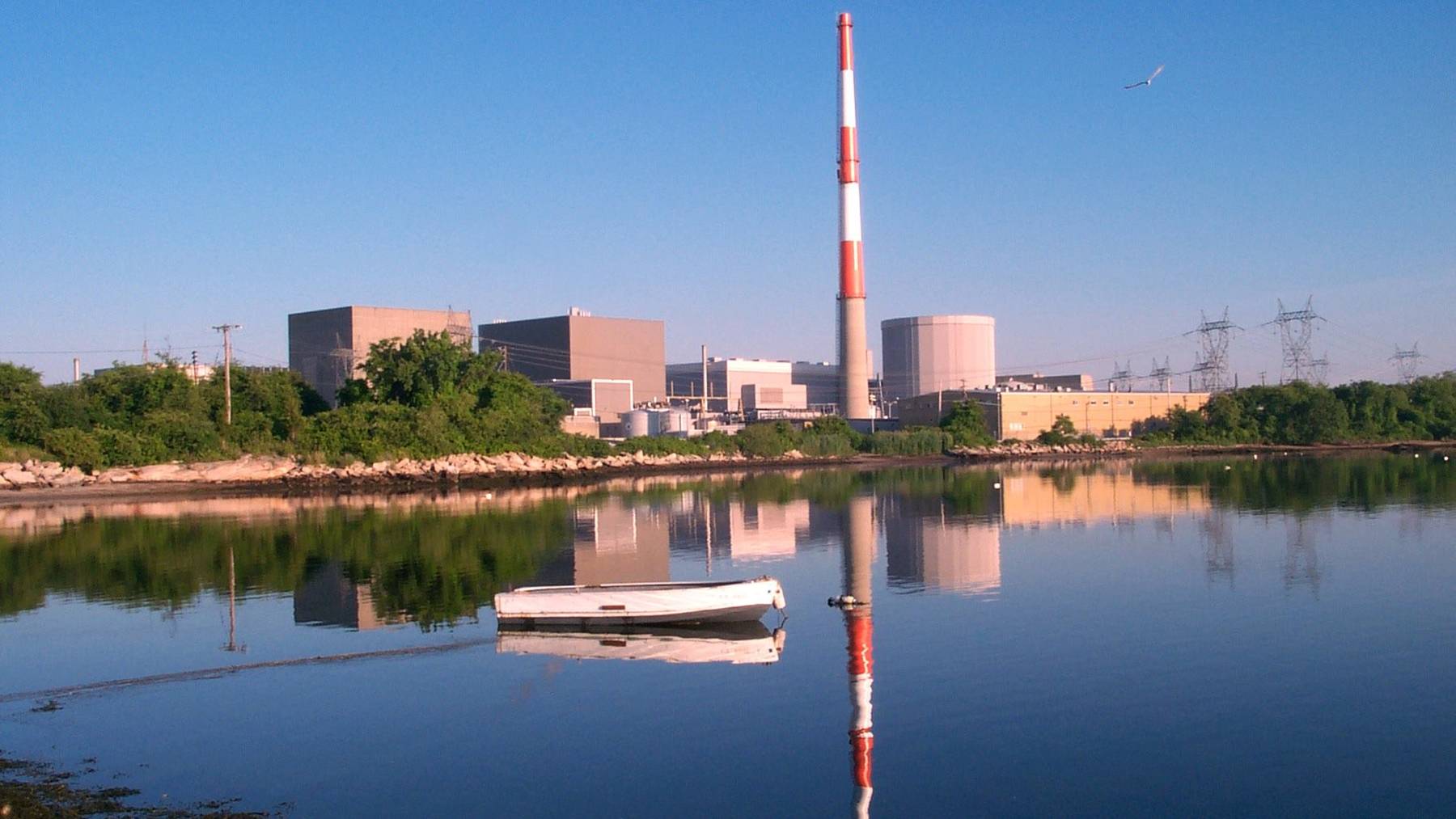
If the word “salp” rings a bell, it might be because of Diablo Canyon. A swarm of them once clogged the seawater intake at California’s only operating nuclear plant, and operators had to shut a reactor down by hand late at night. We went through the whole Diablo Canyon salp saga last week.
Those were shallow-water salps, the kind that show up near the coast in big numbers. The one MBARI (the Monterey Bay Aquarium Research Institute) just announced is a different animal entirely, and it lives a lot farther down.
It’s called the glass salp, or Vitreosalpa gemini if you want to get formal about it. According to MBARI’s announcement, it’s the first salp anyone knows of that spends its whole life in the deep sea, somewhere between 920 and 7,200 feet below the surface. Researchers first came across it in Monterey Bay over two decades ago. It only got an official scientific name a couple of months back.
So what is a salp, exactly?
Salps are barrel-shaped, see-through animals that drift around the open ocean pumping water through their bodies. That pumping pushes them along, and it also runs water across a sticky mucus net that strains out food. Basically, for a salp, getting around and getting lunch are the same job.
Most people who see one in a photo assume it’s a jellyfish. It isn’t. Salps are tunicates, which puts them in the same phylum as you and me (Chordata), while jellyfish sit on a completely different branch of the animal kingdom.
They’re usually small. The Woods Hole Oceanographic Institution puts single salps at anywhere from under half an inch to about 8 inches long, though a chain of them can stretch out for several yards.
That chain is the weird bit. A salp’s life flips back and forth between two forms. A solitary salp clones itself into a chain of linked individuals, and those chain members reproduce sexually to make the next solitary. It sounds like the plot of a low-budget sci-fi movie, but for a salp it’s just Tuesday.
MBARI has been watching this one for a while
The formal description comes from Larry Madin, deputy director emeritus at the Woods Hole Oceanographic Institution and an adjunct at MBARI. His paper in Marine Biodiversity names a new genus as well as a new species, so Madin didn’t just slot the glass salp in next to its relatives. He had to give it a branch of its own.
MBARI says its remotely operated vehicles have racked up thousands of sightings of the animal in Monterey Canyon, the Pacific Northwest and the Gulf of California. The same robots brought specimens back for morphological and molecular analyses, which is science-speak for studying its body in detail and reading its DNA.
If you’ve never come across an ROV, it’s basically an underwater robot on a very long leash. It stays tethered to a ship, and pilots up top drive it while watching its cameras.
So how do you keep seeing an animal for two decades and not give it a name?
Part of the answer is how delicate salps are. MBARI points to two problems: salps are fragile, jelly-like animals, and this one lives a very long way down. On top of that, the glass salp’s tissue is very watery, which MBARI says is common among deep-water tunicates. A net dragged up from thousands of feet down isn’t exactly gentle, and an animal that’s mostly water doesn’t tend to survive that trip in one piece. A robot that can film it where it lives and bring a specimen up intact is pretty much the only way to get a good look.
The other part is that naming species is slow work everywhere. A team led by Benoît Fontaine at France’s National Museum of Natural History looked at 600 species described in a single year and found it took an average of about 21 years to get from first collection to formal description. They also pointed out that taxonomists usually wait for more than one specimen before going public. Marine species tended to get named a bit faster than land species. Still, at a little over 20 years, the glass salp is arguably right around average.
MBARI apparently knew it had something for a long time, too. Its online Deep-Sea Guide has had a Vitreosalpa page for a while, with a note warning that it “may not be an official taxonomic name.” Now it is.
What I can’t tell you is how big a glass salp gets. MBARI’s announcement doesn’t give a size, and I couldn’t get a look at the full paper to check. MBARI also talks about its remotely operated vehicles in general terms, so I can’t say which ones did the collecting. I’m not going to guess.
The glass salp does family life a little differently
MBARI’s robots have seen glass salp chains of up to 20 individuals. The solitary form appears to keep producing new chains nonstop and tows them along behind it while they’re still attached. Each clone in that chain is a sequential hermaphrodite, which means it starts out female and makes eggs, then switches to male and makes sperm.
Then there are the twins. The chain form of the glass salp produces twin embryos, and MBARI says that’s rare among salps. The institute’s suggestion is that it might be a way to get twice the offspring out of every chain member, down where there just aren’t many glass salps around.
Frankly, that makes a lot of sense. If you’re a slow, mostly transparent animal drifting around a few thousand feet down, you probably don’t bump into a lot of your own kind. And if your high school Latin is as rusty as mine, “vitreo” points to glass and “gemini” means twins, which is presumably a nod to exactly this trick.
Everything about it runs in low gear. MBARI says the glass salp is a slow swimmer, and it eats and burns energy at a much lower rate than its relatives near the surface. Since it lives in the twilight zone, where a little sunlight still filters down, and the midnight zone below it, where none does, there’s no living phytoplankton to eat. So it gets by on detritus (bits of dead material and waste sinking from above) and single-celled critters called protozoans.
Salps are a pretty big deal for carbon
Surface salps eat phytoplankton, the tiny plant-like organisms that soak up carbon dioxide near the surface, and Woods Hole says that leaves salp poop packed with carbon. When a big salp bloom crashes, MBARI says that boom-and-bust cycle can move carbon down to the abyssal seafloor pretty quickly.
Does the glass salp do any of that? MBARI hasn’t said, and since it eats leftovers rather than fresh phytoplankton, I’d guess its role is a bit different from that of its surface cousins. That’s my guess, though, not the institute’s.
Madin’s own take is that every trip into the deep ocean reminds researchers of “how little we know about the largest living space on the planet.” I’d say that’s putting it mildly. MBARI says its gear has turned up more than 300 species nobody had described before, and if an animal that shows up thousands of times on camera can wait two decades for a name, you have to wonder what’s down there that nobody’s filmed yet.
MBARI has untethered robots out there too. We recently covered MBARI’s underwater drones docking with a wave-powered buoy off California, and that kind of long-term, hands-off monitoring is probably what it’ll take to keep tabs on animals this hard to reach.
So the glass salp is officially on the books. Madin’s description went online in Marine Biodiversity on September 17, and MBARI announced it on November 24, more than 20 years after researchers first spotted one in Monterey Bay.
 An 81,000-ton concrete box lying in a trench on the Baltic seabed has a damaged rubber seal on its open end, and the next box going down, a 23,000-ton one with a basement and as tall as a four-story building, has to wait until it is fixedIndustry · 4 hours ago
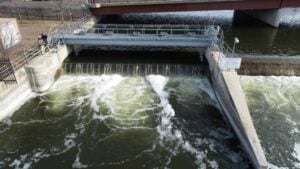 A dam on the Fox River outside Chicago with a 9-foot spillway and a 50-foot hinged steel gate was hit by an apparent cyberattack, and the state cut off access and kept it holding back an 849-acre pool while state police and federal investigators moved inIndustry · 19 hours ago
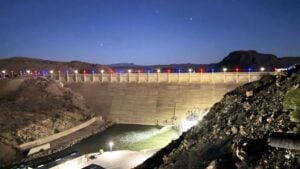 A 301-foot dam on the Rio Grande now has about 112 feet of water against a wall built for 197, up from 66 in September, after the river poured about 2.5 billion gallons into the lake in a single day while the dam let out almost nothingIndustry · 20 hours ago