
- 3 MONTHS AGO · ENERGYAn 86-ton borer has cut the hole that will take a 27-ton canister of spent nuclear fuel, 27.6 feet deep and 5 feet 9 inches wide in granite that formed 1.9 billion years ago, and it is allowed to wander less than an inch off vertical the whole way down
- 3 MONTHS AGO · ENERGYWater boils at 202 degrees in Denver because there is a mile less air pressing on the pot, and a concrete building in eastern Washington takes that much further, boiling radioactive tank waste at 125. One run freed up 353,000 gallons of room underground
- 3 MONTHS AGO · ENERGYA californium wire under a tenth of an inch thick, rolled out on a jeweler’s mill, is what wakes up a new American reactor, and a microgram of it throws 2.3 million neutrons a second. One lab makes all of it, and one swapped molecule just halved the cleanup
- 4 WEEKS AGO · ENERGYA 759-megawatt reactor in South Carolina failed an ultrasound check on the pipe elbow between its pressurizer and one of its three safety valves with all 157 fuel assemblies out of the core, and it won’t restart until the steel is fixed, six months after getting cleared to run to 80
- TODAY · THIS ARTICLEA hole about a tenth of an inch wide in an underground pipe elbow at Honolulu’s trash-burning power plant let up to 403,000 gallons of fuel oil seep into the ground for months, and with 22 wells pulling back 30 to 50 gallons a day, the cleanup could take 20 years
Most of us have dealt with a slow leak at some point. Maybe it was a tire that kept losing a couple PSI overnight, or a radiator hose that left a little puddle on the driveway. You find it and fix it, and that’s pretty much the end of it.
Honolulu’s slow leak didn’t go like that. A hole about a tenth of an inch wide opened up in an underground fuel line at the city’s trash-burning power plant in Kapolei, and by the operator’s own estimate, up to 403,000 gallons of No. 2 fuel oil seeped into the ground before anyone caught it. Nearly seven months after the leak was found, crews are pulling it back out at roughly 30 to 50 gallons a day.
If you’re wondering what No. 2 fuel oil is, it’s basically the same middle-of-the-barrel distillate you’d put in a diesel truck. The two names mostly describe different jobs for very similar fuel, which is why the city’s own updates keep calling it diesel.
H-POWER burns most of Oahu’s trash
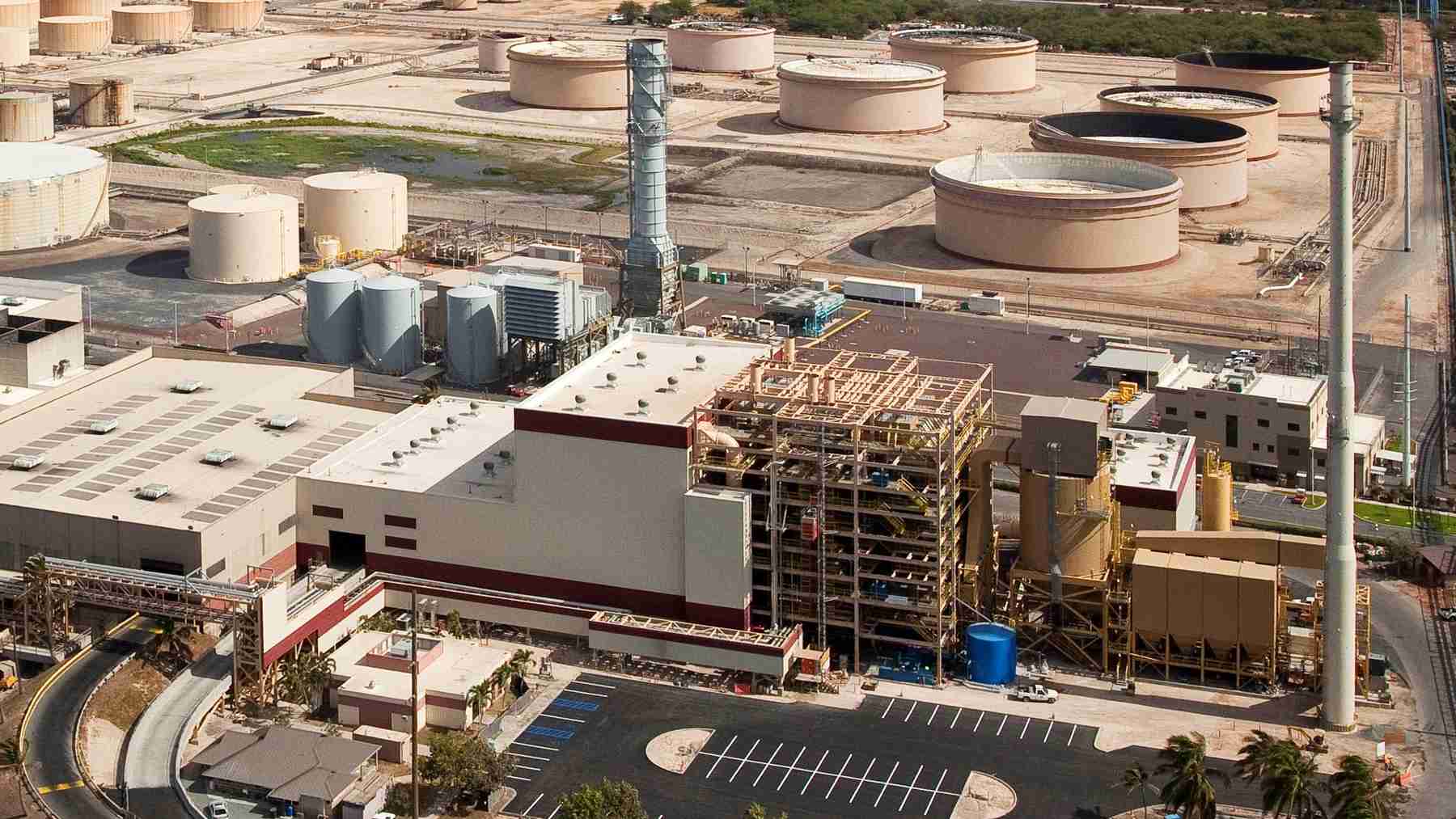
The plant is H-POWER, short for Honolulu Program of Waste Energy Recovery. It’s owned by the City and County of Honolulu, it sits in Campbell Industrial Park, and it’s been running since 1990. According to the city’s Department of Environmental Services, it burns about 2,000 tons of garbage a day and produces up to 10% of Oahu’s electricity, which the city says is enough for 60,000 homes.
The city doesn’t run it day to day, though. That job belongs to Reworld, the company you may know by its old name, Covanta, under a contract with the city.
Reworld has told local TV the hole was smaller than a dime. That’s true, but it kind of undersells things. A dime is about seven-tenths of an inch across, and this hole works out to just under 0.1 inches, so it’s a bit wider than the lead in a pencil. It was in an elbow, one of the bends in the line, and specifically the second elbow once crews had pulled the pipe out of its trench.
When the hole was found depends on which document you read. The city’s November 19 summary puts it on June 9. A Reworld summary included in the governor’s November 24 briefing packet says May 12. I couldn’t find anything in either one that explains the gap.
The leak itself showed up on May 4. A shift supervisor noticed the tank levels didn’t match from one day to the next, then spotted staining around the supply line where it went underground. The line was shut down, the state Department of Health got a call, and the release was reported to the National Response Center on May 5. At that point, Reworld figured it was dealing with about 6,500 gallons. On July 9, the estimate it gave the Health Department jumped to somewhere between 200,000 and 400,000 gallons.
So how does a hole that small let out that much fuel?
Time, mostly. Reworld estimates the leak started in late January and ran until May 4. If those dates are right, that’s something like 4,000 gallons a day for about three months, by my math, all of it going straight into the ground where nobody could see it. Now compare that with the 30 to 50 gallons a day coming back out.
So how do you get fuel back out of the ground?
Fuel oil is lighter than water, so when it soaks down to the water table, it tends to sit on top as a floating layer. Environmental crews call that layer “free product,” and it’s the easiest stuff to get back, because you can skim it.
That’s where the 22 wells come in. They’re monitoring wells, which are basically narrow holes drilled down to the groundwater and lined with a slotted pipe, so you can measure what’s down there and take samples. Reworld drilled the first six in early June and kept adding more through September. Fuel has been found in 15 of them, according to Reworld’s November 13 summary in the governor’s packet, and in 16 according to the city’s November 19 summary.
The same wells double as the recovery system. Now, about those 30 to 50 gallons, since the headline crams a lot into one line. That figure is the total for the whole operation, per a November 23 city update. It isn’t 30 to 50 gallons per well, and it isn’t 22 wells all pumping away.
The city says product removal happens daily at every well where fuel has turned up, and the setup varies. An automated skimming system has been running at the original six wells since August 17. Six other wells have passive canisters and absorbent socks soaking up what they can. An automated system for three more wells is planned for November and December, so you’d expect the daily number to climb at some point.
As of November 23, the city said about 5,500 gallons had been recovered, up from about 4,600 on November 11. That’s roughly 1.4% of the 403,000-gallon estimate. Averaged over the 167 days since daily recovery started on June 9, I get about 33 gallons a day.
Where does 20 years come from?
It comes from dividing one number by another. Hawaiʻi Public Radio ran it on November 25 and landed on at least two decades, and that’s a fair reading of the current rate. At 50 gallons a day, 403,000 gallons takes about 22 years. At 30 gallons a day, it’s closer to 37.
That’s a calculation on today’s pace. None of the agencies or companies involved has put an end date on the cleanup. The governor’s packet describes a multiyear effort with no completion date, and Reworld is working on a conceptual site model for December and January, then a conceptual cleanup design in the first quarter of 2027.
Honestly, I’d be a little surprised if either number holds. The pace should pick up once more automated systems come online, and the state’s health director seems to think it could already be faster. “I don’t know why they’re only able to recover 30 to 45 gallons a day,” Dr. Kenny Fink told Hawaiʻi Public Radio, adding that the oil is near the surface. Then again, from what I understand, skimming wells rarely get every last drop. Some fuel tends to stay stuck in the soil and rock, and that’s what the longer-term remediation design is supposed to deal with, so it’s safe to assume the cleanup won’t be 20 years of skimming at the same rate.
Mayor Rick Blangiardi has said Reworld privately put the cleanup cost “well north of $50 million.” Reworld says it’ll pay for it.
Is anyone’s drinking water at risk?
Not right now, according to the Health Department, the Honolulu Board of Water Supply and the governor’s office. That’s the good news, and it’s a pretty big deal on an island where the Navy’s Red Hill jet fuel leak is still fresh in people’s minds.
Where spilled oil ends up tends to matter more than how much of it there is. We saw that with a cracked oil cooler at Idaho’s Dworshak Dam, which let bearing oil into a river two miles upstream of a steelhead hatchery.
On Oahu, H-POWER’s location helps. Hawaii’s Health Department draws a boundary across the island called the UIC line, short for underground injection control. Groundwater on the inland side is treated as a drinking water source, and groundwater on the ocean side generally isn’t, since it tends to be brackish that close to the coast. H-POWER sits on the ocean side.
The nearest drinking water well is about 4.5 miles inland, to the northeast, and the city describes it as upgradient, which basically means groundwater flows from there toward the plant and not the other way around. The proposed Kalaeloa seawater desalination plant would sit a little over a mile away, but it would draw from a deep saltwater aquifer through wells more than 1,000 feet deep, and the city rates the risk to it as very low.
The fuel has moved, though. The city says the plume has spread off the H-POWER property to the west and south, and it still needs to be mapped, both on and off the site. Hawaii News Now reports the plant is about 1,600 feet from the shoreline, and officials say there’s no evidence the fuel has reached surface water.
The plant’s still running. The city says the underground line has been taken out of service and replaced with an aboveground connection, which, frankly, is the fix I’d have picked too. A pipe you can walk past and look at is a lot harder to lose 400,000 gallons from.
The politics caught up fast once the city went public on November 19. Gov. Josh Green signed an executive order on November 24 requiring the Health Department to report any oil release right away, whatever the size, and set up a review committee with a preliminary report due within 30 days. Roger Babcock, Honolulu’s environmental services director, resigned on November 25.
The next solid numbers should arrive fairly soon. The city says a Deloitte forensic audit meant to build a more precise timeline of the leak is expected in early December, and Reworld’s longer-term remediation plan is due in early 2027.
 A 726-foot dam on the Colorado River has 582 miles of 1-inch steel pipe buried in its concrete, laid there so a plant making 1,000 tons of ice a day could pump cold water through it, because poured in one piece the wall would have needed 125 years to coolEnergy · 2 hours ago
 3,400 solar panels float on a highway stormwater pond in Orlando and rise and fall with every Florida downpour, split into one array facing south and one facing east and west, and the city utility won’t let them cover more than 80% of the waterEnergy · 6 hours ago
 A 1,250-megawatt reactor on the Connecticut shore had to stop its climb back from refueling at 5:07 a.m. and cool below 350 degrees, because one of the two pumps that pull heat out of its core in an emergency couldn’t be brought back into service inside the 72 hours its license allowsEnergy · 8 hours ago