
Whatever heats the building you are sitting in almost certainly burns something. Natural gas usually, oil if the boiler is old enough, wood chips if somebody on the city council got ambitious.
Somewhere in the arrangement there is a flame. A French company called Calogena has spent five years designing a machine to stand in for that flame, and the strange part is how deliberately unimpressive it looks on paper.
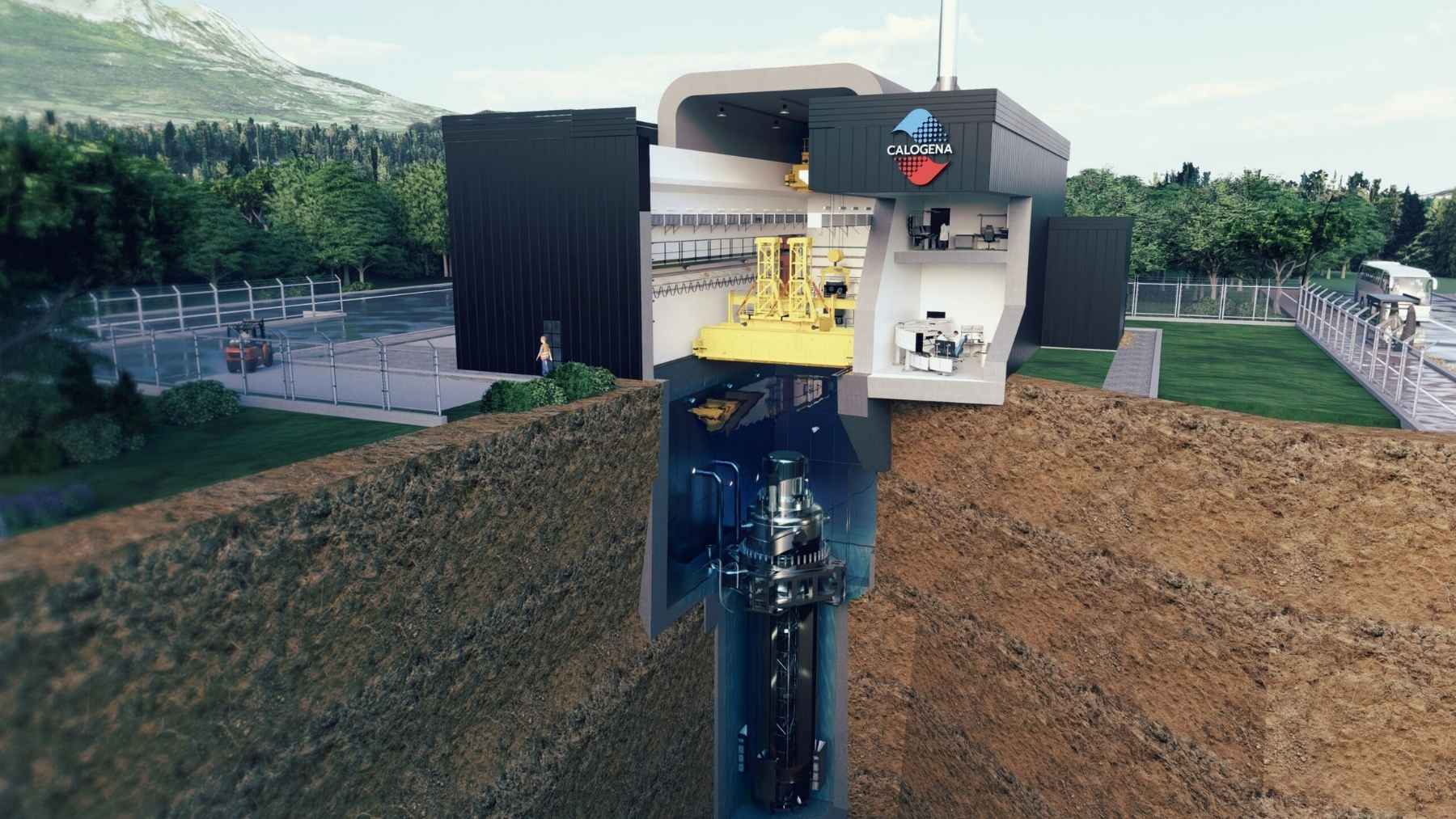
The design is called CAL30. It is a water-cooled reactor rated at 30 megawatts of thermal output that makes no electricity at all, and it is built to sit inside a city and push hot water into the same pipes a gas boiler would have fed. Calogena’s published specification puts one module at 20,000 households.
France’s nuclear regulator refreshed its small-reactor tracker on August 18. CAL30 sits exactly where it sat in the spring: pre-licensing, five documents filed, and no application to build anything.
The pitch is a list of things this reactor refuses to do
Start with what is missing. No turbine, no generator, no grid connection, and no heavy pressure hull, because nothing inside the machine is being held at high pressure in the first place.
Calogena puts the operating pressure at 6 bar, about 87 psi, and the comparison the company reaches for is a bicycle tire. That is not marketing license. A road bike tire runs somewhere between 80 and 100 psi.
Temperature is the other half of it. The reactor works at around 212 degrees Fahrenheit, which is water boiling in a pan on your stove.
The big French power reactors run near 2,250 psi and above 572 degrees. Every bit of that difference is steel, pumps, redundancy and paperwork somebody has to pay for.
The lineage is not exotic either. Calogena describes the concept as a descendant of pool-type research reactors, of which hundreds have operated worldwide, and rates CAL30 at 150 times less powerful than a conventional reactor.
The core is under one cubic meter. The site is about 32,000 square feet of land, roughly three quarters of an acre, with under 11,000 square feet of buildings on it. Call it a supermarket with a small yard.
The money closed in April, and the newsroom has been quiet ever since
On March 10, Calogena said the French state program France 2030 was lifting its support to a 48 million euro grant covering the basic design. That sits on top of the 5.2 million the company won back in 2023, in the first phase of the same competition.
A capital increase followed. Groupe Gorgé, the industrial group that owns Calogena, reinvested and kept majority control, while Snef, Banque des Territoires and the state-backed Deep Tech 2030 fund managed by Bpifrance came in as new shareholders.
Together with the grant, that took the total to nearly 100 million euros. Chief executive Julien Dereux said the money buys “visibility for more than two years,” and that by 2028 the company expects to have finished the basic design, filed its construction authorization application for the first unit, and won its first commercial customers in France and Europe.
One announcement has landed since. On June 4 in Prague, Calogena and Veolia signed a one-year memorandum to study dropping the reactor into district heating networks across Central and Eastern Europe. That is still the newest item on the company’s press page.
France’s regulator has been reading the same file since 2024
This is the part that sets the real schedule. The Autorité de sûreté nucléaire et de radioprotection publishes a table showing where every French small reactor project stands, and it was last updated on August 18.
Calogena filed its safety options request on October 31, 2024, amended it on June 20, 2025, then sent three more on December 23, 2025, January 6, 2026 and May 11, 2026.
Five documents in a year and a half, all of them still inside stage three of four. Stage four is the one where you actually ask to build something.
Jimmy, the other French outfit selling reactor heat, is already there, and even that has been slow going. It applied in May 2024, got a request for more information in February 2025, and only handed back a redesigned file on July 23 of this year.
The two machines are not chasing the same customer. Jimmy runs helium at 1,382 degrees to sell process steam to a sugar mill. Calogena wants to make water hot enough for a radiator and nothing beyond that.
Which is why the 2028 target is worth watching. A construction application has to be written, filed and accepted inside roughly two years, starting from a file that is still answering questions about safety options. Not impossible. Not comfortable either.
China has been heating whole cities this way for six winters
None of this is theoretical, which is easy to forget in a story full of renderings. The Haiyang plant in Shandong province has been pushing heat into municipal pipes since 2019 under the name Nuanhe-1.
By its sixth heating season it covered close to 140 million square feet of floor area. State operator SPIC has said the scheme serves 400,000 households across Haiyang and Rushan, with a third city, Rongcheng, connected in November 2025. Heating capacity has climbed from 31.5 megawatts to 1,134.
The catch is the machine doing the work. Haiyang runs two full-size AP1000 power reactors, and the heat is a byproduct skimmed off the secondary circuit and walked into town down a long pipe.
Those reactors were built where reactors get built, which is not next to anybody’s apartment block. Calogena is arguing the opposite case: rather than put something enormous outside the city and run the pipe in, build something small and cold enough that the pipe barely has to run at all.
A Finnish company is making a version of the same bet with a reactor designed to feed city pipes at 302 degrees and the pressure of four car tires. Calogena is colder and lower still, and the two are partners as much as rivals. Their joint CityHeat project was picked by the European Commission for the bloc’s SMR industrial alliance in 2024.
The fuel is the least interesting thing in the building, on purpose
Most advanced reactor pitches come with a fuel problem attached. New particle shapes, higher enrichment, a fabrication line that does not exist yet, and a decade of waiting for somebody to build it.
Calogena went the other way. It picked the rod-type fuel French power plants already run, cut shorter, with pellets enriched to 3.4 percent and the same structural hardware used in the existing fleet.
Refueling, the company says, means one truck every two years. Orano agreed in November to adapt a used-fuel transport cask it already sells commercially so it fits CAL30’s shorter rods.
That is a boring set of decisions, and boring is the strategy. Every component Calogena does not have to invent is a component the regulator does not have to learn.
America has more than 660 of these networks, mostly on campuses
District heating sounds European until you look up what is already buried under American ground. A Department of Energy fact sheet citing the Energy Information Administration counts more than 660 district energy systems in the United States, one in every state, heating an estimated 5.5 billion square feet of floor space in the 2012 data it uses.
They are mostly not downtowns. They sit on college campuses, hospital and research campuses, military bases and airports, plus the central business districts of cities including Boston, Philadelphia, Denver and Minneapolis.
Which is roughly the load one CAL30 module is drawn around. A big university with a medical center attached is not a wild distance from 20,000 households of heat.
None of that means this is coming here. Calogena’s five projects are in France and Finland, its Nordic push is aimed at Kuopio, where the city’s heating utility invited it into an environmental review covering three modules, and the company has said nothing about the United States.
The American version of the shrinking-reactor idea has gone somewhere else entirely, toward machines like the Westinghouse unit you can move on a truck, which still makes electricity. Calogena is not shrinking a power plant. It is deleting one.
What it has, and what it does not
On the asset side: a finished preliminary design, most of a hundred million euros, siting studies under way at the CEA’s Cadarache research center in southern France, an invitation into a Finnish environmental review, a fuel choice that needs no new supply chain, and partnership deals with Orano, Škoda JS and Veolia.
On the other side: no construction licence, no signed customer, no concrete poured, and a regulator that has been working through safety options for close to two years. The 2030 date on the company’s own website assumes every one of those resolves cleanly.
And the number that decides this is not on the spec sheet anywhere. A gas boiler is cheap, understood and legal in every city on the continent.
A reactor that runs at bike tire pressure has to beat that on the price of a delivered unit of heat, sold to a city council rather than an energy trader. Everything else about CAL30 is an engineering choice. That part is arithmetic.
 @iaingold ROOKIE2 months ago