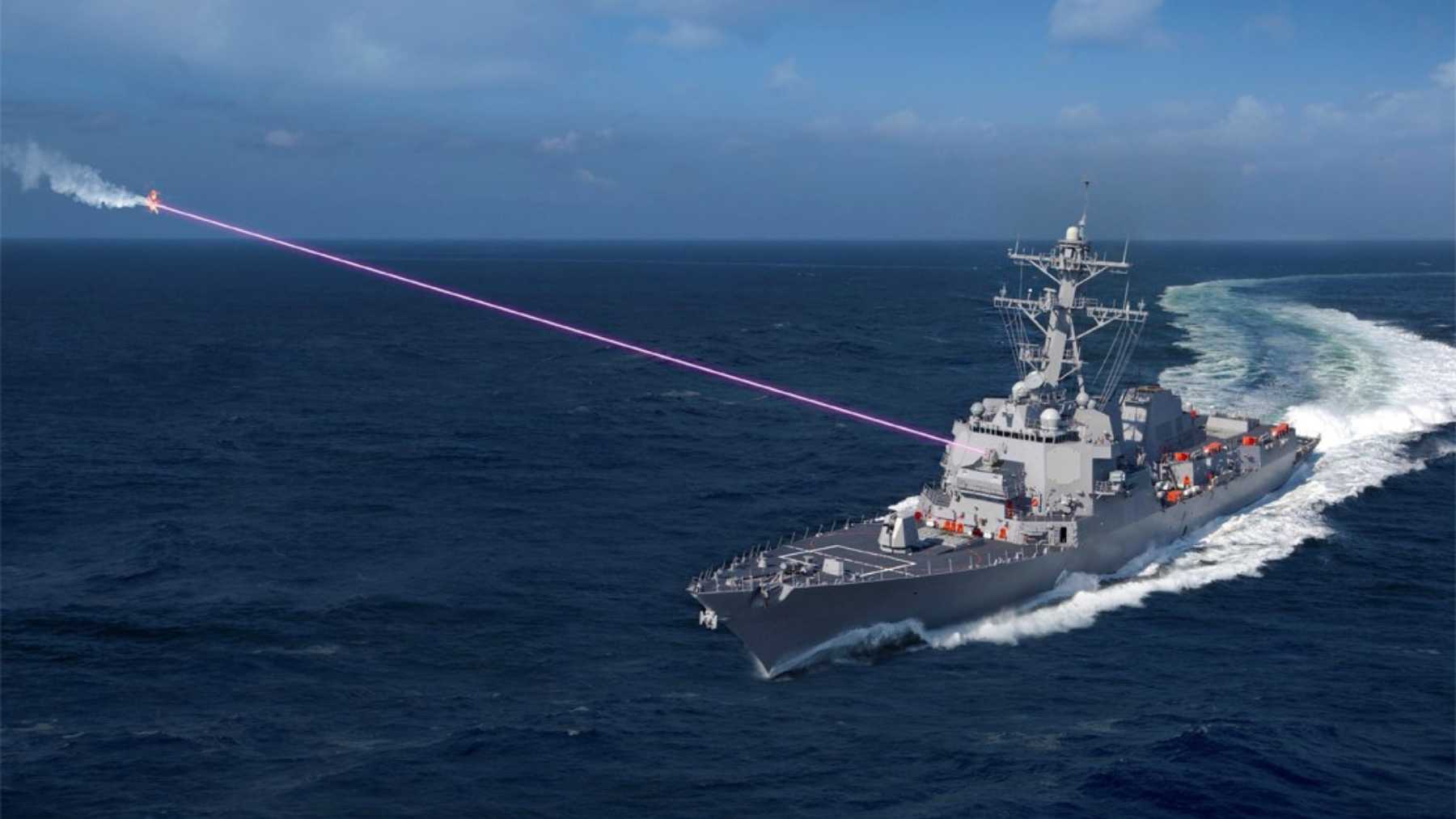

The argument for laser weapons has not changed in about forty years. Electricity is cheap, interceptor missiles are not, and a beam keeps shooting for as long as the generator keeps turning. What changes is the power figure, and on July 9 it jumped.
The U.S. Department of War awarded Lockheed Martin a contract to build a tactical containerized 500-kilowatt laser weapon system, aimed at cruise missiles and drone swarms, under the Golden Dome homeland defense program. Lockheed’s announcement of the award calls it “the highest-power laser ever packaged in a transportable container.” The most powerful laser the company currently has in service is a 60-kilowatt unit bolted to a Navy destroyer.
The sequence is the odd part. Fifteen days before that contract landed, Secretary of War Pete Hegseth stood and watched a directed-energy weapon knock down drones and cruise missiles in the first milestone test of Golden Dome, then posted that it had been a “full mission success.” He did not say whose laser it was.
Fifteen days from a test to a contract
The test ran on June 24. Hegseth said he witnessed it himself and named the system involved as Dynamic Defense Autonomous Defeat, or DDAD, which he said cued, targeted and eliminated a multitude of incoming threats with nobody pulling a trigger.
That is close to the entire public record. No location, no engagement ranges, no target count, no video, no independent confirmation. The Pentagon did not identify the laser, the contractor or the site.
What the test left out matters as much as what it covered. The targets were drones and cruise missiles. No ballistic missile, no hypersonic vehicle, and nothing touching the space-based interceptor layer, which the Congressional Budget Office estimated in May would swallow roughly 70 percent of the program’s acquisition cost.
CBO put the full architecture at about $1.2 trillion over 20 years. The White House has been quoting $175 billion.
The Pentagon never said the word Lockheed
Lockheed said it, a month later. On the July 23 second-quarter earnings call, chairman and CEO Jim Taiclet told analysts that Hegseth had highlighted the first Golden Dome milestone test, and that the directed-energy laser weapon that cued, targeted and eliminated the incoming threats was Lockheed’s. He called it “a true milestone achievement.” Two weeks after that, he said, the 500-kilowatt contract arrived.
So the link between the June test and the July order comes from the contractor, on an investor call, rather than from the Department of War. Nothing in the Pentagon’s award announcement mentions the test at all.
That does not make it wrong. It does mean the tidiest version of this story, laser wins test then laser wins contract, currently rests on a single source with an obvious interest in it being read that way.
The quarter went well regardless. Sales of $20.1 billion, up 11 percent, $65 billion in new orders, and a record backlog of $230 billion.
500 kilowatts is the target, not the first delivery
The number is real. It is also the far end of the program rather than the near end.
The Department of War issued two agreements on July 9, one to Lockheed Martin Aculight and one to nLIGHT Defense, with a combined initial value of $86 million and a program ceiling of $847 million. nLIGHT disclosed its own share: $44 million now, up to $627 million if every option gets picked up. The department has not broken out what Lockheed is getting.
The first prototypes under the program are rated at roughly 150 kilowatts, built for the urgent job, which is drones. Scaling into the 300 to 500 kilowatt band is what the Pentagon says cruise missile defense actually requires, and the full 500-kilowatt system draws its laser source from a separate effort called the High Energy Laser Scaling Initiative.
The announcement carried no delivery date, no period of performance and no prototype timeline, as Breaking Defense noted at the time.
The jump from drones to cruise missiles is where the engineering gets ugly, and it explains why the power ladder exists at all. A quadcopter is slow, thin-skinned and flying more or less where you last saw it. A cruise missile arrives fast and low, which shortens the time the beam has to sit on one spot and drags that beam through the dirtiest air available. Smoke, dust, humidity and rain all scatter laser light before it reaches anything, and a target that jinks forces the tracker to hold a point smaller than a coin at several miles.
That is the problem 500 kilowatts is meant to brute-force. More power means less dwell time needed on target, which means more shots in the seconds a defender actually has.
For scale on where the technology sits today, Lockheed’s HELIOS aboard USS Preble, an Arleigh Burke-class destroyer, shot down four drones during a Navy counter-drone exercise. That is a 60-kilowatt system, and the company only disclosed the result on an earnings call afterward. At the opposite end of the same technology, an American firm was recently blinding drone cameras with a unit running 1 to 10 watts, which is a rounding error next to any of this.
The Army already tried the 300-kilowatt version
This is the part that tends to get skipped. Before anyone ordered half a megawatt in a box, the Army spent years on a 300-kilowatt class laser called Valkyrie, formally the Indirect Fire Protection Capability High Energy Laser, designed to hold a beam on a cruise missile long enough to break it.
A Congressional Research Service report published on March 9 confirmed the Army had cut Valkyrie back to a single prototype and that it would not become a program of record. The service folded the work into the joint Navy effort instead.
The 50-kilowatt laser the Army mounted on a Stryker, DE M-SHORAD, drew a similar verdict after difficult operational testing: not mature enough to buy.
None of that means the 500-kilowatt system fails. It does mean the power figure has been climbing on paper faster than any of this hardware has reached a unit. Emil Michael, the Under Secretary of War for Research and Engineering, has committed to a directed-energy demonstration inside the Golden Dome architecture by the summer of 2028, and told lawmakers the fighting with Iran had doubled the department’s interest in these systems.
The same day, $35 billion went to missiles
June 24 was a busy Wednesday. The same day the Pentagon was celebrating a laser, the Missile Defense Agency handed Lockheed Martin a seven-year contract worth up to $35 billion to quadruple production of THAAD interceptors, from 96 a year to 400.
The precise figure is $35,327,237,604, running to June 2032, with more than $842 million obligated on the day of award. Set that beside $86 million to start two laser programs and the department’s revealed preference is not hard to read.
The economics are why lasers keep getting money anyway. A PAC-3 MSE interceptor runs roughly $4 million apiece in U.S. Army budget documents, according to Defense News. A Shahed-type attack drone costs whoever launches it something nearer $35,000. National Defense Magazine, citing figures from the Missile Defense Advocacy Alliance, put a laser shot at about $3.50. It is the same arithmetic that pushed Germany to bolt a laser onto a tracked robot back in June.
Lockheed is working both ends of that trade. At Farnborough on July 20 it introduced PAC-3 ACE, a Patriot interceptor priced under half an MSE, and MORFIUS X-Rotor, a recoverable drone that flies into a swarm and cooks it with microwaves.
The honest version of all this is smaller than the headline number. Lockheed has a 60-kilowatt laser at sea today, the first container built under this program will be rated at 150, and 500 is a design target attached to a demonstration two summers out. The Pentagon has not said when any of the hardware shows up.
Whether that gap matters depends on what Golden Dome is being sold as. If the pitch is a shield against Russian and Chinese ICBMs, one container of laser is a rounding error on a trillion-dollar problem. If the pitch is a way to stop spending $4 million to kill a $35,000 drone, the beam is the only piece of the program with the arithmetic on its side.