
If you’ve ever checked your tire pressure right after an hour on the interstate, you know the gauge won’t match the reading you got in the driveway that morning. Same tires, same air. Neither number’s wrong. They’re just describing one tire at two different temperatures.
Reactor designers deal with pretty much the same thing, only with neutrons instead of air and a lot more paperwork. A team working on Westinghouse’s eVinci microreactor got its hot reading on September 3 at a federal nuclear site in Nevada, and the company made it public on September 15.
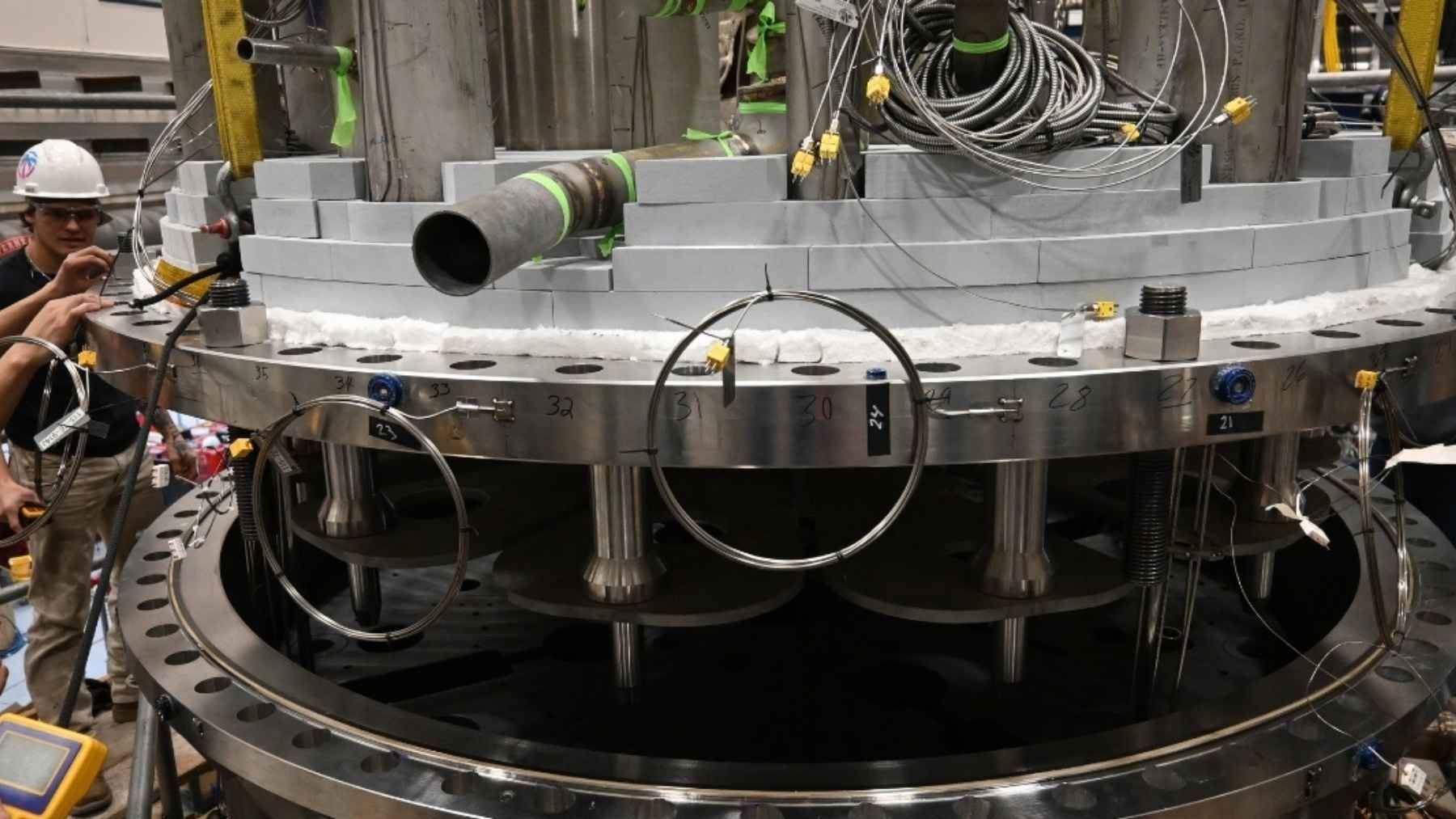
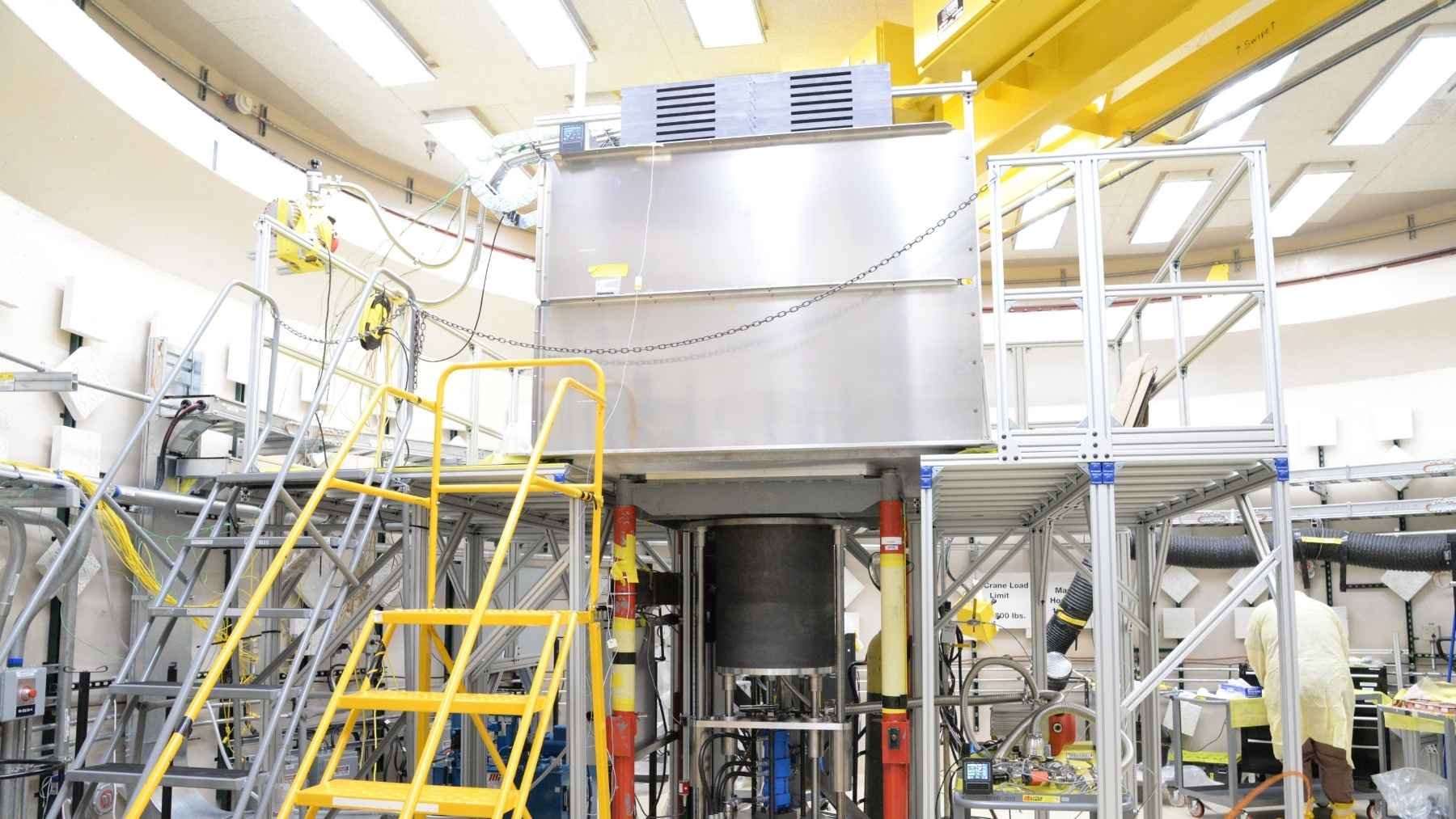
According to Westinghouse, the eVinci test went critical at 1,225 degrees Fahrenheit (663 Celsius) at the National Criticality Experiments Research Center, run for the National Nuclear Security Administration out on the Nevada National Security Site. Researchers also took a subcritical reactivity measurement with the core at 1,852 degrees (1,011 Celsius). Westinghouse says no one’s taken that kind of measurement at a higher temperature at that center.
That run came 10 days after the program’s cold criticality test, which is fairly quick for an industry that usually counts its schedules in years.
So what’s a reactivity measurement?
Reactivity is basically a number for how close a pile of nuclear fuel is to keeping a chain reaction going on its own. At zero it’s exactly critical, above zero the reaction grows, and below zero it fades out.
You take a subcritical measurement with the core sitting below that line. You’re not letting the reaction carry itself, but you can still read how far off it is, which seems like a pretty sensible way to collect data from a core at 1,852 degrees.
Why heat it up at all?
Fuel and graphite don’t treat neutrons the same way hot as they do cold. As the fuel heats, the uranium-238 in it gets better at soaking up neutrons without splitting, and designers generally want effects like that to pull reactivity down as a core warms, so it settles itself instead of running away. You can model that on a computer all day. Someone’s still got to heat the real materials and check. Westinghouse says this test gave it temperature-dependent data to tighten those models and speed up its prototype design.
I can’t tell you how close 1,852 degrees gets to real operating conditions, though. Westinghouse’s release says the materials were heated toward them, but it doesn’t give the temperature an eVinci core is supposed to run at.
Where did all that heat come from?
The chain reaction didn’t supply it. A zero-power test stops the reaction before fission makes any measurable heat, so a core at that temperature got hot some other way. Westinghouse hasn’t said how.
A few years back, NCERC’s own staff published a plan for testing a piece of eVinci on one of their machines, and they sized that setup for readings anywhere from about 68 to 2,192 degrees (20 to 1,200 Celsius). They also wrote that experiments there would have to run at lower power from then on, and lower power often means electric heaters instead of nuclear heat.
Los Alamos did exactly that with ZiaCore, its own heat-pipe microreactor design, which it fitted with custom electric heaters for high-temperature runs at NCERC this spring. So it’s a fairly safe bet someone plugged something in for eVinci too. The company hasn’t confirmed whether its rig looked anything like that old plan.
The 1,852-degree reading is the record
ZiaCore’s also a handy yardstick for that record claim. Los Alamos says its core ran tests above 1,472 degrees (800 Celsius) while critical at near-zero power, hotter than the 1,225 degrees where eVinci went critical. So the record being claimed belongs to the 1,852-degree measurement, which is frankly the more impressive of its two numbers anyway.
The Department of Energy’s write-up of the test lists a couple of partners the company release doesn’t, crediting Los Alamos alongside Idaho National Laboratory, the Nevada site and a joint DOE and Nuclear Regulatory Commission criticality safety effort. Westinghouse CEO Dan Sumner, for his part, says his teams are “rapidly building, testing, learning and improving advanced nuclear technologies.” That’s pretty standard press release language. In fairness, two criticality tests 10 days apart back him up a little this time.
The Army already picked a base
On August 26, the Army picked Fort Drum in upstate New York for a Westinghouse microreactor under its Janus Program, which is basically the service’s plan to have companies build and run small reactors on its bases. Fort Drum officials say the unit will fit on less than five acres and put out less than 20 megawatts. If you live around Watertown, that’s the reactor you’ll be hearing about.
The commercial eVinci is pitched at 5 megawatts of electricity, and it moves heat out of a solid graphite core through sealed heat pipes rather than pumps and water, which we went through in more detail earlier. The company hasn’t put an output or a delivery date on its Fort Drum unit.
The Army’s own goal is to have at least one Janus microreactor producing usable power on one of its installations by September 30, 2028, which gives Westinghouse and the other four companies in the program just over two years.