
Anyone who’s driven past a pasture in July knows what cattle do when it gets hot. They’ll walk to the nearest tree, or the nearest barn wall, and they’ll stand in the shade until the sun lets up.
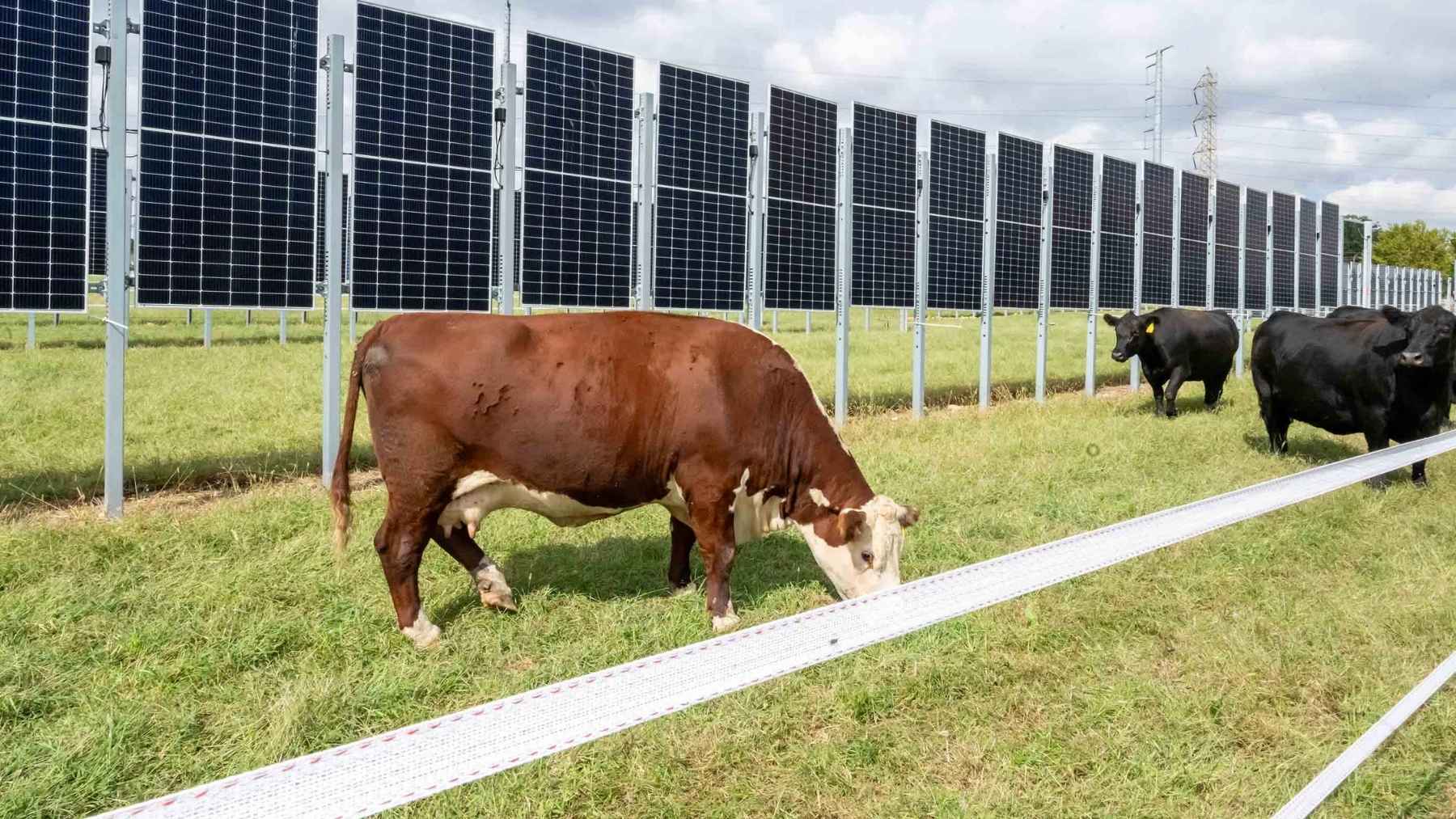
So what’s a cow supposed to do when the only vertical thing in the field is a row of solar panels standing on edge like a fence?
Six cows in New Brunswick, New Jersey are answering that right now, and there’s no guesswork involved. Cameras photograph the herd every five minutes.
The field is part of the Rutgers Animal Farm on the Cook campus, and the array standing in it runs to 378 bifacial panels in 18 rows of 21, all of them upright and pointed north to south. The Rutgers School of Environmental and Biological Sciences rates the site at 170 kilowatts DC and says the panels are ZnShine 450-watt modules with a bifaciality rating of 70 percent.
That’s a spec-sheet way of saying the back of the glass makes roughly seven-tenths of what the front makes. It’s three acres of grass, and you can walk down every alley in it.
The pasture is laid out as a randomized, replicated trial, which is the polite way of saying Rutgers built the same experiment three times over so one odd corner of the field can’t drag the whole result around. Each of the three blocks holds four panel configurations plus a control pasture with no panels in it at all.
Two things get swapped between those configurations. The rows sit either 20 or 40 feet apart, and the bottom edge of the glass starts either 2 or 4 feet off the ground. That’s the clearance underneath, not the height of the panel.
The herd is six brood cows out of the Rutgers beef cattle breeding herd, four Angus and two Herefords, and they run from 3 to 10 years old. Rutgers named them all on its research page, so I’m going to as well. Ideal, Queen, Fizzle and Blossom are the Angus. Misty and Flurry are the Herefords.
So why stand a solar panel on its edge?
Two reasons, and squeezing more power out of the glass isn’t either of them. A vertical panel facing east and west catches the sun on one face in the morning and on the other one late in the day. So you don’t get a single midday spike out of it. You get two humps, and Rutgers says peak production at this site lands in the early morning and the late afternoon, when the light comes in sideways. If you run a utility, that’s arguably worth more to you than another helping of noon power, because demand climbs through the afternoon right as the state’s south-facing arrays start to fade.
The other reason is ground. A fence-shaped array doesn’t need much of it, so a tractor can drive the alleys and cut hay without anything having to fit underneath a panel, and the cattle can be turned out into the same field.
So do the cows get any shade out of this?
Not much, and not when they’d want it. A panel standing on end throws a long shadow at eight in the morning and another one at six in the evening. At one in the afternoon, with the sun nearly overhead, that shadow shrinks to a stripe along the base of the row. That’s about the opposite of the shade schedule a cow would order if you let her.
That’s presumably why the team also built dedicated shade structures out in the pasture, and why one of the questions on its list is whether the animals go for those or for the thin shade beside the panels. Another is whether the cows avoid the tight 20-foot rows and spend their day in the 40-foot ones instead.
A third is what the panels do to the grass. Shade changes the microclimate, which is just the weather in the few feet around each row, and Rutgers is measuring how much forage grows there and how good it is to eat.
Rutgers hasn’t published any of those answers. The June writeup from the Rutgers Agrivoltaics Program lays out the questions, the layout and the cows and stops there, and I can’t find a paper, a dataset or an end-of-season summary from this grazing season anywhere on the program’s site. So if you see a post going around claiming that cows prefer solar shade, or that the pasture is out-producing the control strip, it didn’t come from New Brunswick.
The array has been making power the whole time
The Animal Farm project page carries a live readout from the site’s SolarEdge monitoring. Last time it updated, at 4:25 in the morning on September 3, it showed 104,613 kWh generated so far this year against 415.8 kWh for the month, and that’s small because the month was three days old.
Rutgers runs two more agrivoltaics sites on the same program, one over tomatoes, peppers, eggplant and soybeans in the south of the state and one over hay ground in the northwest.
We’ve written up a Massachusetts field this week that finally attached a harvest figure to all this, with sweet corn under 10-foot panels coming in at about 80 percent of the open rows next door. Sheep have been mowing under Volkswagen’s Tennessee array for years, with a rescued donkey on predator duty.
Rutgers is chasing something narrower than either of those. Animals can plainly live around panels, and that’s settled, so the open question here is which geometry they’ll pick when you give them four to choose from and a control pasture.
Frankly, I’d want the shade answer first, because it decides whether a grazing array needs a separate shade structure written into the budget or whether the hardware handles it. Rutgers is running a public tour of the Animal Farm array on Friday, September 25, from 1:30 to 2:30 p.m., with the cattle grazing between the rows, and program coordinator Shawn Sorrels is taking registrations by email. Dress for a field.