
When you picture a naval mine, you’re probably picturing the one from old war movies: a big steel ball hanging on a cable somewhere under the surface, waiting for a ship to run into it. Apparently that design is still around, at least in practice form. American and German sailors dropped some into the water off Portugal earlier this month, along with a couple of other shapes.
It happened between September 3 and 7 during REPMUS 26, the uncrewed-systems exercise the Portuguese Navy hosts every year off Troia and Sesimbra. The mines went out from the NRP Figueira da Foz, a 273-foot Portuguese patrol ship, and Naval News, working from photos the Portuguese Navy released, picked out three kinds: a cylinder that sits on the seabed, a sphere tethered to an anchor and a cone-shaped one meant for shallow water.
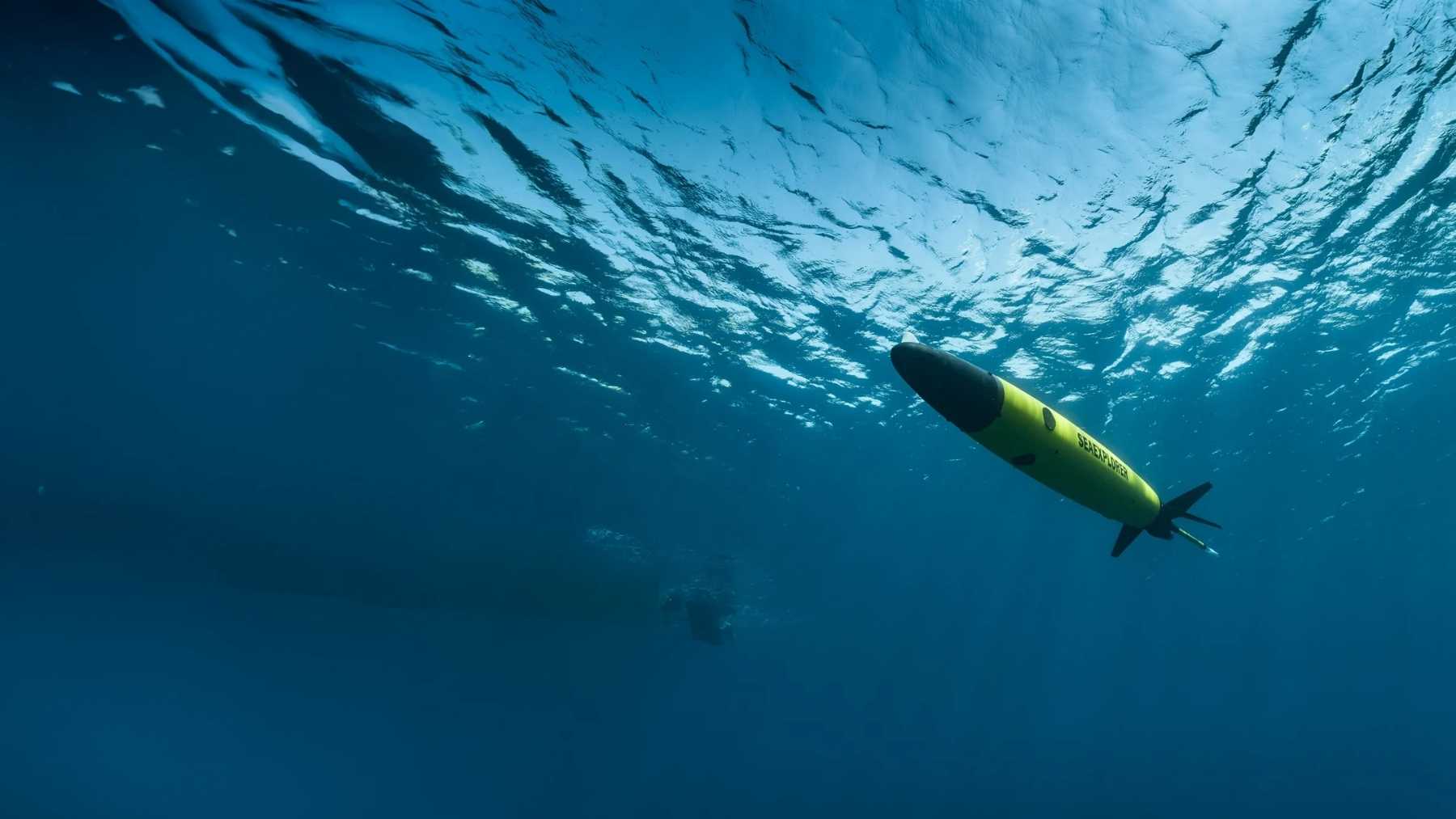
But frankly, the mines weren’t the most interesting thing on that flight deck. Sitting right next to them were several yellow SeaExplorer gliders, underwater drones built by the French company Alseamar, plus a drone aircraft from the Portuguese company Beyond Vision for good measure. Pretty much every report on the drill mentions the gliders in passing and moves on, which is a shame, because the way they get around is kind of brilliant.
So what’s a glider doing at a minelaying drill?
According to Naval News, the gliders were there for something called Rapid Environmental Assessment. That’s military shorthand for measuring the water before you go to work in it: temperature and salinity from the surface down, plus currents and the shape of the seabed. The gliders weren’t laying anything. The mines went over the side of a crewed ship the old-fashioned way.
So why would a navy need a robot to tell it how salty the sea is?
Because sound doesn’t travel through seawater in a straight line. Its speed changes with temperature, pressure and salt, and a sonar pulse bends toward whichever layer of water slows it down, which can leave patches the sonar never properly covers. Basically, if you don’t know what the water’s doing, your minehunting sonar can tell you an area’s clear when it’s really been looking in the wrong place.
A National Academies report on mine warfare says seawater temperature and salinity readings mostly go into models that predict how well minehunting sonar will work. And according to Alseamar, SeaExplorers at an earlier edition of this same exercise sent back a fresh sound-speed profile every time they surfaced, so the people running the sonars could see how sound was moving through the area almost as it happened.
It’s arguably the least glamorous job at the whole exercise. It’s probably also one of the more useful ones.
The SeaExplorer doesn’t have wings
Most underwater gliders look like a torpedo that someone bolted a pair of wings onto, and those wings are what turn sinking and rising into forward motion. The SeaExplorer is sold as a wingless design. All it has at the back is a set of small tail fins spanning about 22 inches tip to tip, and apparently the hull and those fins are enough to turn a dive into a slanted glide.
So how does it get anywhere without a propeller? It changes its buoyancy. A pump pushes oil out into a bladder on the outside of the hull, which makes the glider slightly bigger without making it any heavier, so it floats up. Pull the oil back inside and it shrinks a little and sinks. It also slides its battery pack forward or back to tip its nose down or up, so each dive and climb comes out at an angle, and that angle is what carries it forward.
The electric Slocum gliders built in the US do the same job with a piston that draws seawater in and pushes it back out, and we covered the biggest Slocum yet when the Royal Navy ordered one. Either way, gravity’s doing most of the work.
Why ditch the wings? The company says it leaves nothing to snap off and less for plastic trash, seaweed or fishing nets to snag, which sounds like a pretty sensible trade for a machine that spends months on its own at sea.
It’s not fast. The military spec sheet lists a cruising speed of half a knot and a top speed of 1 knot, a little over 1 mph, which is well below a normal walking pace. It doesn’t need to be quick, though, because the point is staying out there. Every time it surfaces, it sends its GPS position and its data home by satellite and then heads back down.
We don’t know which SeaExplorer was on the deck
Here’s where I have to admit a gap. The SeaExplorer comes in several models, and I can’t find anything from the Portuguese Navy or Naval News that says which one sailed on the Figueira da Foz, or who owned the gliders. The Portuguese Navy has run its own SeaExplorers at this exercise before, according to Alseamar, but that doesn’t mean these were Portuguese.
Three of the current models compare like this on paper, which is why any single set of numbers for “the SeaExplorer” should really come with a model name attached.
There’s also an option that adds two small wings with electric propellers for moving around in shallow water, so even the lack of a propeller depends on how a customer orders the thing. From what’s been published, there’s no way to tell whether the gliders in Portugal had it.
The Portuguese Navy also hasn’t said how many mines went over the side or how deep they were set, which is fair enough for a minelaying drill.
Bottom mines and moored mines work differently
If you’re wondering what separates those three shapes, it mostly comes down to where the mine sits. A bottom mine rests on the seabed, and Naval News says mines of that type typically carry sensors that pick up a passing ship’s magnetic field, its noise and the pressure change it pushes through the water. A moored mine is the movie version. Its anchor sinks to the bottom, and the mine itself floats on a tether at a preset depth, waiting for a hull or a submarine. Naval News reads the cone-shaped one as a moored shape built for shallow, coastal water.
As for the ship, the Figueira da Foz is a Viana do Castelo-class ocean patrol ship with a crew of 36 and a top speed of 21 knots, and the Portuguese Navy lists laying mines among its jobs, right alongside search and rescue and fisheries inspections in the North Atlantic.
There’s a bit of irony in that. The US Navy has been testing a drone submarine that plants mines on its own, yet at what the Portuguese Navy calls the world’s biggest uncrewed-systems exercise, this particular batch of mines still went off a crewed ship, and the robots were busy measuring the water.
The gliders weren’t short of company, either. REPMUS 26 also drew a German drone submarine built to fit a torpedo tube, and the Portuguese Navy says more than 1,500 people from 36 navies and more than 300 uncrewed systems are taking part before the exercise wraps up off Troia and Sesimbra on September 25.