
Horizontal drill rigs are about the least dramatic machines in heavy construction, and that’s the whole point of them. One parks at the edge of a river, a crew runs a steerable bit under the riverbed and out the far bank, and a couple of weeks later there’s a pipeline down there that you never saw go in. If the job goes well, the only evidence is some flattened grass on each side.
So it’s a bit odd that the FBI now has a file open on two of them.
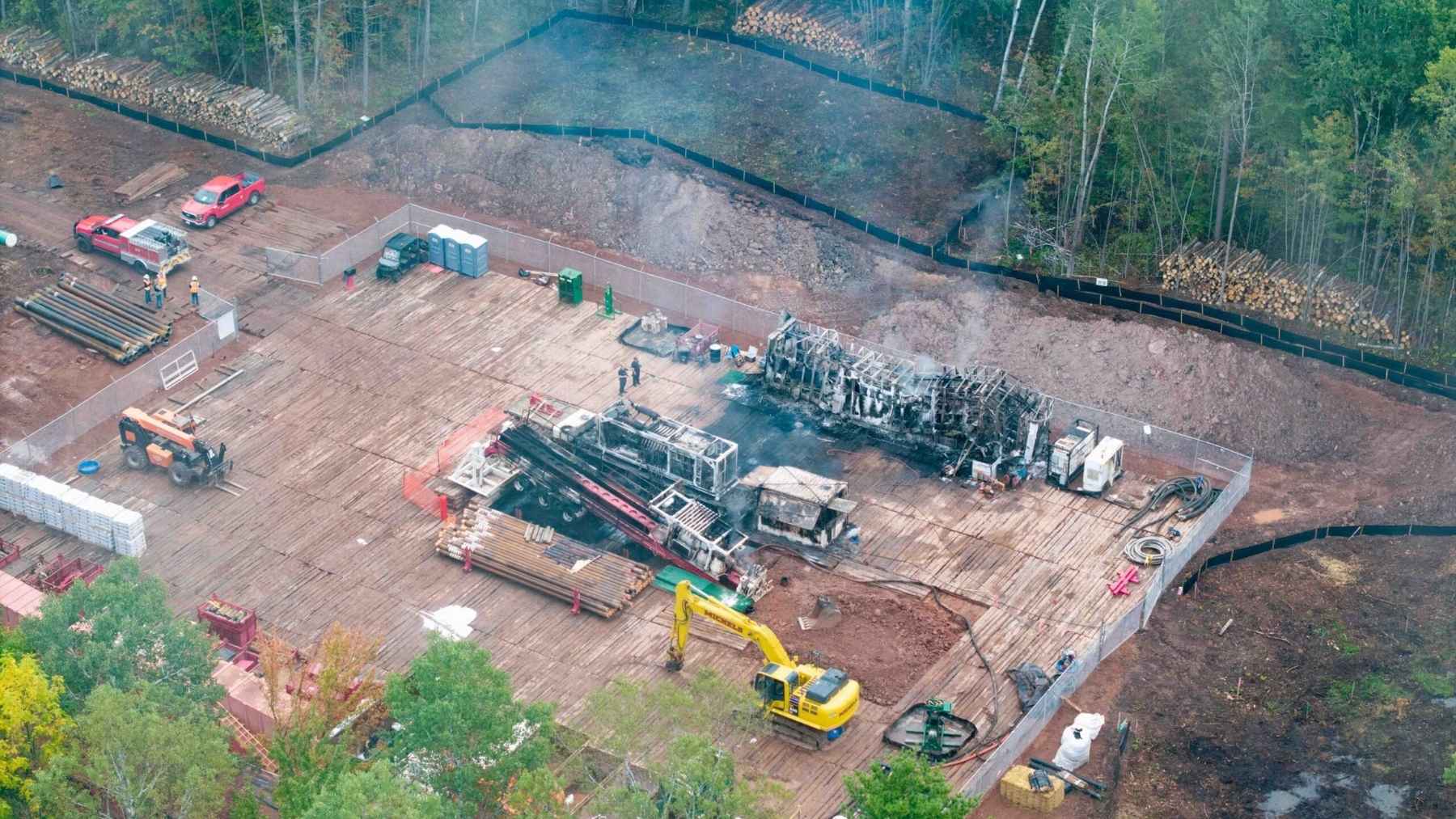
On a 41-mile oil pipeline detour in northern Wisconsin, a horizontal directional drill rig and its support equipment burned before dawn on October 12. It was the second rig lost on the same job in 25 days. And in between the two fires, a crossing the crew had just finished under the Marengo River started pushing groundwater up to the surface, and it hasn’t stopped. So what exactly is going on up there?
So what is this job?
Line 5 runs 645 miles of 30-inch pipe from Superior, Wisconsin, across Michigan to Sarnia, Ontario, moving as much as 23 million gallons of crude oil and natural gas liquids a day to 10 refineries and propane plants. About 12 miles of it crosses the Bad River reservation, and after a federal court found the Canadian company that owns it, Enbridge, was trespassing there, the fix was a new 41.1-mile loop around the reservation. The price tag is roughly $1 billion, the job is about two-thirds done, and the contractor, Michels Pipeline, has around 700 people on it.
Most of that pipe goes in the boring way, with a trench, and that includes most of the roughly 70 waterway crossings. The big rivers, the White, the Marengo, the Bad, get drilled under instead, which is where the rigs come in. We’ve covered the technique before, when two rigs met nose to nose under a Canadian river and when one bored under a live rail line in London from a side street. Same idea here, with a fatter pipe.
What a drill rig actually does under a river
Picture an oilfield drilling rig laid on its back at a shallow angle, pointed at the far bank. The bit is steerable, so an operator can curve the hole down under the riverbed and bring it back up hundreds or thousands of feet away. That first pass is the pilot hole, and it’s skinny. Then the crew swaps in bigger cutting heads and reams it out, pass after pass, until it’s wide enough to drag a 30-inch steel pipe back through from the exit side.
The whole time, the rig is pumping drilling mud down the hole. Enbridge says the mix on this job is roughly 96 parts water to 4 parts bentonite, a clay that swells into a slick gel, and it’s there to cool the bit, carry the cuttings out and hold the hole open. Which brings us to the thing that goes wrong on pretty much every long HDD job: the mud finds a crack and comes up somewhere you didn’t want it, usually in a wetland. The trade calls it a frac-out. On this project a crew lost as much as 1,900 gallons of it into a forested wetland in Iron County back in June, and a few gallons reached a creek.
Frankly, one frac-out isn’t news. The state’s count is what makes it news. In the notice of violation it sent Enbridge on October 13, the Wisconsin DNR lists 18 instances between May 13 and September 25 where it alleges the company broke the terms of its wetlands and waterways permit, five of them drilling fluid or muddy water getting into wetlands or streams. Those are allegations for now. Enbridge says it’s reviewing the notice, and the two sides sit down for an enforcement conference on October 26.
Then the Marengo River bore started leaking the wrong way
On September 28, with the pipe just pulled through the finished bore under the Marengo River, water started flowing up out of the ground at the site. Not drilling mud this time. Groundwater.
Enbridge reported it to the DNR and started sucking it up with vacuum trucks. John Petoskey, the Earthjustice attorney who represents the Bad River Band, says state staff and independent monitors told the tribe it was coming up at 85 to 100 gallons a minute, call it ten garden hoses running wide open. “The Bad River Band said this would happen, and now it has,” Petoskey said in a release carried by WTMJ.
Why does that matter if it’s just water? Because the worry is an artesian aquifer, which is groundwater sitting under pressure beneath a lid of clay or rock that keeps it sealed in. Poke a hole through the lid and the water pushes itself to the surface, and as Petoskey put it, it isn’t going back in. It’s lost to the aquifer for good, and if your well draws from that aquifer, you’ll eventually notice.
The DNR hasn’t called it a breach yet, and I think that’s a fair position for now. A spokesperson told WPR the hydrology under the site is complicated, that the measured flow is around 5 percent of what confirmed breaches on comparable pipeline jobs elsewhere in the country have produced, and that monitoring wells are going in to pin down where the water comes from. Enbridge says the pipe at that crossing is in and the flow is contained.
Two things make me less relaxed than the DNR. During the permit hearings for this project, Enbridge’s own experts put the risk of an aquifer breach at essentially nil. And this is the same company that, as WPR has reported, paid millions in Minnesota over four aquifer breaches during its Line 3 replacement there, breaches that let groundwater out by the hundreds of millions of gallons. So “essentially nil” apparently has some wiggle room in it.
What nobody has published, and I’ve looked, is how long or how deep the Marengo bore is, or what rig drilled it.
And then the rigs started burning
The first fire came in on September 17 at 6:28 in the morning, off Hegstrom Road outside Gingles. The Ashland County Sheriff’s Office says deputies found “an equipment trailer and two boring machines” burned at a horizontal drilling site. Three days before that, a fire had hit Enbridge’s mostly empty office in Superior, graffiti included.
The second rig fire was October 12, around 5:20 a.m., off Wilson Road outside White River, and the sheriff’s description is word for word the same: a trailer and two boring machines. Enbridge says there was graffiti at this site too. Nobody was hurt at any of the three.
“This is the second major vandalism involving construction equipment on the project,” Enbridge spokesperson Juli Kellner told Wisconsin Public Radio. That’s the company’s word for it. The FBI and the ATF are looking into what caused all three fires. As far as I can find, nobody’s been charged. And neither agency has said in public what started either blaze. Drill rigs do catch fire on their own now and then, a hydraulic line lets go onto a hot exhaust and that’s that. Two of them 25 days apart on one job, with graffiti at both, is the kind of coincidence that gets federal agents interested, and that’s as far as I’d go with it.
The pipeline itself already had a bad summer
The rig fires came on top of the biggest pipeline leak Wisconsin has seen. On August 25, a subcontractor’s flatbed truck left in neutral rolled into an open trench near Saxon and hit a valve on the existing Line 5, and more than 1.3 million gallons of natural gas liquids, mostly propane and butane, boiled off into the air. Enbridge puts the cleanup at $15 million. The line was down about 10 days while the company built a temporary bypass around the damage, and the DNR says that bypass went in without the permits it needed, one more line item in the October 13 notice.
The DNR can fine the company as much as $25,000 a day per violation and can hand the case to the state Department of Justice. Enbridge says it has worked closely with the agency through permitting and construction, and it’s still drilling, here and soon under the Straits of Mackinac, where the same line gets a four-mile tunnel. The DNR’s notice of violation sets the enforcement conference for October 26, and the monitoring wells at the Marengo River were due in the ground the week of October 5.
Image Credit: Ed Monroe