
For most of 2026, the underwater drones making headlines have all been chasing the same job: finding mines. The Strait of Hormuz is still being cleared of them, every robotics outfit with a sonar is pitching a fleet to go sweep it, and the machines doing the sweeping keep getting stranger, from German hydrogen swarms to an American crawler that drives up onto the beach to hunt the mines a swimming drone can’t reach.
General Dynamics has spent that same stretch working on the exact opposite problem. Its drone doesn’t go looking for mines. It plants them, and then it stays down there for good.
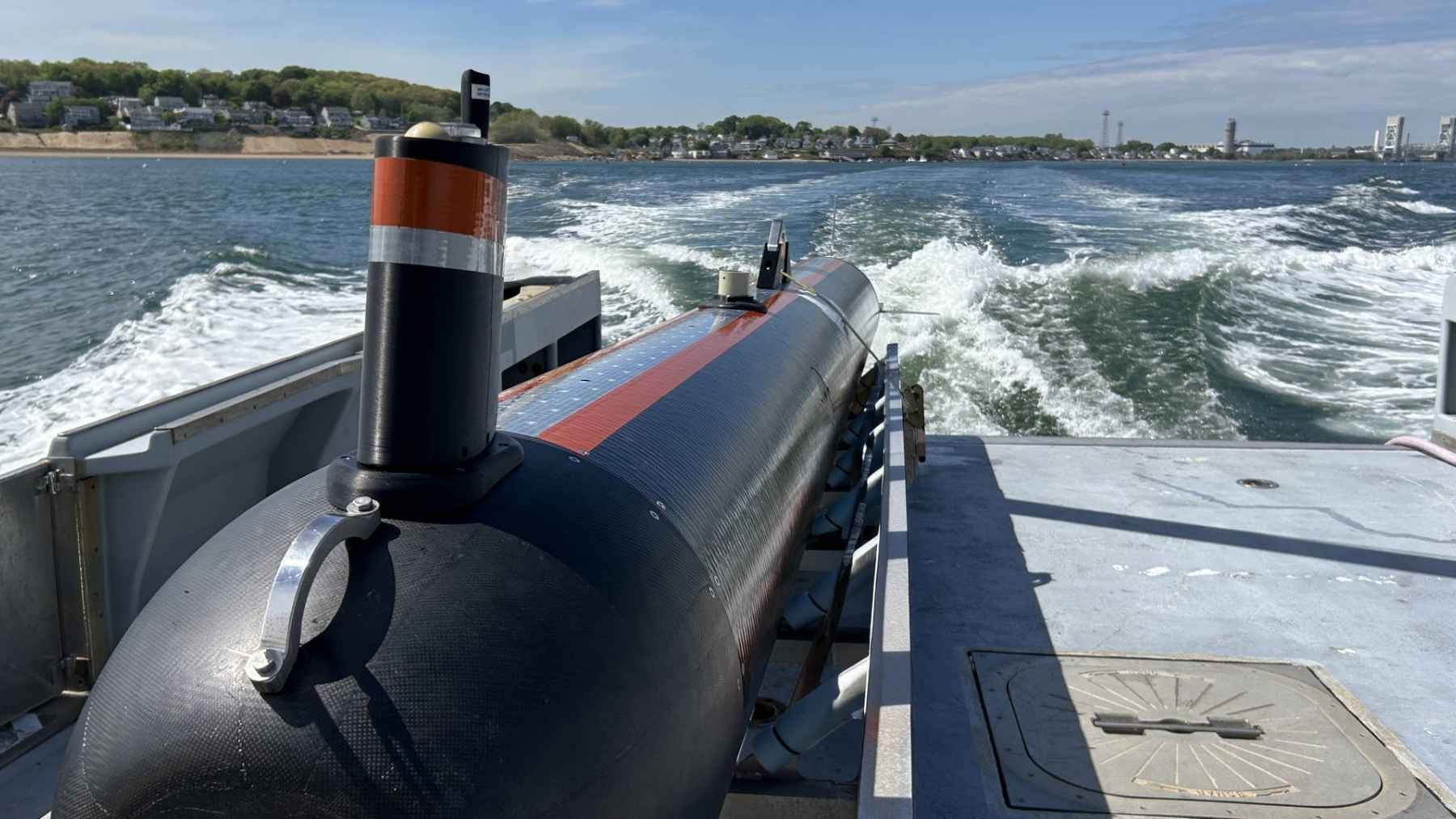
The program is called MEDUSA, which stretches out to Mining Expendable Delivery Unmanned Submarine Asset, and the Navy has been running a prototype off the coast of Massachusetts. It’s a medium-class robot submarine that a crewed boat fires out of its torpedo tube, sends off to seed a minefield a long way from where the submarine actually sits, and then abandons on the seabed. The “expendable” in the name isn’t a softer word for something else. The machine is meant to be used once and left behind.
That one design choice is the entire point, and it’s a deliberate flip of how almost every other undersea drone gets built. The questions that follow are simple enough: what MEDUSA actually is, why the Navy would rather field something disposable, and why offensive mining, a mission the U.S. mostly shelved for decades, is suddenly back.
MEDUSA is built to do the one undersea job nobody automates
Strip the acronym away and MEDUSA is a fairly compact idea buried under a lot of classified detail. A submarine carries it the way it would carry a torpedo, fires it out of a standard 533mm (21-inch) tube, and the drone swims off on its own to drop naval mines at a set of coordinates. The submarine never goes near the spot. It stays deep, stays quiet, and keeps its distance while the robot does the dangerous part.
Naval News reported the testing after General Dynamics flagged it at the start of the year, and the company’s framing has been consistent: the system can be safely deployed from a submarine, and it’s designed to be thrown away once the job is done.
What makes MEDUSA strange is the direction it runs. Nearly every underwater drone you’ve read about this year is a hunter. The Navy’s Knifefish, built by General Dynamics on its 21-inch Bluefin-21 platform, exists to find mines. So does that beach-crawling Bayonet. So do the German and Norwegian machines combing the seabed for weeks at a time. They all go out, locate the threat, and come back with the data. MEDUSA runs that logic backward. It’s the layer, not the hunter, and it isn’t coming back at all.
Mines also happen to be one of the cheapest and most stubborn weapons in naval warfare, which is part of why a disposable truck for delivering them makes sense. A minefield needs no fuel and no crew. It just sits there and forces an enemy to either clear it slowly or route around it, and both of those cost time the other side may not have. Letting a submarine seed one from far off, without ever giving away where the boat is, hands the U.S. a capability it has talked about for years without truly fielding.
A reusable drone keeps getting stuck in the tube. A disposable one can’t
Building something on purpose to never come back sounds wasteful until you look at how hard the reusable version has turned out to be. Getting a drone out of a submarine’s torpedo tube and then back into it, underwater, is one of the genuinely unsolved headaches in this field. The Navy has been grinding at it for years under a separate effort, and the road has been rough.
The first drone USS Delaware launched from its tube in 2024 was lost and never recovered. A replacement refused to dock during attempts in a Norwegian fjord in early 2025, and divers had to go fish it out. It wasn’t until late May 2025 that the Navy could log a real forward-deployed launch and recovery from a torpedo tube with nobody in the water.
MEDUSA sidesteps that whole problem by refusing to play it. There’s nothing to recover, so there’s no recovery to botch, no drone wedged in a tube off Norway, no divers going over the side at the worst possible moment. The trade is blunt: you spend the hardware, you keep the mission simple, and the submarine that fired it is already miles away by the time anyone works out that a minefield exists. General Dynamics has built the program around exactly that bet, designing a vehicle it plans to lose rather than one it has to coax home.
The contract, the timeline, and what’s actually been tested
The paper trail on MEDUSA is a lot more public than the hardware. The Navy competitively awarded the development deal to General Dynamics Mission Systems in September 2024, with the work run out of the service’s Unmanned Maritime Systems program office, known as PMS 406. The base contract runs about $15.9 million, and it climbs to as much as $58.1 million if the Navy exercises its options for more prototypes and support. General Dynamics is on the hook for four prototypes, with the bulk of that work expected to wrap up around September 2026.
Rather than design on paper and hope, the company built a full-scale rapid prototype early and started running it hard. Those tests, carried out off Massachusetts, have been feeding back into the design on the things that actually decide whether one of these vehicles works: propulsion, navigation, energy management, and what General Dynamics calls specialized autonomy behaviors, which is the polite way of saying the drone has to find its own way to a spot and do the job with nobody steering it.
In early January, the company said the program had cleared its key risk-reduction activities, which is engineering-speak for getting past the scary unknowns before the expensive part starts. Chris Clapp, the company’s senior program manager for MEDUSA, called the rapid prototype “an immensely helpful tool” for shaping the design ahead of major milestones.
What the Navy hasn’t said is the part everyone actually wants. There’s no published number for how far MEDUSA can travel, how big it is, or how many mines it carries. The program is tight-lipped by design, and the only official line on its reach is that it drops its payload far from the launch platform. Anyone quoting you a hard range figure is guessing. About the only color the company has offered is that operators have had hands on the prototype for months, and that before long it wants real Sailors planning and running the system rather than contractors.
Why offensive mining is suddenly back on the menu
The U.S. spent the back half of the 20th century treating offensive sea mining as an afterthought, which is part of why a program like this is news at all. The renewed interest lines up almost exactly with the Navy’s worries about a fight in the Western Pacific. China’s navy now outnumbers the U.S. fleet in surface combatants, and a lot of war planning assumes any conflict over Taiwan opens with somebody mining the approaches to it.
That isn’t hand-waving. A 2025 CSIS wargame of a Chinese blockade found that, with no U.S. intervention, Chinese submarines and mines destroyed 40% of the ships trying to reach Taiwan. CSIS’s earlier blockade research sketches the same move from the other direction, with submarines quietly laying mines at the mouths of Taiwan’s major ports before a shot is fired.
And the other side isn’t standing still. At its September 2025 military parade, China rolled out its own extra-large minelaying drones, including a vehicle state media billed as a dedicated minelayer. MEDUSA is, in part, the American answer to that: a way to seed minefields of its own without spending a crewed submarine to do it.
MEDUSA shouldn’t be confused with its sibling, either. General Dynamics is also building Hammerhead, a different system entirely: an encapsulated mine tethered to the seabed and armed with a Mk 54 torpedo that fires when it hears a target, broadly like the Cold War-era CAPTOR mine. Hammerhead waits and kills submarines. MEDUSA carries the minefield in and leaves. Same company, same general line of work, two very different machines.
MEDUSA is still a prototype on an aggressive schedule, and the next real checkpoint is whether it clears its development phase this fall and whether the Navy spends the money to push it toward production. The Sailors who would eventually fire it haven’t had their turn yet. But the shape of the thing is already clear, and it’s a quietly ruthless one: a submarine that can drop a minefield somewhere it would never dare sail itself, fire-and-forget, with the only thing left at the scene a robot that was always meant to stay.