
The usual story about defense technology runs one way. The military pays for something expensive and strange, then twenty years later it turns up in your pocket, and you get GPS in your car and a microwave in your kitchen because somebody once needed to guide a missile or cook a radar test.
This one went the other direction. A 49-foot robot built to fly along oil pipelines in the North Sea, and the onshore control room that drives it, are now U.S. Navy purchases. The Defense Innovation Unit ordered both in October 2024, and the vehicle gets built at a yard in Morgan City, Louisiana.
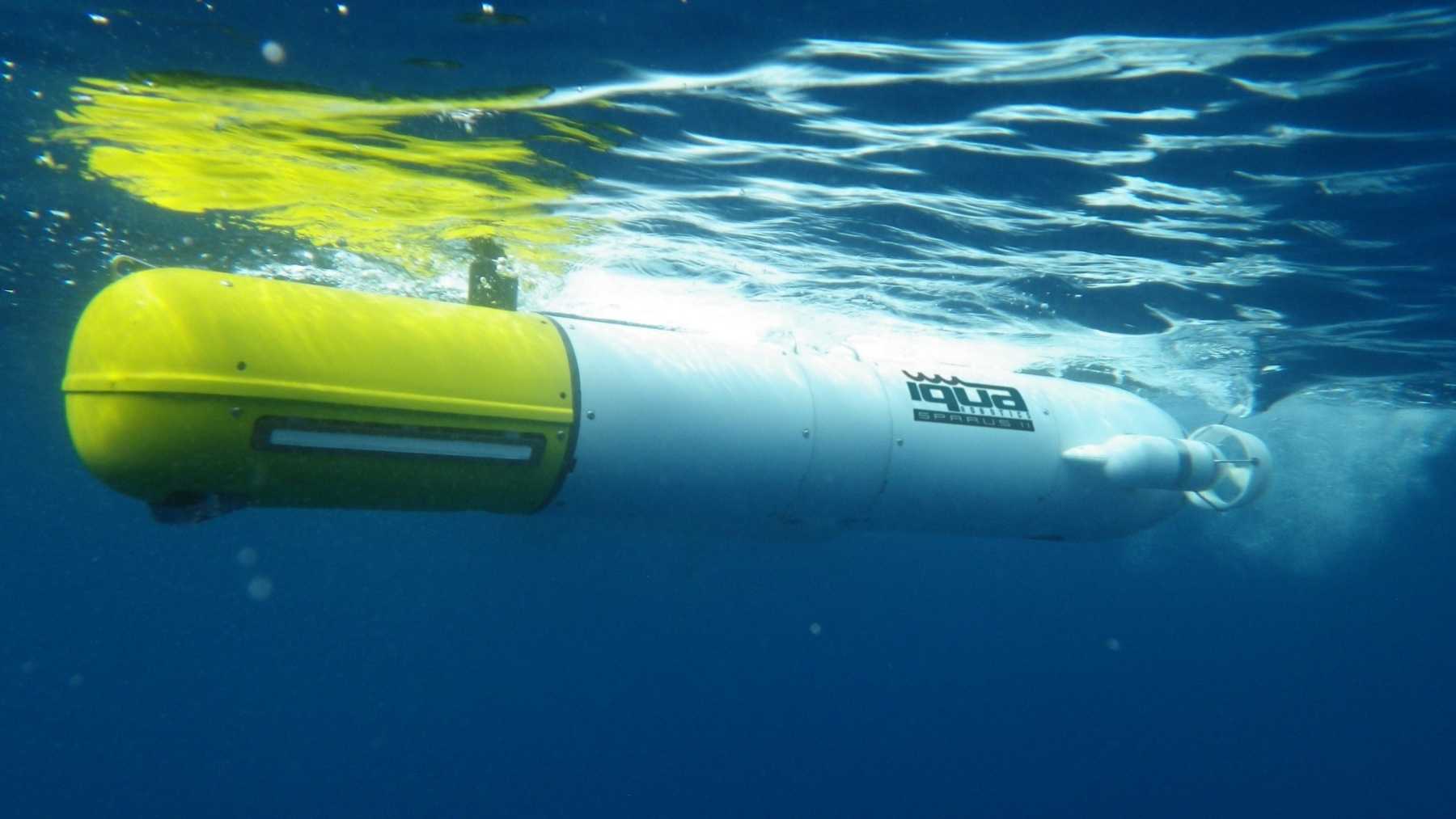
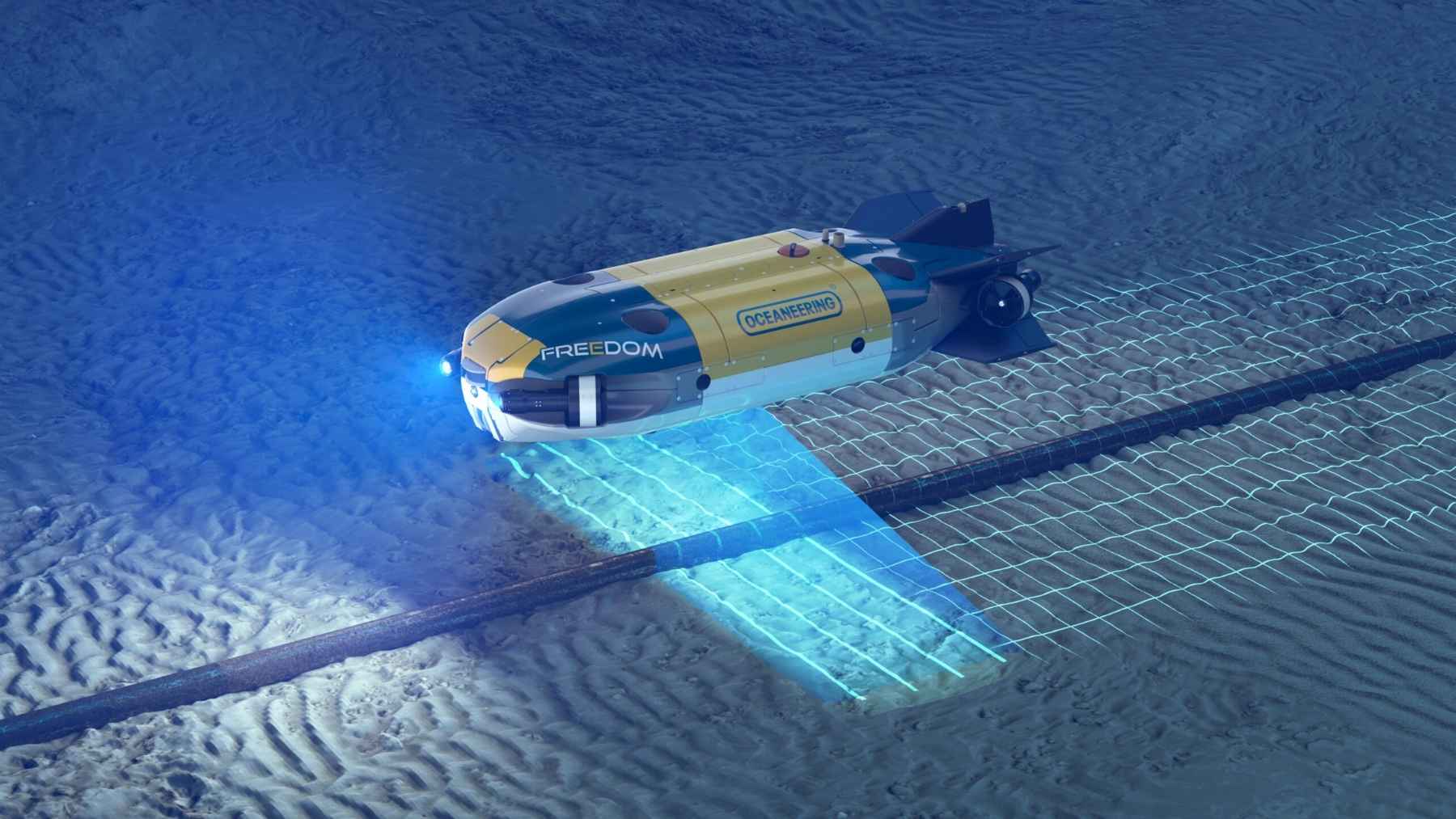
The machine is called Freedom, and Oceaneering International made it for customers who pump crude.
Freedom does in one pass what other machines need three for
TotalEnergies handed the Houston company a pipeline job in the North Sea and let the vehicle run it alone. Freedom inspected over 120 km of submarine pipeline, about 74.6 miles, on top of the 60 km of near-shore pipeline it had already covered for the same customer in an earlier demonstration.
A conventional autonomous vehicle needs two or three passes over the same pipe to gather what Freedom collects in one, by the manufacturer’s own accounting. The vehicle holds station 3 to 5 meters over the pipeline, or 10 to 16 feet, and finds the pipe by itself instead of being flown down onto it.
Onboard, a laser scanner and a multibeam sonar do the looking. Software called COMPASS reads the sonar and camera feeds while the vehicle is still swimming, which lets it measure cathodic protection without touching the steel and sniff for hydrocarbon leaks on the same run. Spot a free span, a burial or a crossing and the vehicle can launch its own sub-mission to go look closer, rather than logging the anomaly and coming back next season.
Andy Gower, the R&D subsea robotics project lead at TotalEnergies, framed the point as “reducing the impact of using large vessels” on inspection work. Both companies put the time and emissions saving at roughly 50 percent against existing methods.
Freedom is filed as a hybrid AUV/ROV rather than a pure autonomous vehicle, and the distinction is doing real work. A conventional AUV flies a route and hands you the data afterwards. An ROV hangs off a cable with a pilot on the other end. Freedom carries its own decision-making but keeps the close-quarters precision of a piloted machine, which is why a free span it spots on the way past can turn into an inspection instead of a note for next year.
The docking station is the whole trick
Most underwater robots end the day the same way, which is hanging off a crane on the back of a ship. Freedom can end it on the seabed instead.
The vehicle locates a docking station, orients around it, lines up and latches in horizontally. That station either hangs over the side of a vessel or sits resident on the bottom. Once Freedom is docked it swaps tools, recharges and offloads its data, and none of that requires bringing it back to the surface. Weather that would stop a crane operation stops mattering. A campaign that used to be cut into vessel-length chunks stops being cut into vessel-length chunks.
Getting there took a while. The project timeline the builder publishes starts in 2017, puts a prototype in a test tank in January 2020, has the vehicle running untethered on batteries by June 2020, moves it offshore for trials in July 2021, and only reaches commercial pipeline operations in September 2023. The collaboration underneath it runs back to 2014 with TotalEnergies and Chevron, with Equinor joining in 2019.
Six years from first sketch to paying work. Four oil companies helped fund the homework.
A Houston contractor has been flying robots from an office since 2015
The second half of this is the part with no propeller on it. Oceaneering has run commercial subsea robots from onshore remote operations centers since 2015 and logged more than 120,000 hours doing it. Operators sit in a room on land, the robot works a field hundreds of miles away, and the satellite link in between carries the commands.
That model built its own hardware alongside it. Liberty is an all-electric, battery-powered resident ROV that lives at the worksite and talks to shore through its own antenna. Equinor’s figures, cited in the congressional testimony below, put the emissions saving from moving to resident and remote ROV operations at up to 40 percent per project.
Congress heard about the Navy adoption in March 2025
Earl Childress, Oceaneering’s senior vice president and chief commercial officer, appeared before the House Committee on Science, Space, and Technology on March 26, 2025, at an Environment Subcommittee hearing on blue economy technologies. His written testimony put the onshore remote operations center on the record as “now being adopted by the U.S. Navy,” and floated NOAA using the same setup to drive bathymetric survey fleets.
The Navy business behind that line has a paper trail. DIU contracted Oceaneering in February 2024 to develop and test Freedom as a large-displacement uncrewed vehicle prototype for the Navy’s Program Office for Advanced Undersea Systems. The in-water demonstrations ran at the company’s subsea autonomy facility in Norway and covered undocking, docking, obstacle avoidance, precision payload placement, survey and transit.
Then on October 1, 2024, DIU came back and bought the hardware. The award covers building a Freedom vehicle at Morgan City and standing up an onshore remote operations center for the Navy. No delivery date for either one has been published.
One detail explains the pairing that came later. The Houston company already sells Kongsberg’s Hugin Superior 6000 through its own catalog, so the two firms picked for the Navy’s next submarine design had been running each other’s hardware on oil jobs for years before any of it reached a defense contract.
Other people are circling the same idea from different directions. Nauticus Robotics has been running an untethered electric drone 7,500 feet down off Louisiana, Kongsberg’s majority-owned Eelume built a robot snake that lives on the seabed for six months, and Fugro has a 57-foot drone boat working the Norwegian shelf from a control room in Aberdeen. Every one of those started as a way to stop paying for a ship.
The oil work pays for all of it
The company reported second-quarter results on July 23, 2026. Revenue came in at $768.2 million against $698.2 million a year earlier, net income at $65.0 million against $54.4 million, and adjusted EBITDA at $115 million, the company’s best quarter on that measure since the third quarter of 2015.
Subsea Robotics, the segment that owns Freedom and the ROVs, booked $232 million of that and $66.3 million in operating income. The fleet stands at 250 work-class vehicles. Average revenue per ROV day utilized climbed to $11,894 from $11,265, while utilization slipped to 66 percent from 67 percent.
Not everything pointed up. Backlog stood at $445 million on June 30, 2026, down 13.8 percent from the same date in 2025. Management told analysts it sees growing demand in defense and autonomy and is looking at selective acquisitions on the defense side.
Defense is still the small half of the house. The pipelines pay the bills, and the pipelines paid for the docking station, the shore link and the autonomy stack that the Navy is now buying.
The next job is a submarine
DIU picked Oceaneering and Norway’s Kongsberg on July 14, 2026, to work concept definition, system architecture and design trade studies for the next extra-large uncrewed undersea vehicle under the Combat Autonomous Maritime Platform program. That vehicle has to run past 1,000 nautical miles, work below 656 feet and place payloads up to 21 feet long on the seafloor. Neither company is cutting metal on it. Both are drawing it, and at least two rival teams are drawing their own.
Bill Merz, Oceaneering’s senior vice president for aerospace and defense technologies, is the executive named on the announcement. The design is owed to DIU in the third quarter of 2026, and the quarter closes on September 30.