
Thorium pitches almost always arrive with a reactor attached. Molten salt, pebble bed, something that ships inside a 40-foot container: the fuel gets the headline, and the fine print says you have to build an entirely new machine before you can burn a gram of it.
Clean Core Thorium Energy has spent nearly a decade going the other way. On August 18 the Chicago company announced it had brought in Kinectrics to run an independent technical review of its ANEEL fuel qualification program, which sounds like paperwork because it is paperwork.
It is also close to the last box on the list before somebody drops thorium into a heavy water reactor that has been running for decades. No new reactor. No new core. Same bundle shape, different pellets inside it.
That is the whole bet, and it is a much stranger bet than the usual thorium sales deck. The announcement from Clean Core says Kinectrics will assess fuel design, manufacturing, safety and regulatory readiness, with the results aimed at utility Fuel Design Authorities, the people inside a power company who actually sign off on what goes in the core.
Burnup is the number that decides how much fuel a reactor throws away
Fuel burnup gets written as gigawatt-days per metric ton, and it measures exactly what it sounds like: how much energy you pulled out of each ton of fuel before you had to take it out and store it forever.
A CANDU is spectacularly bad at this, and on purpose. It runs on natural uranium straight out of the mine, which means only about 0.7% of it is the fissile stuff, so a bundle gets tired fast. Typical discharge burnup sits around 7,500 megawatt-days per metric ton. Conventional pressurized water reactors running enriched fuel are usually quoted somewhere between 33,000 and 55,000.
The trade was always worth it to Canada, because skipping enrichment skips an entire industry. We got into that when a 700-megawatt CANDU was pitched to American regulators earlier this year.
Cheap fuel, no centrifuges, refueling while the machine is still making power. The bill arrives at the back end, in bundle count and in spent fuel volume.
ANEEL is a thoria-urania pellet, thorium dioxide blended with high-assay low-enriched uranium and a burnable neutron absorber. Thorium on its own will sit in a reactor and do nothing, because it is fertile rather than fissile. It has to absorb a neutron and transmute into uranium-233 before anything fissions, and the enriched uranium in the mix is what supplies those neutrons.
The interesting part is the geometry. The bundle keeps the same external dimensions as the natural uranium bundles CANDUs already burn, in both the 19-element and 37-element designs.
The Idaho number and the CANDU number are not the same number
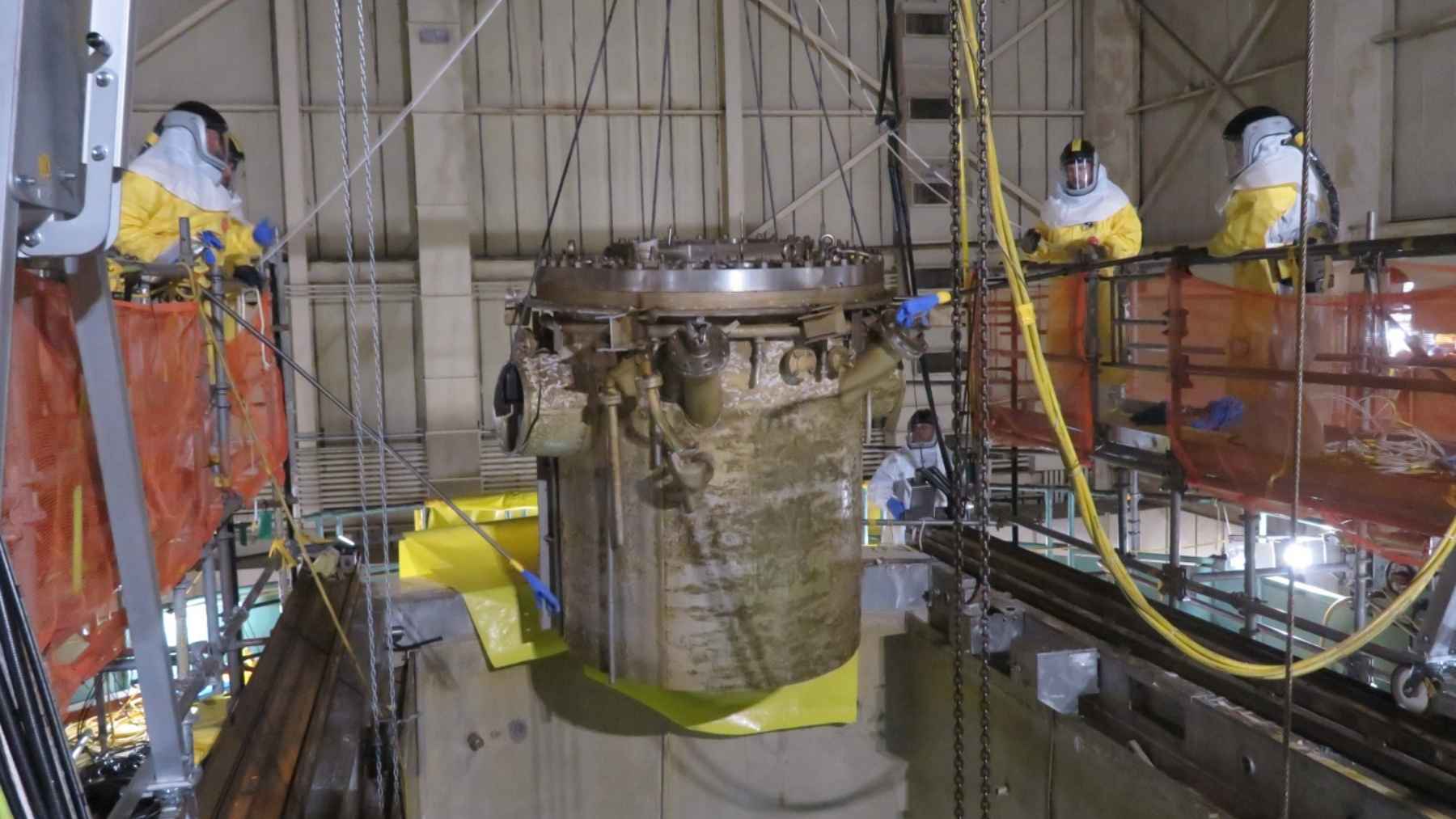
Twelve ANEEL rodlets went into the Advanced Test Reactor at Idaho National Laboratory in May 2024, aimed at three burnup targets: 20, 40 and 60 gigawatt-days per metric ton. Eight cleared the first two during 2025. The last four passed 60 in under two years, which Clean Core describes as more than eight times what a CANDU normally gets from a ton of fuel.
Worth pinning down what that rig is, though. The ATR is a test machine, not a power plant, and Clean Core says its irradiation conditions are more aggressive than a heavy water reactor would ever impose. It compresses years of reactor life into months, which is the same accelerated punishment another advanced fuel went through in the same reactor this year.
So 60 GWd/MTU is what the fuel survived in a lab. What it would do inside an actual CANDU is a different, lower figure, and that one comes from the modeling.
The peer-reviewed assessment published in Nuclear Engineering and Design in July puts the average discharge burnup for ANEEL in a CANDU-6 at over 44,000 megawatt-days per metric ton of heavy metal. Roughly six times natural uranium. The paper headlines a ceiling of up to eight times, but the optimized CANDU-6 design it actually works through lands at six, and that is the figure tied to a real core.
That last card is the one nuclear engineers will care about most. CANDUs have a positive coolant void reactivity, meaning that if coolant is lost the chain reaction speeds up rather than slowing down. It is the design’s oldest known headache and the reason its shutdown systems are built the way they are.
The paper reports ANEEL pulling full-core void reactivity from 16.4 milli-k down below 13.3, and Canadian Nuclear Laboratories ran its own MCNP calculations confirming that existing control and shutdown systems keep adequate margin without redesign. Useful. But the number goes down, not negative. The headache gets smaller, it does not leave.
Canada’s regulator had exactly one finding, and it wasn’t about physics
Here is the part that reframes the Kinectrics announcement, and it has been sitting on a Canadian government website since 2024.
Clean Core asked the Canadian Nuclear Safety Commission to look at ANEEL under a service agreement signed in March 2023. The review ran about six months across nine focus areas, and the company has cited it ever since as a Phase 1 vendor design review. It did clear that bar. No issues were identified that would present a fundamental barrier to licensing the fuel in Canada.
The commission’s own filing calls it something drier: a preliminary regulatory design assessment, built by modifying the standard vendor design review process and picking a subset of focus areas that applied to a fuel pellet rather than a whole reactor.
Read the CNSC’s published executive summary and the tone is more measured. Staff concluded that Clean Core generally understands and has correctly interpreted the high-level intent of the requirements, that additional work will be required, and that the issues raised are foreseen to be resolvable.
The commission is also explicit that the exercise is not a licence and not part of the licensing process.
Then there is the findings section, and it contains one entry. Not fuel chemistry. Not void reactivity. Management systems.
CNSC staff wrote that the management system was not yet well documented enough to meet regulatory requirements, with specific emphasis on vendor management, and that there did not appear to be a system in place to ensure the “smart buyer” model was working in its documented oversight of contractors and partners.
Now line up what Clean Core has announced since. April 2026: an agreement with Canadian Nuclear Laboratories to fabricate full-scale demonstration bundles at Chalk River. August 3: BWXT Canada supplying qualified bundle hardware under an existing manufacturing quality assurance program. August 18: an independent technical review of the qualification program itself.
Three announcements, each one a documented contract with a documented partner performing a documented role. Whether or not anyone plans it that way, it reads as a company building the exact paper trail its regulator said was missing.
Independent of Clean Core is not the same as independent
Kinectrics is a serious outfit. It employs more than 1,300 engineers and technical specialists across 20 sites, it has spent decades on CANDU lifecycle work, and Clean Core COO Milan Shah called the firm “one of the most trusted independent evaluators in the nuclear industry” in the announcement.
It is also owned by BWX Technologies, which agreed to buy it for about $525 million in January 2025 and closed the deal that May. BWXT’s own filings list Kinectrics inside its Commercial Operations segment.
BWXT Canada is the company supplying the fuel bundle hardware for this same program. Clean Core’s release says so in the same paragraph where it introduces Kinectrics as a BWXT division, so nobody is hiding anything.
The review is genuinely independent of Clean Core, which is the entity whose program is under review, and that is the standard meaning of the word in fuel qualification. It is not independent of the supply chain. Neither company has suggested the arrangement raises any issue, and there is no rule against it. It is simply worth knowing which fence the reviewer is standing on.
Nobody has said which reactor gets the bundles
Every physical piece of this is now spoken for. Clean Core supplies the design and material specs. BWXT Canada supplies the hardware. CNL fabricates the pellets and assembles the finished bundles at Chalk River. Kinectrics reviews the whole program.
What is missing is a reactor. Clean Core has not publicly named the utility or the station that would host the demonstration irradiation, and no operator has stepped forward to say it is theirs. You can build reactor-ready bundles all day. Somebody still has to agree to put an unproven fuel into a core that earns them money every hour it runs.
The company’s own list of remaining work is honest about the rest of it. Bounding safety analyses across a wider range of accident scenarios, qualification testing against thoria-specific empirical data, and post-irradiation examination of the Idaho specimens, still underway at INL’s Materials and Fuels Complex.
Early observations there suggest some rodlets held fission gas better than conventional uranium dioxide. That examination is not finished.
What makes this worth watching is the shape of the thing rather than the thorium. Copenhagen Atomics is building a thorium reactor that fits in a shipping container, and that machine has to be designed, licensed, built and financed before it burns anything.
ANEEL is a pellet with a fifty-year-old bundle wrapped around it, chasing reactors that were paid off decades ago.
One of those paths needs a construction industry. The other needs a utility willing to sign a purchase order and a regulator willing to say yes. That is a much smaller ask, which is the entire point, and it is still an ask nobody has publicly answered.