
Anyone who’s waited months on a back-ordered part for their truck knows the feeling. Now picture the part weighing 187 tons, the machine it belongs to being the most powerful thing plugged into your country’s grid, and the overseas factories quoting a year to a year and a half just to build you a new one. That’s roughly the year Australia’s biggest battery has had, and on September 28 it finally ended.
That Monday morning, Penny Sharpe, the New South Wales energy minister, announced that the Australian Energy Market Operator had cleared the Waratah Super Battery to run at its full 850 megawatts. Akaysha Energy, which built the thing and runs it, put out a statement the same day declaring “final commercial operations,” which is industry-speak for the whole machine now counting toward the contract it was built for. Renew Economy, which has followed this project for years, puts that full-size start roughly 18 months behind the original schedule.
So what’s it actually getting paid for?
Waratah mostly gets paid to stand still
Most grid batteries make their living the boring way. They buy cheap solar in the middle of the day and sell it back around dinner, when everyone’s home and the AC is running. Waratah does some of that with whatever capacity it has left over, but its main contract pays it to do almost nothing. It sits there, charged, waiting for a transmission line to fail.
New South Wales calls the arrangement a System Integrity Protection Scheme. If you’ve spent any time around a US grid operator you’d call it a remedial action scheme, and the idea’s identical on both continents. You let your existing transmission lines carry more power than they could safely carry on their own, because you’ve parked something next to them that reacts faster than any human operator if one of those lines drops out.
EnergyCo, the state agency that planned the project, lays out the sequence. A control system spots an overload, tells the battery to dump power into the network, and at the same moment tells a set of paired generators to wind their own output down. Power goes in at one end and comes off at the other, so the stressed corridor never sees the surge. Those pairs are the Metz solar farm, the Sapphire wind farm, the Tumut pumped hydro station and, added more recently, the White Rock wind farm.
The control system’s a fairly serious piece of engineering in its own right. Transgrid, the network operator that built it, says it watches 36 transmission lines in real time from equipment at 19 sites around the state, and that it has to spot an overload and act within seconds. Under the full contract, Waratah has to be ready to push 700 megawatts into the grid for at least two hours whenever that system asks.
Why pay for a battery instead of building another line? Because if you live anywhere in the US where the wind and solar sits 400 miles from the people who need it, you already know how long a new line takes. A decade, if you’re lucky. Renting a battery so you can run the wires you’ve already got closer to their limits is, frankly, the cheap trick, and it’s the kind of thing nobody holds a ribbon cutting for.
The transformer took most of a year to replace
Waratah had actually hit its full 850 megawatts once before all this. On October 10 of last year it discharged at full power into the grid for the first time, a record for a single battery in the state at the time. Eight days later, one of its three high voltage transformers failed. Akaysha called it a catastrophic failure in its own statements, a second transformer came down damaged alongside it, and the battery dropped to 350 megawatts, half of what the contract asked for.
The dead transformer was beyond repair. It had to be rebuilt from scratch, and Akaysha went to a domestic manufacturer, Wilson Transformer Company, to do it, which Energy-Storage.news reports saved it the 12 to 18 months you’d typically wait on a specialized transformer ordered from overseas. The damaged one went back into service in June, taking the battery to 700 megawatts. The 187-ton replacement arrived and was energized in early September.
Then came the tests. On September 7 it touched 850 megawatts again, for a single five minute interval. On September 9 it held about 700 megawatts on the grid for two hours. On September 11, between 1 p.m. and 3 p.m. local time, it did it a second time, then charged at 850 megawatts for a short stretch, which Renew Economy called the biggest single charge the Australian grid had seen. The final sign-off came in the last full week of September, and Sharpe’s announcement followed on the 28th, which we covered at the time.
What’s the delay cost? The regulator’s put a number on part of it. The Australian Energy Regulator, which has to approve every dollar Transgrid pays the battery and its paired generators, cut the total payments for that service by more than A$90 million in May, bringing the whole five and a half year contract down to A$512.6 million. Renew Economy reported that the regulator blacked out the adjustments for this financial year and the last one as commercially confidential. I can’t tell you how that A$512.6 million splits between the battery and the four generators, because the filing doesn’t say. The money itself comes from New South Wales electricity customers, through the network charges on their bills.
The coal plant it was built for is still running
Waratah was ordered up for a deadline that keeps moving. The whole point was to shore up the grid before Eraring shut down, the 2,880-megawatt plant on Lake Macquarie that’s the largest coal generator in the country and sits just up the road. Eraring was first going to close in August of last year. Then 2027. Then, in January, Origin Energy told the market operator it’ll keep all four units running until April 30, 2029.
So the shock absorber showed up at full strength about two and a half years before the shock. I wouldn’t call that wasted money, because the same trick that covers a coal closure also lets more wind and solar reach Sydney, Newcastle and Wollongong while everybody waits. It’s still a slightly strange thing, buying insurance against something that keeps refusing to happen.
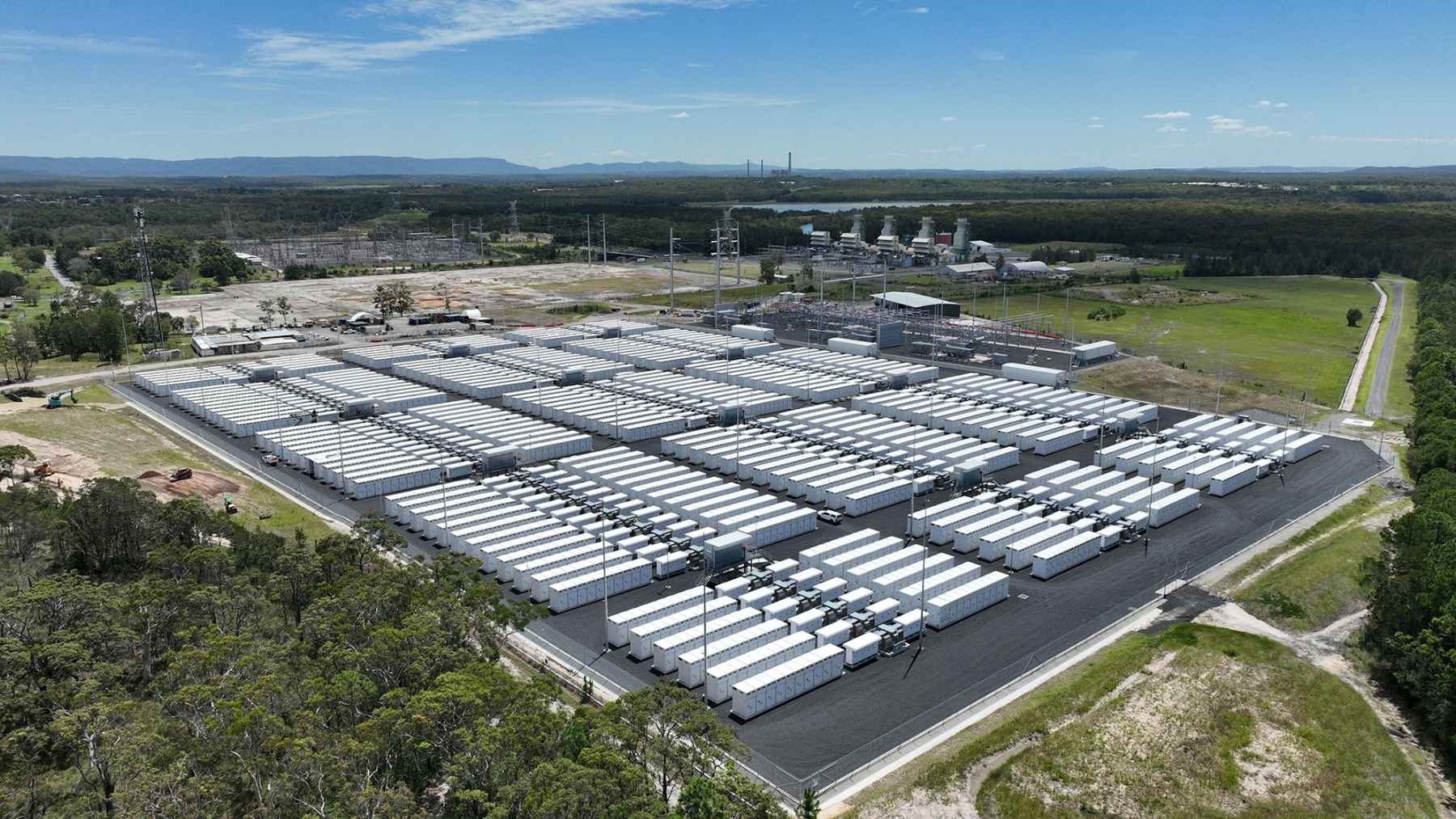
We’ve gotten used to batteries replacing coal plants on paper. This one did it on the same patch of dirt. Waratah stands on the footprint of the Munmorah power station, a 1,400-megawatt coal plant about 60 miles north of Sydney that ran for 45 years before it closed and got knocked down. Renew Economy calls what’s there now the most powerful machine of any kind connected to the Australian grid, and it can push out more than half of what the old plant managed, for two hours, from a field of containers nobody has to feed.
It isn’t the only one down there, either. The same owner recently switched on a wall of 448 Tesla Megapacks in the New South Wales outback, and a utility outside Brisbane has plugged in a sodium sulfur battery running at 645 degrees. Lithium’s winning by a mile, but it’s not the only chemistry turning up on the Australian grid.
Akaysha chief executive Nick Carter wrote on LinkedIn that the project “tested us in many ways,” which is about as much drama as you’ll get out of a man who just spent a year waiting on a transformer. Akaysha dated final commercial operations September 28, 2026, and the full 700-megawatt contract, with its 1,400 megawatt-hours of guaranteed storage, is now running at full size, roughly 18 months after it was supposed to.
 @markkinner ROOKIE3 weeks ago