
Every nuclear startup pitching the US right now is selling some flavor of small modular reactor. Usually a light-water design, usually still on a slide deck, usually promising to be ready by the early 2030s.
It’s been the same script for about five years.
So when a Canadian engineering firm walks into the Nuclear Regulatory Commission this month with a 700-plus megawatt heavy-water reactor that already exists in four countries, runs on unenriched uranium, and gets refueled while it’s still making electricity, it stands out.
That happened on June 24. AtkinsRéalis, the Montreal-based steward of CANDU technology, filed a Notice of Intent with the NRC to start pre-application licensing for the Enhanced CANDU 6 in the United States.
The pitch is blunt. Hyperscalers and industrial loads need round-the-clock baseload that wind and solar can’t deliver alone, the existing American fleet is aging, and the SMR crowd is still years from a commercial unit.
CANDU, the company argues, can plug that gap with a reactor that’s already logged decades of grid hours abroad.
What a CANDU actually is, and why it’s the oddball in the room
The acronym stands for Canada Deuterium Uranium, and that name carries most of the engineering.
Instead of regular water, a CANDU uses heavy water, where the hydrogen is swapped for deuterium, as both moderator and coolant. Heavy water absorbs far fewer neutrons than the ordinary kind, so the chain reaction runs on plain, unenriched natural uranium straight out of the mine.
Every reactor in the US fleet, by contrast, runs on enriched fuel and ordinary light water.
That one choice cascades. The fuel is cheaper per kilogram and doesn’t need centrifuge cascades to make, and the supply chain isn’t tied to enrichment services dominated by Russia and a handful of others.
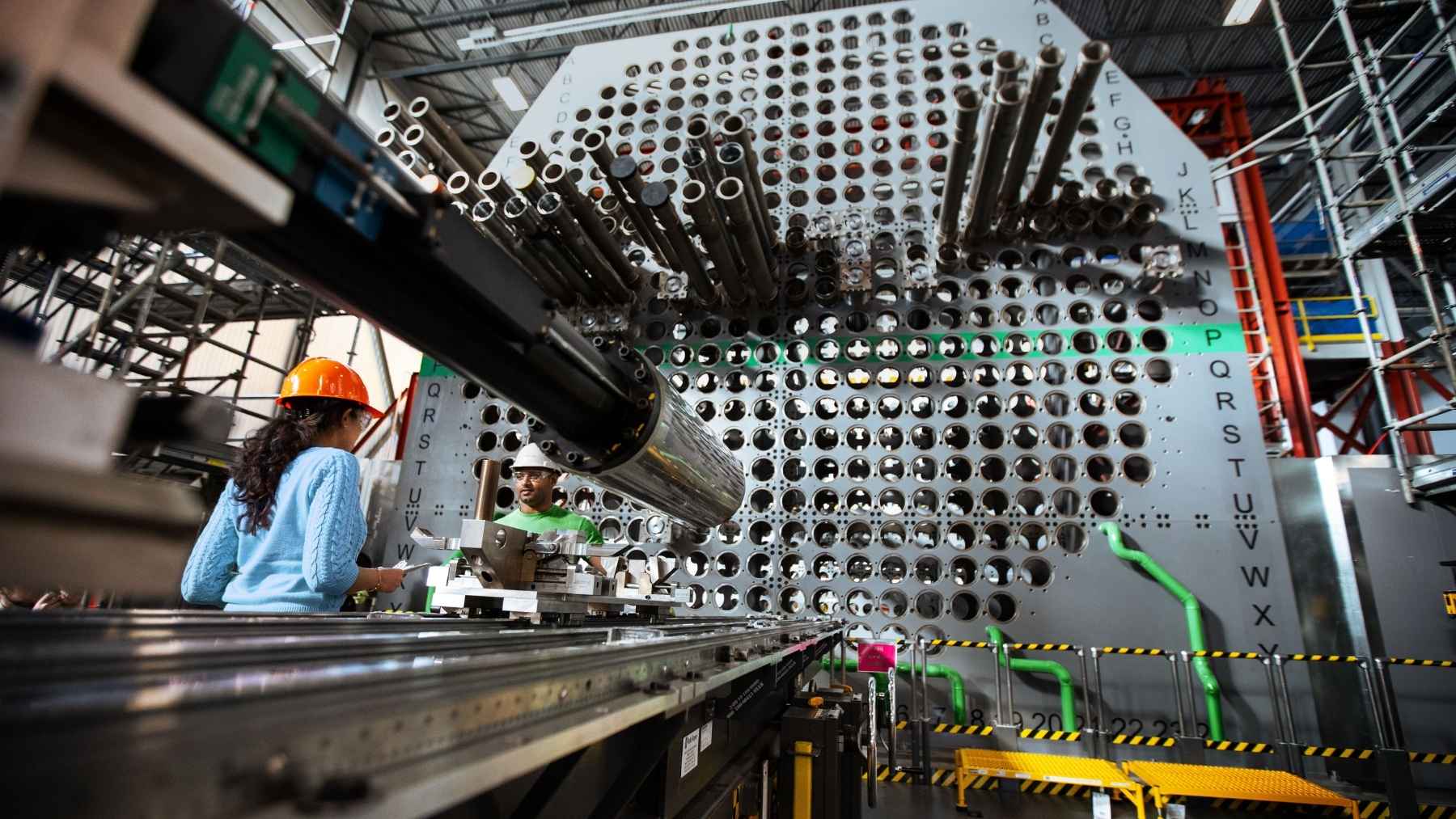
And because CANDU bundles its fuel into hundreds of short pressure tubes instead of one big vessel, individual fuel channels can be opened while the reactor is running.
That last part is the headline feature. The machine doesn’t have to stop generating to swap fuel bundles.
A light-water reactor takes a multi-week outage every 18 to 24 months to reload. A CANDU just keeps running.
An SMR this is not
Most of the nuclear pitches chasing AI money are paper reactors. Designs from a handful of well-funded startups, lots of renderings, a few prototypes scheduled for the end of the decade.
CANDU is a different animal. AtkinsRéalis says the platform has 34 units built and nearly 1,000 reactor-years of operating experience across Canada, South Korea, China, Romania and Argentina.
Every power reactor in Canada is a CANDU. The design has kept the lights on for an entire G7 country for half a century.
Compare that to the SMR ecosystem being marketed by billionaire-backed startups, and the contrast is the whole sales pitch.
One side is offering a first-of-a-kind concept that needs a first-of-a-kind license, like the SMR-300 Canada just lowered into a shaft in Ontario. The other is offering a machine you can go watch run at Bruce or Darlington today.
The trade-off is size. A 700-plus MW CANDU isn’t a small reactor, it’s a full-scale baseload unit. If you want one on your data-center campus, you need an actual nuclear site, not a parking lot.
The geopolitics pitch
The filing itself is procedural. A Notice of Intent is the entry ticket, not the license.
But the argument behind it is aimed at a specific anxiety in Washington: where reactor fuel actually comes from.
Joe St. Julian, who runs AtkinsRéalis’s nuclear business, says CANDU pulls American utilities out of the enriched-uranium lane entirely, cutting “reliance on foreign enrichment services.”
Natural uranium needs no enrichment, and the enrichment market the US leans on is dominated by Russia. CEO Ian Edwards framed the filing as a new chapter for US civilian nuclear and a win for Canadian industry.
The NRC is the hard part
The US regulator has spent more than half a century writing rules for light-water reactors. Boiling water, pressurized water, every chapter of the code assumes that family of designs.
Drop a heavy-water reactor with hundreds of horizontal pressure tubes into that framework and a lot of the playbook simply doesn’t map.
AtkinsRéalis has been here before, and it didn’t go well.
The predecessor Atomic Energy of Canada tried to license a different design, the ACR-700, starting in 2002 with Dominion Energy. That one actually used slightly enriched uranium and light water as coolant, a more conventional hybrid than the EC6.
It still got flagged. In a 2004 letter, the NRC warned the review would be tougher and might “take longer to review than a typical light-water design,” pegging certification at past 60 months. Dominion walked away soon after.
This time the company is filing under a newer framework. Part 53, the NRC’s risk-informed, technology-inclusive rule, only became final in March 2026, and it compels the agency to decide on a commercial plant within 18 months.
St. Julian has said the team is shooting for around 12. Whether the NRC hits that on the first large non-light-water reactor it has reviewed in two decades is another question.
The customer list is already half-built
This isn’t a speculative pitch hoping a utility shows up. AtkinsRéalis says it’s already talking with US utilities, state governments and hyperscalers, including data-center operators, about possible sites.
The strategy is to bolt new CANDU units onto existing nuclear sites, where the licensing, transmission and community-acceptance work is largely done, rather than greenfielding reactors into new jurisdictions.
That lines up with the rest of the US nuclear restart story. Three Mile Island Unit 1 coming back for Microsoft, Palisades being pulled out of decommissioning, Constellation pushing license extensions on its existing fleet.
The cheapest reactor to build is one you already have. The next cheapest is one you put on a site that’s already nuclear.
And then there’s the Monark
The EC6 isn’t the only CANDU AtkinsRéalis wants in the US conversation.
The company is also developing an updated version of its 1980s-era CANDU 850, dubbed the Monark, with a planned capacity of 925 megawatts. That one has to clear the Canadian Nuclear Safety Commission first, then it heads to the NRC.
For now, the EC6 is the test case.
If a 700-plus MW heavy-water reactor with a 50-year pedigree can get through a US process built around an entirely different family of machines, it cracks open a market that’s been functionally closed to foreign vendors since the 1970s.
If it can’t, AtkinsRéalis becomes the second Canadian CANDU bid to bounce off the NRC in 25 years, and the SMR crowd gets the AI baseload market to itself by default.
Either way, the next 12 to 18 months in Rockville are going to be more interesting than usual.
 @luismolina ROOKIE3 months ago