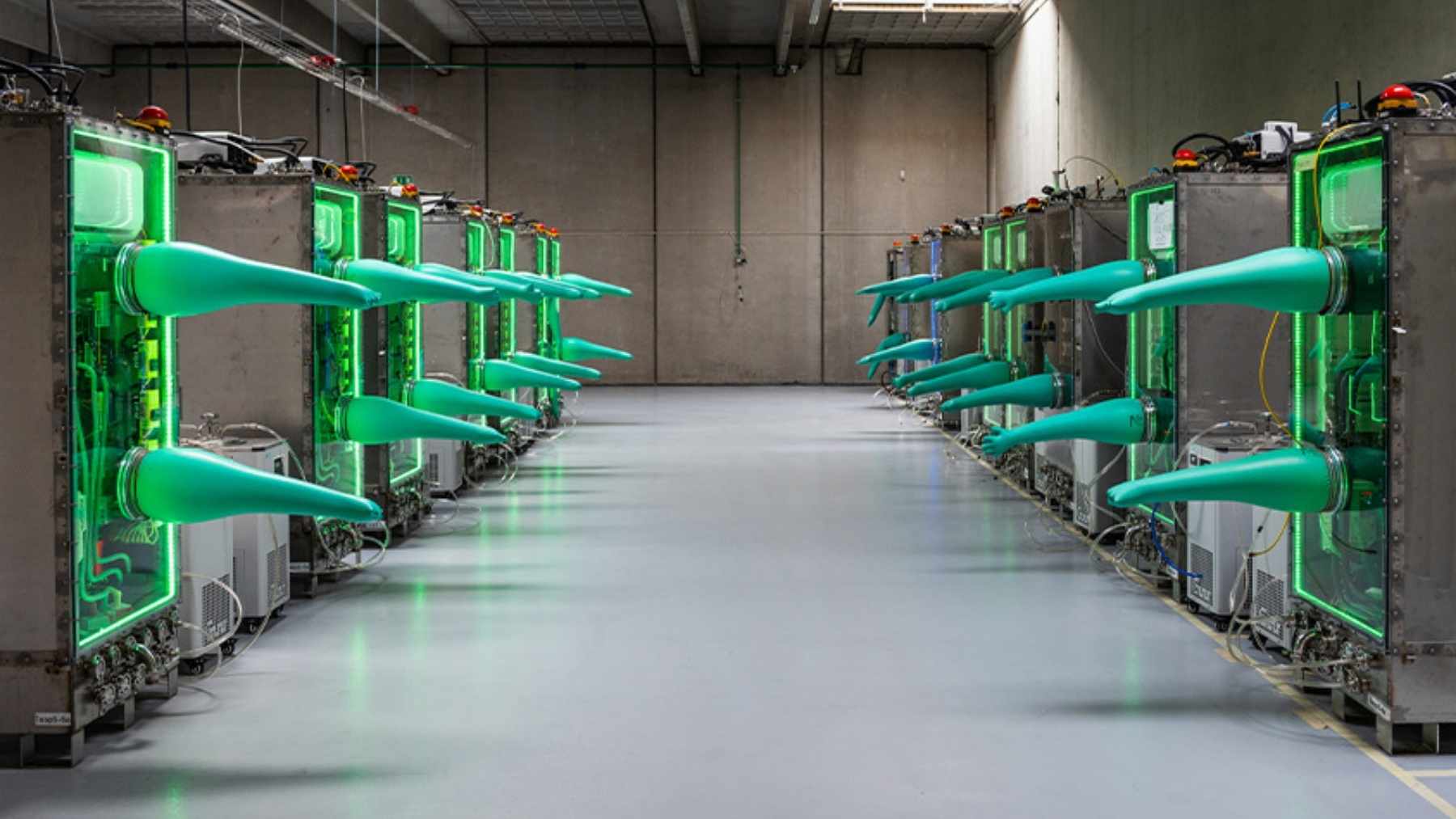

Building a nuclear reactor is one of the slowest, most expensive things a country can decide to do. The typical plant takes the better part of a decade, runs into the billions, and gets poured in place one giant concrete slab at a time.
A Danish company called Copenhagen Atomics looks at that and sees a manufacturing problem, not a physics one. The plan is to stop building reactors like cathedrals and start stamping them out like cars. One per day, off an assembly line, each one small enough to fit inside a standard 40-foot shipping container.
That is the pitch, anyway. The reality is a company that has built real hardware, run a molten salt pump for two years straight, and still has not split a single atom in one of its own reactors. Both of those things are true at once, and the gap between them is most of the story.
The whole reactor is designed to fit in a shipping container
Start with the machine, because it is the part that actually exists. Copenhagen Atomics is building a thorium molten salt reactor rated at 100 megawatts of heat, small enough that the whole core assembly drops into a 40-foot container and ships on a truck, a train, or a boat. There is no pouring concrete around it on site. You install it, you do not build it.
Inside, the design is something the company trademarked as the Onion Core. It is built in layers, like the name says. The outer layer is a blanket of molten thorium salt. Inside that sits a layer of heavy water. Further in is the fuel salt, a mix of lithium-7 fluoride and low-enriched uranium that runs into the core at around 1,100°F (600°C) and comes out hotter.
The heavy water is the moderator, which is the unusual part. Most molten salt designs lean on graphite or run a fast neutron spectrum, and Copenhagen Atomics went a different way with unpressurized heavy water instead.
The salt does double duty as fuel and coolant, and that is the whole reason these reactors behave differently from the pressurized water plants on the grid today. Water has to be squeezed under enormous pressure to stay liquid in a hot core. Molten salt is already liquid and stays that way at ordinary pressure, so there is no thick steel pressure vessel and no boiling-dry failure mode to design around. It is the same basic advantage behind the molten salt reactor America just cleared for construction in Oak Ridge, Tennessee.
The pitch is one reactor a day, built like a car
Here is where the automotive comparison stops being a metaphor. Copenhagen Atomics says the entire point of shrinking the reactor into a container is so it can be built the way cars are built: on an assembly line, in sequence, from parts made by hundreds of suppliers.
The stated target is one reactor per day per line, according to Nuclear Engineering International, with finished units bolted together like Lego bricks for a larger plant. No on-site reactor assembly, only installation.
The reason to bother is cost. The company is aiming for electricity below $20 per megawatt-hour once it reaches manufacturing scale, which would undercut just about everything, nuclear or otherwise. It even publishes a sticker price: $50 million per reactor unit, all-in, plus a $2 million annual fee, quoted in 2025 dollars. Whether those numbers survive contact with a real factory is an open question. Putting a price tag on the thing at all is the point.
Copenhagen Atomics is upfront that this is the Tesla and SpaceX playbook aimed at fission: build the hardware first, test it to death, fix what breaks, and worry about scale later. The reactors themselves are meant to be deployed by a sister company, UK Atomics, which would own and operate a fleet and sell the power as a service, eventually numbering, the company says, in the thousands. That is a long way from where things stand. But it explains why a reactor outfit keeps talking like a manufacturer.
Thorium is the fuel the US shelved in the 1960s
Thorium is the other half of the pitch, and it comes with a catch that has kept it on the shelf for decades. Thorium is not actually a nuclear fuel. It is fertile, not fissile, which means a lump of it will sit there and refuse to sustain a chain reaction on its own.
It has to absorb a neutron and transmute into uranium-233 before anything fissions, and that only happens if you seed the reaction with something fissile to begin with, like low-enriched uranium or plutonium.
Do that, though, and thorium turns into one of its stranger selling points: a reactor that eats nuclear waste. Copenhagen Atomics calls its design a waste burner, because it can run on the transuranic elements left over in spent fuel from conventional reactors. Feed it that leftover plutonium as a kickstarter and it converts the long-lived material into fission products that need storing for roughly 300 years instead of 100,000. Company co-founder Thomas Jam Pedersen has said the reactors can pull about ten times more energy out of spent fuel than the original reactor got out of it the first time.
None of this is new science. It is old science that got abandoned. In the 1960s, Oak Ridge National Laboratory in Tennessee ran the Molten-Salt Reactor Experiment, proved the chemistry worked, and then the US quietly dropped the whole line in favor of the uranium reactors that became the standard.
Right now the country furthest along on picking it back up is China, where a small experimental machine in the Gobi Desert became the first anywhere to convert thorium into usable fuel while running. Copenhagen Atomics is chasing the same physics from the opposite direction, betting on a factory instead of a single national lab.
The nuclear part hasn’t happened yet
This is the part to keep straight. Copenhagen Atomics has built two full-size prototype reactors and is assembling a third, but all of them run on non-radioactive salts heated with electricity. They are engineering test rigs, not power plants. No Copenhagen Atomics reactor has ever gone critical.
What the company can point to is component testing, and there it has a real number. In early 2026 it reported running a single molten salt pump continuously for two full years at high temperature, one of the longest tests of its kind anywhere, with more than 100,000 hours of combined pump runtime across its test loops.
Circulating hot salt reliably for years is exactly the unglamorous problem that has sunk molten salt reactors before, so proving a pump can do it matters more than it sounds. Component reliability, as CEO and co-founder Thomas Jam Pedersen put it, “has to be proven repeatedly over long periods and under realistic conditions.”
The first actual chain reaction is supposed to happen at the Paul Scherrer Institute in Switzerland, in a critical experiment using the Onion Core design. That test has slipped. It was once floated for 2026 to 2027, and the company’s current schedule now puts it no earlier than 2028, with commercial reactors penciled in for the early 2030s.
The company did lock down one piece of the supply chain in February 2026, signing a letter of intent with Rare Earths Norway to source thorium from one of Europe’s largest rare earth deposits, where the material currently gets treated as a byproduct. It is not a binding supply deal, but it is a signal the company is thinking past the lab.
So the honest scorecard reads like this. The container is real, the pump is real, the salt chemistry is real, and there is a published price list. The assembly line stamping out a reactor a day is a rendering, and the first fission is still years out.
Copenhagen Atomics has nailed the part everyone underestimates, keeping a pump alive for two years, and has not started the part everyone assumes, actually splitting an atom. For a technology the US invented in Tennessee and then buried, getting even this far inside a shipping container beats fifty years of the idea going nowhere. A reactor a day is the easy sentence to write. It is a much harder thing to build.
















It is also extremely difficult to produce weapons grade materials, compares to uranium reactors, hence the worldwide preference of uranium over thorium cycle reactors.