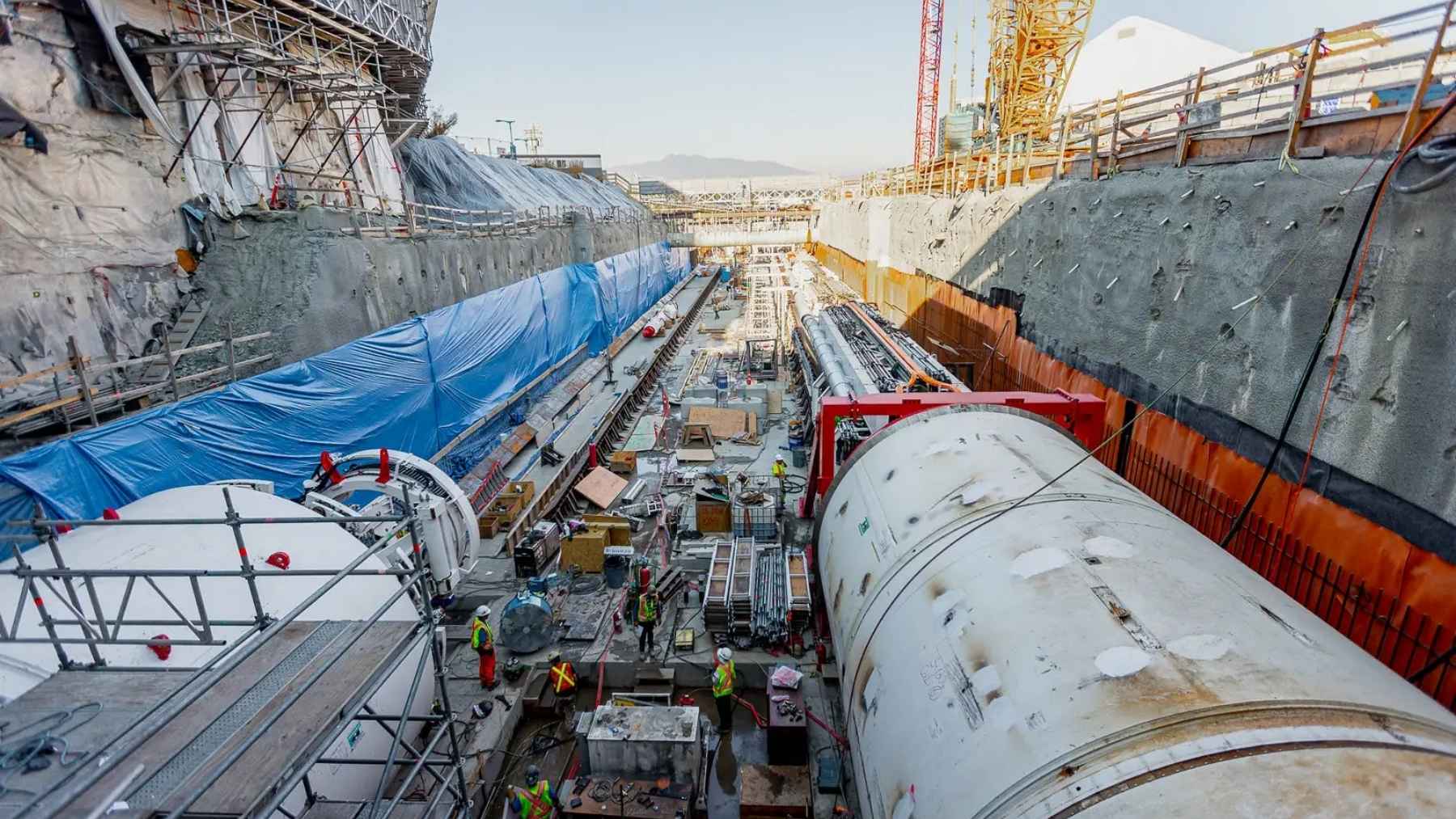

Tunnel boring machines get retired the way most heavy industrial equipment does. They finish the hole, a crew cuts them into pieces small enough to lift, and the pieces go out on trucks. Vancouver’s two went through exactly that between March and July of 2024, at the bottom of a pit on Cypress Street.
But the names bolted to those two machines belonged to a woman who ran fighter plane production during the Second World War and a woman who found a mountain nobody had mapped. And now that test trains are finally moving through the tunnels they left behind, the machines are worth a second look.
The Broadway Subway Project extends Vancouver’s Millennium Line 5.7 kilometers, about 3.5 miles, west from VCC-Clark Station to Arbutus Street. Roughly 2,300 feet of that is elevated guideway. The other 5 kilometers, a shade over 3 miles, is twin bored tunnel running under Broadway with six new underground stations strung along it.
Two Herrenknecht machines dug it. The Province of British Columbia named them Elsie and Phyllis in October 2022, after Elizabeth “Elsie” MacGill and Phyllis Munday.
The province measured its own machines in elephants and blue whales
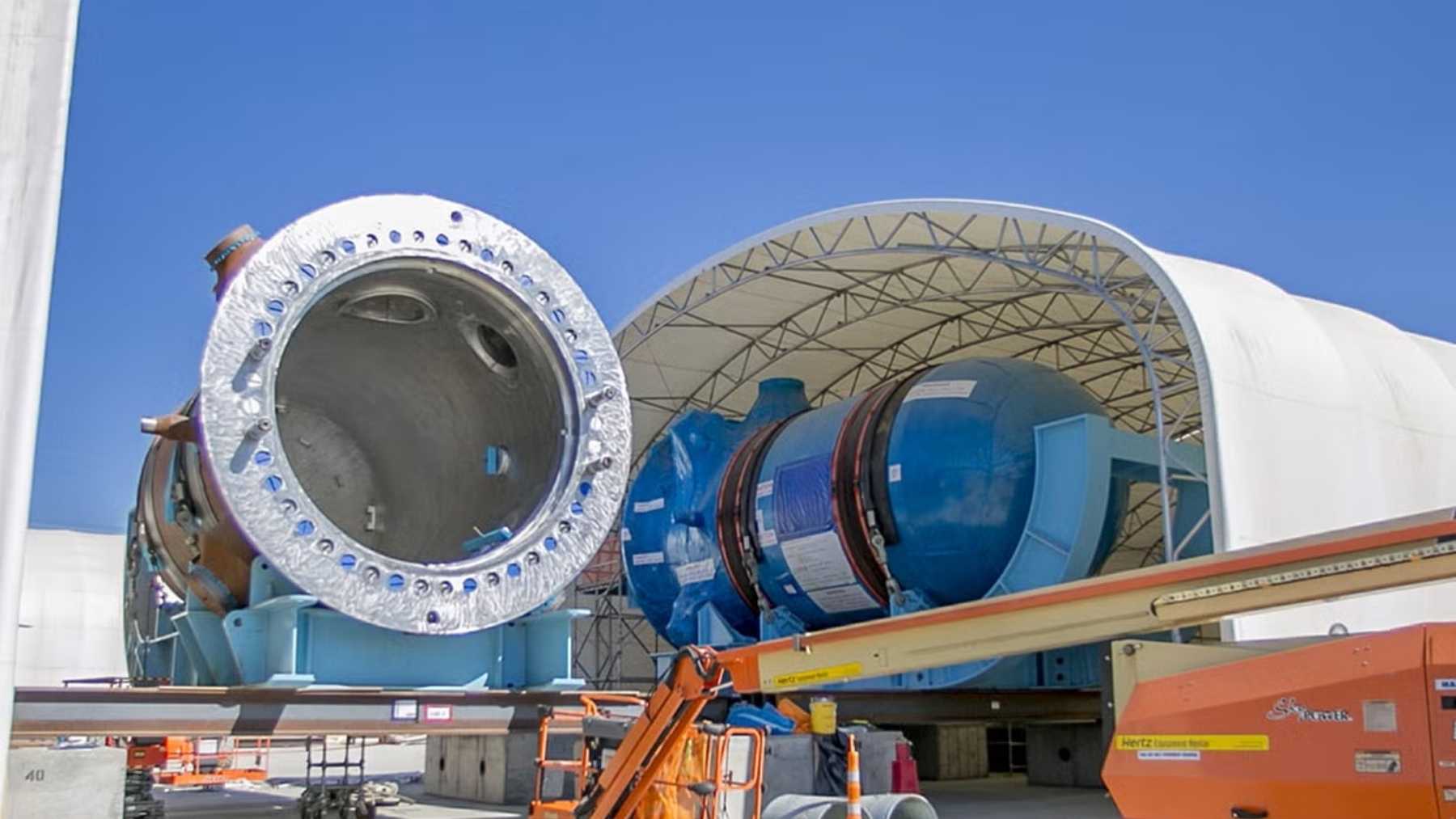
Each machine ran 150 meters end to end, close to 492 feet, with a cutterhead 5,960 millimeters across. That is a hair under 20 feet, or wide enough to swallow a two-lane road.
Each one weighed roughly a million kilograms, about 1,100 US tons. British Columbia’s own technical bulletin on the machines puts that at 333 elephants, and the 150-meter length at five blue whales laid nose to tail. Government communications teams do not usually get to write sentences like that, so you can tell they enjoyed it.
Eight to 12 people worked inside each machine. The spec called for about 18 meters of advance per day, roughly 59 feet, with the tunnels sitting around 15 meters below the street and dropping to 20 meters at Broadway-City Hall. The extra depth there is not a geological accident. That station has to duck under the existing Canada Line tunnel, and the 2018 business case set the alignment accordingly.
Between them the two machines pulled out about 200,000 cubic meters of ground, near enough 262,000 cubic yards, all of it hauled to the surface at Great Northern Way on a conveyor. The concrete rings that line the tunnels came from a plant in Nanaimo, on Vancouver Island. Munday died on that island in 1990, at 95.
Elsie MacGill finished her aeronautics degree the year polio put her in bed
MacGill was born in Vancouver in 1905. She started engineering at the University of British Columbia, finished at Toronto in 1927 as the first woman in Canada with an electrical engineering degree, and then went to the University of Michigan for a master’s in aeronautical engineering.
She contracted polio in 1929, the same year she finished that degree. Doctors told her she might not walk again. She did, with canes, for the rest of her career.
The Province’s backgrounder on the two namesakes calls her “the first woman aeronautical engineer and professional aircraft designer in the world.” Several aviation historians hedge that slightly to first in North America and probably the world, which is the more careful version of the same claim. Either way nobody has produced an earlier one.
Her actual job was harder than the title suggests. At Canadian Car and Foundry in Fort William, Ontario, she was handed a railcar factory and told to turn it into a Hawker Hurricane plant for the Royal Air Force. She got it retooled inside a year, running a workforce that eventually numbered in the thousands, most of them with no aircraft experience and a lot of them women.
The winterization work is the part that ended up on the machine. MacGill developed the ski undercarriage and the de-icing system that let Hurricanes operate through a Canadian winter. Wartime comics nicknamed her Queen of the Hurricanes. She died in 1980.
Phyllis Munday carried a 77-pound pack and declined the lighter one
Munday was born in 1894 in what was then Ceylon, now Sri Lanka, where her father managed tea estates. The family reached British Columbia in 1901 and the Vancouver area in 1907.
She trained as a nurse and met her husband Don Munday while he was recovering from wounds at a military hospital where she worked. They married in 1920 and honeymooned climbing near Mount Robson.
In 1924 she became the first woman to reach the summit of Mount Robson, at 12,972 feet the highest peak in the Canadian Rockies. According to the Canadian Encyclopedia she carried loads of up to 35 kilograms on climbs, about 77 pounds, on the grounds that she was not interested in special treatment. Over three decades the Mundays climbed more than 100 peaks in British Columbia and Alberta, a third of them first ascents.
The mountain that took the longest was the one they spotted through a gap in the clouds from Mount Arrowsmith on Vancouver Island in 1925. They called it Mystery Mountain, spent more than a decade trying to reach it, and it was officially named Mount Waddington in 1928 on their recommendation. At 13,186 feet it is the highest peak lying entirely inside British Columbia.
She also founded the first St. John Ambulance brigade in North Vancouver, and the province credits her with founding the Girl Guides in British Columbia. She received the Order of Canada in 1972 and turned up on a Canada Post stamp in 1998.
The ground under Broadway is sandstone, and the machines were specified for it
Neither province nor contractor published much about what was actually down there, which is normal. Herrenknecht did. Its own project reference page lists both machines as earth pressure balance shields with 1,400 kW of drive power and 4,713 kNm of torque, driven through sandstone at a typical depth of 15 to 20 meters. The company says the EPB configuration was chosen for the ground conditions between Great Northern Way and Arbutus.
The schedule tells you the rest. Elsie launched on October 7, 2022 and Phyllis on November 29. Each was billed as roughly a year of digging.
Elsie broke through at Mount Pleasant on the evening of January 23, 2023 and reached Broadway-City Hall on April 14. Phyllis came through Mount Pleasant on March 18 and Broadway-City Hall on May 26. Both sat through unusually long maintenance stops at that deep Cambie Street box, and it was around there that Phyllis overtook the machine that had launched seven weeks ahead of her.
Phyllis made her final breakthrough into the Arbutus pit on March 20, 2024. Elsie followed on April 26. That is about 16 months for one and 18 and a half for the other against a plan of about 12, and it works out to an average closer to 9 or 10 meters a day than the 18 the machines were rated for once you count every day they spent parked.
Nobody at the province is calling fall 2027 a delay
The 2018 business case had trains running in 2025. The current date is fall 2027, and the language around that gap is worth reading closely.
The June 2026 monthly status report marks the project as “tracking within the approved schedule,” which is true against the rebaselined date rather than the original one. When the province announced the shift in May 2024 it pointed at utility relocations, traffic decks, tunneling under the Canada Line, station excavation, and a five-week concrete strike in 2022 that held up construction of the launch pad. Canadian outlets reported it as a delay. Both descriptions are accurate depending on which baseline you use.
The money is more straightforward. That same June report puts total spending at C$2.232 billion against an approved C$2.954 billion, with C$22.7 million going out in June alone. The funding splits into C$1.957 billion from British Columbia, C$896.9 million from Ottawa and C$100.3 million in land from the City of Vancouver.
Testing started in late May 2026, with vehicles 013 and 014 fitted out and running on roughly 2 kilometers of finished track. Transportation Minister Mike Farnworth said in the announcement of the testing phase that the exercise will “confirm that all systems are performing safely and reliably.” Crews are also adding ballast to the trains to fake a full passenger load.
Surface work is still ongoing. A six-month closure of West Broadway between Cambie and Alberta started on July 20, 2026, timed for the day after the World Cup final, so crews can pull out the temporary traffic decking above Broadway-City Hall Station.
Elsie and Phyllis came apart at Cypress Street
Both machines were always going to end at the same place. The 2022 bulletin said they would be disassembled and lifted out through an excavation shaft at Cypress Street, and that is what happened, between March and July 2024, alongside the removal of the conveyor system that had been carrying spoil out for a year and a half.
Where the pieces went after that is not on the public record. No project document, provincial release or contractor statement says whether they were scrapped, warehoused, refurbished or sold on to another job. Herrenknecht machines do get rebuilt and redeployed, and Vancouver’s would not be the first, but nobody involved has said so and it would be guessing to write it down as fact.
Canada has kept a decent run of these going. Montreal launched Lisette under the Blue Line in May, Toronto has Diggy Scardust grinding a 39-foot hole under Scarborough and a 1,000-tonne water tunnel machine that crossed a buried prehistoric valley. Melbourne is training the first all-women tunneling crew to run one. Herrenknecht just finished a 16.4-meter machine for what would be America’s widest subway tunnel in San Jose, which still has no start date.
The naming convention on all of them is the same, and it is usually the softest part of the press release. Vancouver picked an engineer who retooled a factory in twelve months and a nurse who spent a decade walking into unmapped country to find a mountain. Two machines got their names for about eighteen months and then got cut up. The tunnels are the part that stays.
 @geordiebirch ROOKIE2 months ago