
Sails on cargo ships sound like the kind of thing that got retired around the time steam engines showed up. Canvas, wooden masts, the whole Age of Sail package, filed under “cute historical footnote” a century and change ago.
A Swedish outfit called Oceanbird disagrees. It just bolted a 131-foot rigid wing sail onto a working car carrier and sent the ship straight back to its regular commercial route, betting that wind can shave roughly a tenth off the fuel bill without anyone rewriting a schedule.
The vessel is the Tirranna, a 230-meter (754-foot) Wallenius Wilhelmsen car carrier. Alfa Laval, which owns Oceanbird together with Wallenius Lines, confirmed the ship passed its harbor and sea acceptance tests on July 1, 2026. In shipping terms, that means the thing works and nobody wants it back in dry dock.
The wing has a name, Wing560, and it’s the first Oceanbird prototype ever installed on a ship. The company says it opens the entire car carrier segment to wind propulsion.
The wing is 40 meters of aircraft engineering stood on end
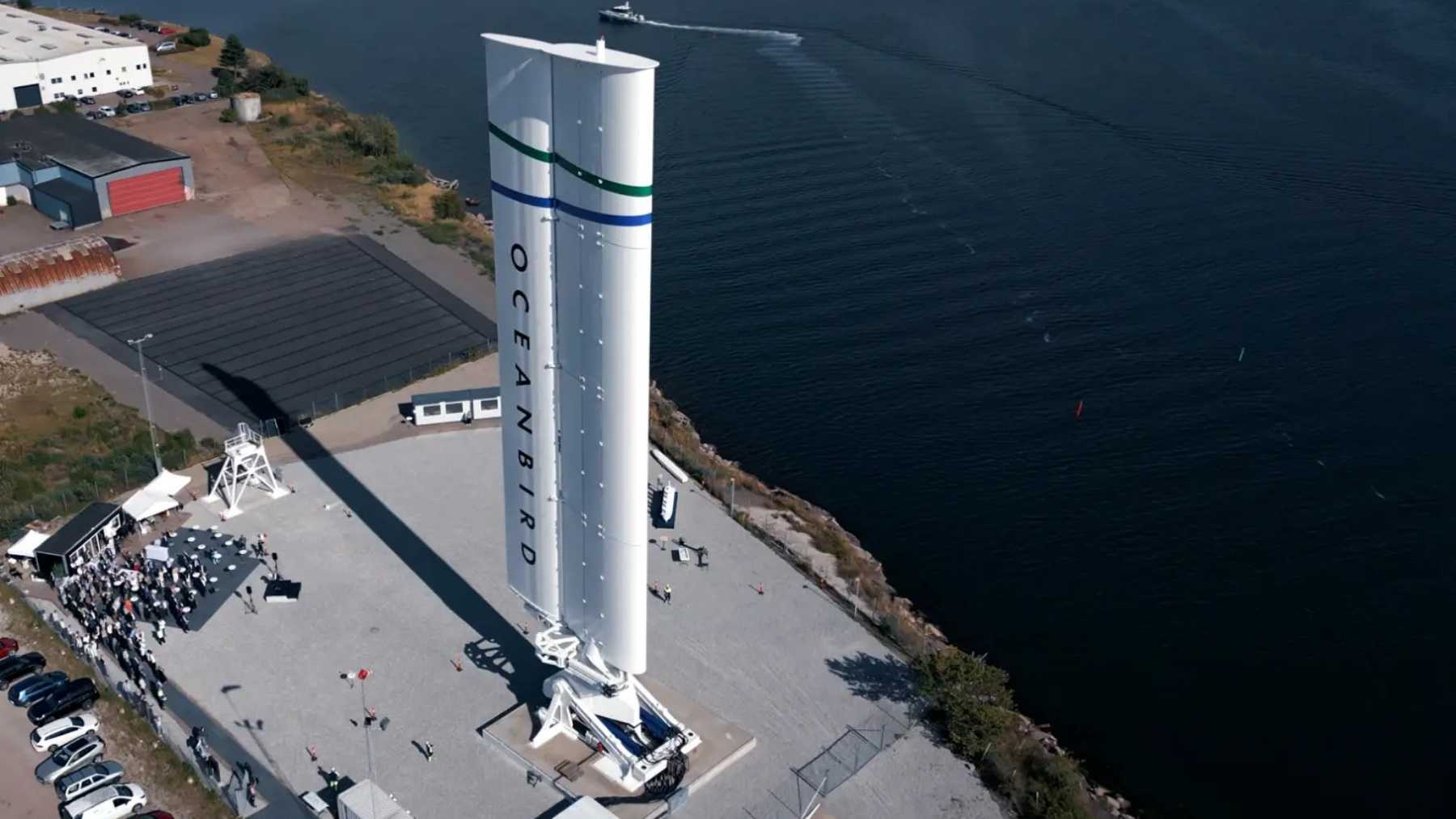
A rigid wing sail is closer in spirit to an airliner wing turned vertical than to anything you’d find on a schooner. The wing itself stands 40 meters tall and 14 meters wide per Alfa Laval, 46 meters if you measure from the foundation to the tip. Call it 131 feet by 46 feet in freedom units.
The name comes from the sail area: 560 square meters of it, on a mast and foundation of carbon steel, with the flap and panels built around a PET core wrapped in glass-fiber composites.
Running the thing costs almost nothing. Oceanbird puts the wing’s own consumption at 6 to 10 kilowatts during normal operation, the electrical appetite of a few kettles, in exchange for free thrust off the wind.
It also tilts. That matters for bridges and cranes, but it was designed first as a safety feature for hard weather, and it’s a big part of why classification society DNV blessed the concept. When DNV granted the design its Approval in Principle back in 2023, it specifically stress-checked extreme wind loads, snow and ice, and green sea, the cheerful maritime term for waves crashing over the deck. The final design certificate for the Tirranna installation landed in the first week of June 2026.
The ship is a 17-year-old workhorse, and that’s the point
The Tirranna is not an experimental research hull. Built in 2009 by Daewoo in Okpo, South Korea, it’s a 29,936-dwt roll-on/roll-off carrier with room for 7,620 cars, and it has spent years as a regular on the transatlantic run, hauling vehicles from Bremerhaven, Gothenburg and Zeebrugge to US ports.
The retrofit has been cooking for a while. Back in 2024, during its ordinary five-year docking, the ship went through structural surgery at IMC Shipyard in Zhoushan, China: steel reinforcements, cabling, and the foundation for the wing’s folding mechanism. The original plan penciled the wing in for early 2025. It went on in June 2026.
The installation itself ran June 21 to 24 at Damen Shipyard in Rotterdam, per Oceanbird, and the Tirranna left the yard the same day it finished to get back on its commercial schedule. Wallenius Wilhelmsen confirmed the sea acceptance test wrapped on July 1.
“We look forward to testing the technology and seeing its impact first hand,” said Jørgen Westrum Thorsen, the company’s vice president for its Orcelle Accelerator program.
The 10% number is a target, not a result. Yet.
Oceanbird’s stated goal for a single Wing560 is around a 10% energy-efficiency gain. Nobody has measured it in service, and that’s the whole reason a team of Oceanbird engineers is currently living aboard the ship, collecting performance data and watching how the wing behaves when the North Atlantic starts having opinions.
They aren’t starting blind. The wing on the Tirranna is the second one built; its identical twin has been running land-based tests at Oresund DryDocks in Landskrona, Sweden. And the crew went through Oceanbird’s first training program back in December 2025, learning when the wing needs to stow and, more usefully, when it doesn’t. The fastest way to kill a new technology at sea is to hand it to a crew that doesn’t trust it.
Car carriers make an interesting test case. They’re floating parking garages, tall and boxy, with enormous flat sides that act like giant sails whether you want them to or not. In crosswinds that profile is a liability. Bolt an actual sail on top and you can, in theory, start converting a problem into propulsion.
A 10% cut sounds modest until you look at what these ships burn. A vessel this size chews through tens of tons of fuel oil a day on ocean crossings, and shipping as a sector produces about 3% of global greenhouse emissions while carrying roughly 90% of world trade. Trimming a tenth per ship, fleet-wide, with no new port infrastructure, is real money and real carbon.
One wing today, an EU consortium and a newbuild behind it
The Tirranna is the flagship demonstrator for Orcelle Horizon, an EU-funded program with eleven partners, including Wallenius Wilhelmsen, Oceanbird, Wallenius Marine, Sweden’s KTH Royal Institute of Technology, research institute RISE and Ghent University.
Data from this single-wing setup feeds the design of Orcelle Wind, a planned newbuild engineered around multiple wing sails from the keel up rather than retrofitted. The Wallenius fleet vision, as the companies describe it, is wind covering up to 50% of propulsion power on suitable routes, without wrecking commercial schedules. Anyone can build a wind ship that arrives whenever the weather feels like it. Building one that hits its Thursday port call is the hard part.
Oceanbird has already sold the next batch, too. The company took its first commercial order in February 2026, a pair of Wing560s for an undisclosed vessel, with installation slated for spring 2027.
Wind assist itself isn’t new. Rotor sails, the spinning Magnus-effect cylinders, have been on commercial vessels since the mid-2010s, and the industry keeps piling into alternatives, from battery-electric container ships on coastal runs to gas turbines certified to burn pure hydrogen. What hadn’t happened until now was a full-scale rigid wing operating on a car carrier route.
It’s still a supplementary system. The engine is there, still burns fuel, still handles the days when the wind quits or blows from the wrong direction. “This is a pivotal moment for us, and it is just the beginning,” Oceanbird CEO Amrit Bhullar said in the company’s announcement. One wing on one ship is a proof point, not a revolution; the revolution is if the sea data backs the modeling and owners start ordering these by the dozen.
The Tirranna is out there right now, hauling cars with a very tall wing on its deck and a group of engineers in the accommodation block watching sensors. If the 10% holds up in real weather, expect a lot more car carriers to start looking like they’ve grown a fin.
 @sandrajanes ROOKIE2 months ago