
Keeping the grass down on a solar farm sounds like the most boring job in clean energy, right up until you remember what’s sitting in that grass. Miles of cabling, banks of inverters, and a few million dollars of hardware, all of it allergic to a mower blade in the wrong place.
The modern instinct is to throw machines at the problem. In California, a fleet of robots recently clamped down 100 megawatts of panels faster than any human crew could manage.
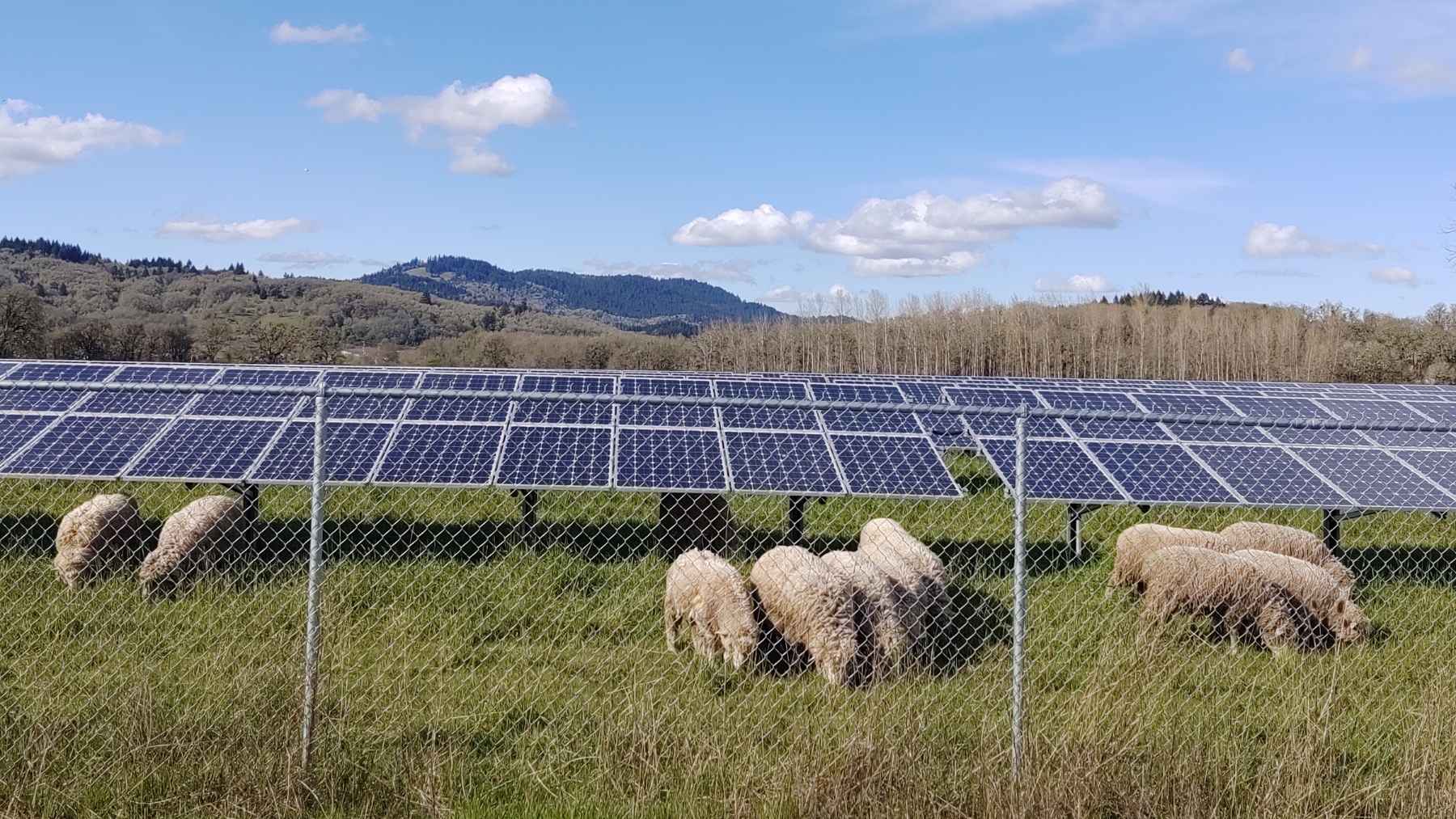
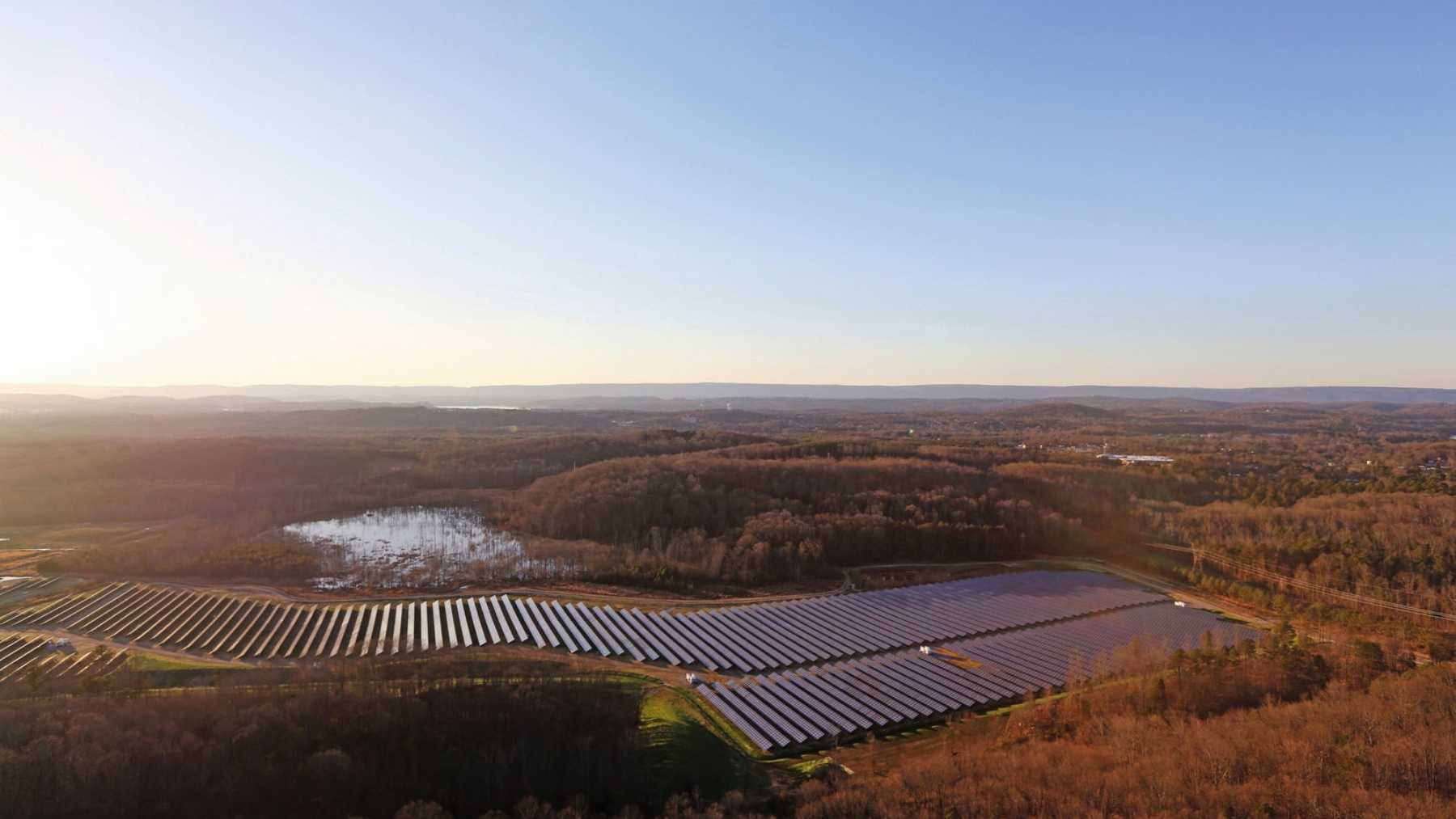
At Volkswagen’s plant in Chattanooga, Tennessee, the grass under 33,600 solar panels gets handled the old way. About 50 sheep eat it. And because sheep in coyote country need looking after, a rescued guard donkey patrols the rows to keep them alive.
A mower and a field full of inverters don’t mix
Solar farms have to keep their vegetation in check. Let the grass grow tall and it shades the lower panels, drags down output, and turns into a fire risk by late summer.
The obvious fix is mowing. The trouble is that a solar field is wall-to-wall electrical gear: buried cabling, sensitive inverters, and steel mounting posts every few feet. Run heavy machinery through that and you’re one bad turn from shredding a cable or cracking something expensive. Fuel-powered mowers also drip hydraulic fluid and burn diesel right next to the thing that’s supposed to be clean.
So Silicon Ranch, the Nashville company that owns and runs the array, brought in sheep instead. They crop the grass low, reach the awkward spots between rows that a mower can’t, fertilize as they go, and never touch the wiring.
Volkswagen did weigh the cheaper grazer. It says goats were a hard no, because they jump on the panels and bite through the cables. Sheep keep their heads down and their teeth on the grass, which is exactly what you want around acres of glass and copper.
The sheep needed a bodyguard
Putting a flock in a field solves the mowing problem and creates a new one: predators. Tennessee has coyotes, and 50 sheep with nobody watching them is an open invitation.
Silicon Ranch’s grazing partner, a rancher named Tyler Menne, answered that with donkeys. Not as a gimmick. Donkeys are a genuinely effective livestock guard. They’re territorial, they have sharp eyes and ears, and they treat a herd as their own to defend. By Silicon Ranch’s account, a single donkey can cover as many as 300 sheep, and when a coyote shows up the donkey goes at it, charging, kicking, and braying loud enough to send it running.
The two that took the job at the VW farm are rescues, named Gail and Buddy. Volkswagen’s own newsroom still runs a photo of Buddy planted in front of a panel like he owns the place, which, as far as he’s concerned, he does.
He learns the layout of the rows and posts, walks the perimeter during the day, and checks a section before the sheep are let into it. The work runs without much human supervision, which is the whole point.
Menne has said the sheep “show up every day” and don’t call in sick. The donkey is the reason they get to keep showing up.
What those 33,600 panels actually power
The array next to the factory is no token gesture. Volkswagen now pegs it at an 8-megawatt system supplying up to 8 to 10 percent of the plant’s electricity at full production, with the 33,600 panels spread across about 60 acres. Silicon Ranch puts the output at roughly 13.5 gigawatt-hours a year.
For most of the last few years, that power was helping build the ID.4, Volkswagen’s electric SUV and the first EV the company assembled on US soil.
That part just changed. In April 2026, Volkswagen told workers it was ending ID.4 production in Chattanooga and handing the line to the second-generation Atlas, a gas SUV, with the 2027 model starting production this summer. Leftover ID.4 inventory will carry US buyers into 2027, and the company says a future ID.4 for North America is planned, with no date attached.
So the sheep and the donkey are now keeping the grass off panels that help power a plant building gas SUVs, at least for the moment. The array doesn’t care what rolls off the line. It feeds the meter either way.
Volkswagen didn’t invent this, and it’s spreading
Solar grazing stopped being a Chattanooga quirk a while ago. Silicon Ranch alone runs sheep across thousands of acres of its sites. By its own count, around 6,000 of the 11,000 acres beneath its panels are managed this way, with a string of projects across Tennessee.
The logic travels. Mowing a fenced field full of electrical gear is slow and expensive, spraying herbicide next to all that wiring makes operators nervous, and a flock eats the problem cheaply while the panels earn their keep up top.
It has gone global, too. China’s largest solar farm grew so much grass on a high-altitude desert that the operator had to bring in 20,000 sheep to keep the modules clear. Outside Calgary, one Canadian site decided sheep alone weren’t enough and added pigs, chickens, and beehives under 109,000 panels to finish the job.
The guard-animal part is where Chattanooga stands out. Plenty of farms hire the sheep. Fewer keep a rescue donkey on staff to make sure the sheep come home.
The low-tech answer to a high-tech problem
Strip away the novelty and it’s a tidy bit of engineering. Two cheap, low-tech animals doing a job that machines do worse and more expensively, on infrastructure that cost millions and can’t take a mower.
The ID.4 that this solar farm helped build is on its way out of Chattanooga. Buddy isn’t going anywhere. Of everyone on that property, the rescue donkey might have the most secure job of all.