
Another day, another automaker attempting to cut costs as tariffs rage on.
The latest company is not really a shock: Lucid. But unlike other automakers, which are cutting down on luxury details or pivoting to higher-margin sports cars, Lucid is doing something quite drastic.
Lucid plans to eliminate 18% of its workforce in the United States, its second major layoff this year. Alongside this, Lucid is reducing production at its Arizona factory. After Chief Operating Officer Marc Winterhoff left, Lucid has decided to eliminate that position entirely. All of this restructuring will save Lucid $158 million.
Calling the shots now is Silvio Napoli, who took over as CEO on June 1 after running the Swiss elevator giant Schindler. Yes, elevators. This is his opening move, and it’s a big one: roughly 1,500 jobs gone, the whole thing wrapped up by the third quarter, and a stated goal to “simplify the company.” Winterhoff isn’t the only one clearing out his desk, either. Founder and former CEO Peter Rawlinson stepped down in early 2025, chief engineer Eric Bach was let go late last year and is now suing for wrongful termination, and another senior leader headed out earlier this month. For a company this size, that’s a lot of empty offices at the top.
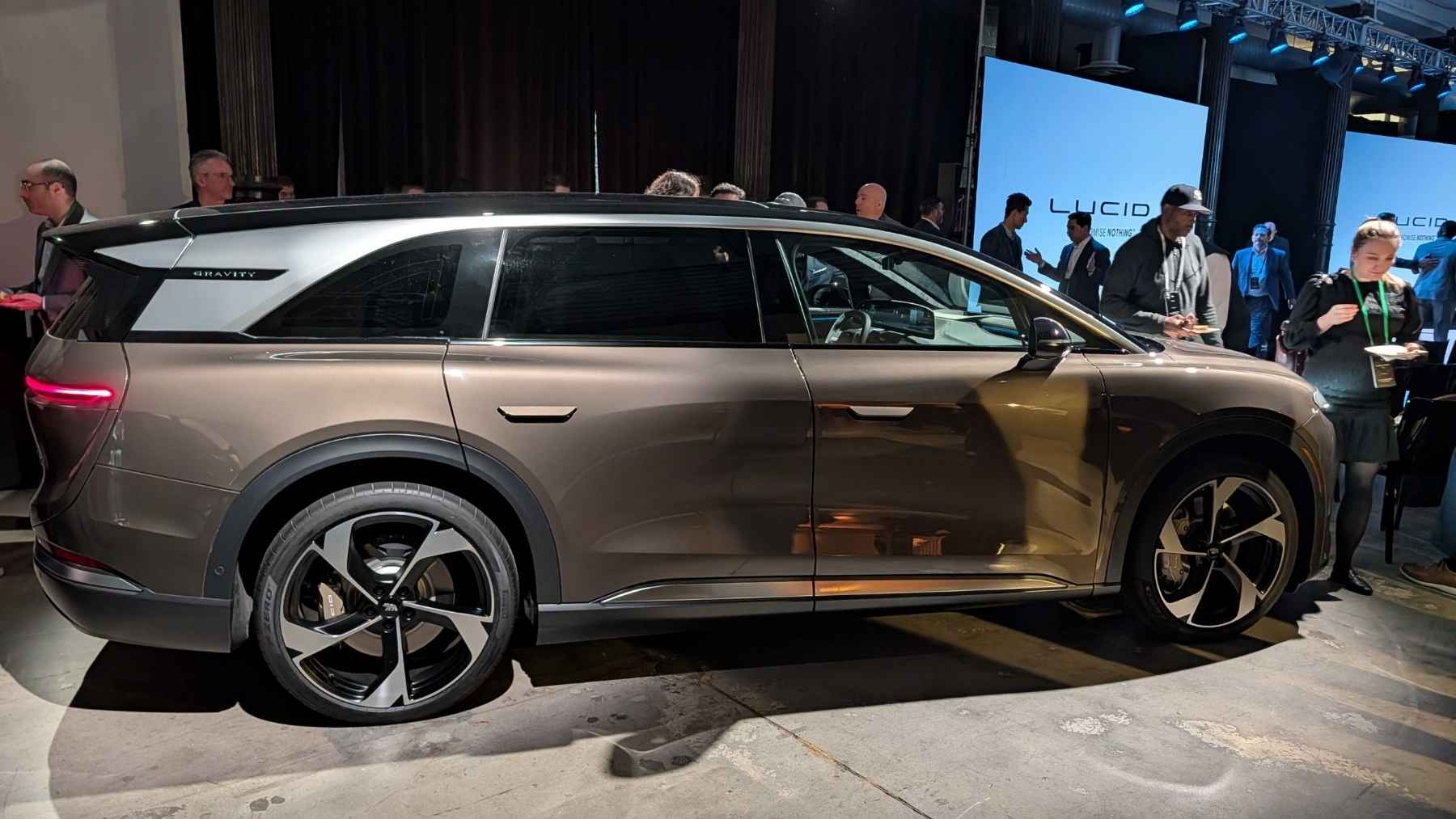
It’s a big move ahead of the Cosmos reveal this summer. It’s one of the automaker’s upcoming mid-size SUVs, an attempt to focus on more cost-effective vehicles. And by cost-effective, we mean around $50,000. But it’s still a price cut for Lucid. The Gravity starts at $80,000. My coworker has said it’s the “best EV in the country,” so maybe a cheaper Lucid will be a game-changer for the U.S.
Lucid’s last few years were a struggle
Last year was rough for Lucid, as it was for most EV companies. In 2025, Lucid reported a net loss of $2.7 billion. The full-year operating loss was $3.5 billion, and free cash flow was negative at $3.8 billion.
And no, it’s not because nobody wants a Lucid. In fact, the automaker sold 15,841 vehicles globally in 2025, representing a 55% increase over its 2024 delivery totals. Pretty sweet considering the questionable state of EVs in the United States and the brand’s luxury status.
However, it was not enough to make up for the money lost from tariffs. Despite being a domestic brand, Lucid lost $54 million from tariffs in 2025. Contrary to what the Trump Administration claims, domestic production will not exempt you from tariffs, as Lucid pays massive import duties on battery cells, building materials, and automotive parts. So much for the tariffs “benefiting” Lucid, as previously predicted. I don’t see any benefit, personally. Unless you count “not as bad as it could be” as a benefit. I don’t.
In February 2026, Lucid laid off 12% of its American workforce. Wait, weren’t tariffs and domestic manufacturing supposed to create jobs? Shocker. Unfortunately, not even that massive layoff was enough. Lucid is now cutting back on employees once more.
Similar to Rivian’s R2, I think Lucid is relying quite heavily on its smaller, cheaper Cosmos to ensure its survival. Luckily for Lucid, it’s a pretty neat vehicle.
The only reason Lucid can stomach two mass layoffs in one year without folding is Saudi Arabia’s Public Investment Fund, which owns most of the company and keeps writing the checks. That money buys time, and time is exactly what the Cosmos needs. It’s lined up as a Tesla Model Y and Rivian R2 rival, riding a new platform with a cheaper, simpler drive unit, with production due late this year and sales in 2027. If it connects the way the Gravity did, Lucid might finally grow into the company it has been spending like for years.