
On most big bridge jobs, the crane is the star of the show. It is the thing that turns up in the news footage, the reason a lane gets shut for weeks, the piece of gear everyone stops to film. So the odd part about the railway bridge Austria’s national operator just swapped out in Innsbruck is that there wasn’t one.
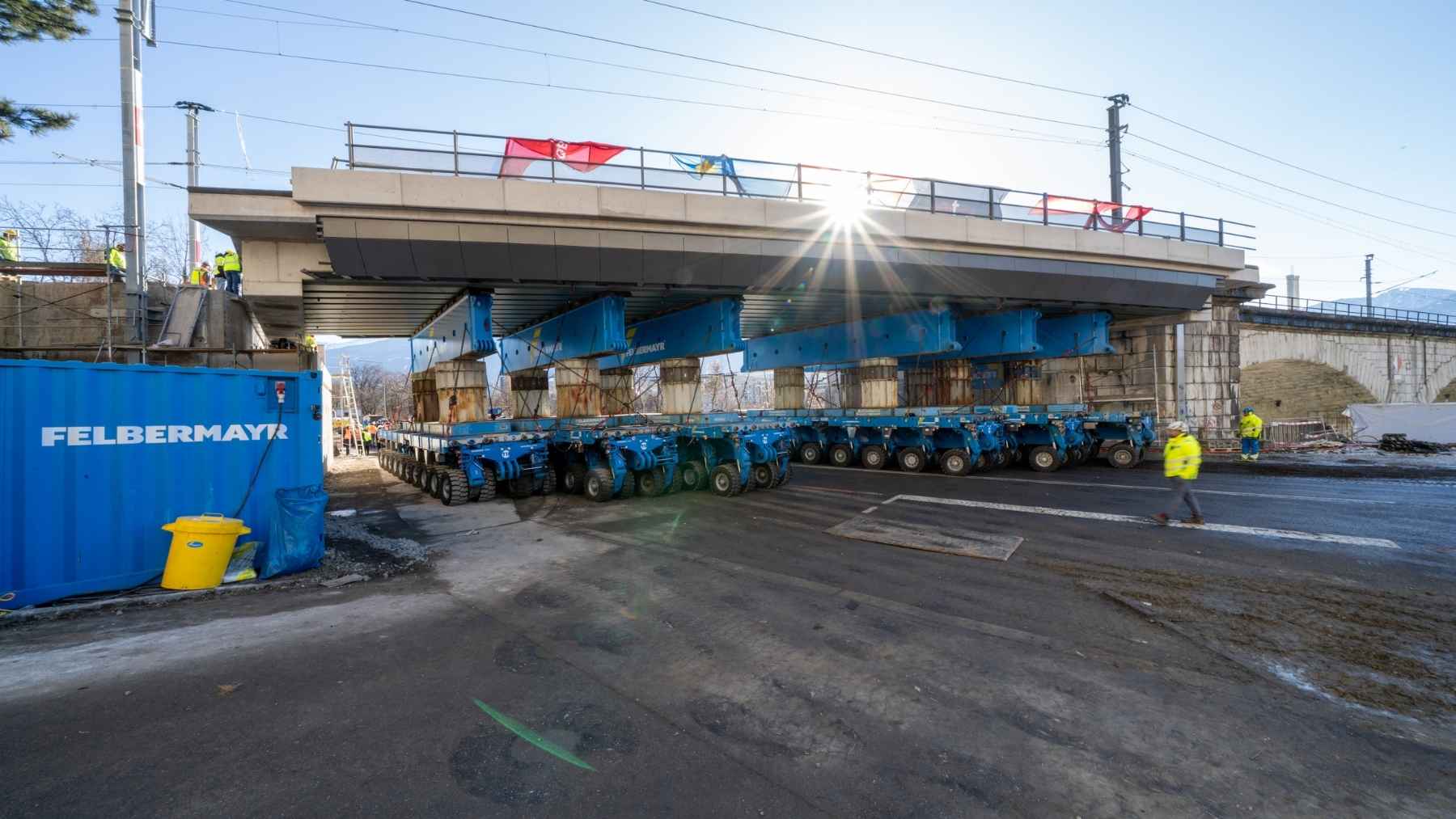
No crane anywhere on the site. In January, ÖBB moved a 1,400-metric-ton railway bridge about 100 meters (330 feet) into its final position, after first jacking it more than five meters off the ground, then turned it roughly 90 degrees and lowered it onto its supports to the millimeter. It did the whole thing by rolling the bridge in on its own wheels.
By the standards of the machines that do this work, a 1,400-ton bridge is barely worth mentioning. The same basic equipment has carried more than 23,000 tons in a single move. That makes the Austrian job worth pulling apart, because moving a structure that heavy without lifting it from above is a genuinely clever piece of engineering, and it is the same trick a growing number of road crews use to drop a new bridge in over a weekend instead of closing a route for half a year.
The bridge rode in on its own wheels
The machine under the bridge is called a self-propelled modular transporter, or SPMT, and the name does most of the work. It is a low platform built out of multi-axle modules, each one packed with wheels, all of them steered and driven by a computer instead of a person turning a wheel. The whole assembly lifts the load from underneath on hydraulic suspension, carries it at walking pace, and sets it back down. Every axle can swivel through close to a full circle, so the platform can creep straight ahead, slide sideways, or rotate in place without the load itself ever changing the way it faces.
In Innsbruck, ÖBB ran 12 of these units coupled together, for a total of 56 axles and 112 individually steered pairs of wheels. The new bridge crept along at 1 to 2 km/h, slow enough that the crew running the controls walks alongside it the entire way. The reason it beats a crane comes down to geometry. A crane lifts from above, which means it needs clearance overhead, a stable footprint off to one side, and a load hanging on cables the whole time.
An SPMT lifts from below and drives, so nothing is swinging in the air and there is no height limit to fight. That matters most in exactly the kind of cramped urban rail junction ÖBB was working in, and it is the opposite philosophy to the heaviest crane lifts on the planet, like the one Britain used when it lowered a 500-ton reactor into place with the largest crane on Earth.
Five meters up, ninety degrees around, then down to the millimeter
The bridge ÖBB was replacing, the Rauchmühlbrücke, had been carrying trains next to the old Rauchmühle mill site in Innsbruck for more than 60 years, and it was finished. Around 270 trains a day had been crossing the old steel structure, and decades of that load plus alpine weather had worn it out. The replacement is concrete, which the railway expects to last a great deal longer while running quieter and smoother under the trains.
Building that replacement happened off to the side, near its final spot, over the preceding months, so the only disruptive part was the move itself, which ran on Sunday, January 18. Crews used hydraulic presses to jack the finished span up to 5.13 meters (about 16.8 feet), then the transporters carried it the roughly 100 meters across Hallerstraße to the bridge abutments.
After the straight run, the platform turned the bridge about 90 degrees to line it up, then lowered it onto its bearings to the millimeter. For scale, the deck spans 29 meters (95 feet), measures 11.25 meters wide, and covers 325 square meters. Crews also had to pull up and relay about 100 meters of track and ballast on either end.
The closure was the trade-off. The line between Rum and Innsbruck’s main station shut on January 7 and stayed down through January 29, with up to 90 buses standing in for trains while crews finished the bearings and the rail fittings. Three weeks of disruption for a bridge meant to last the rest of the century is the kind of math that makes the whole approach worth the effort.
1,400 tons is a featherweight for these machines
The Austrian job starts to look almost modest next to what these transporters do on a heavy day. The same type of equipment that rolled in that bridge is the one that, in May 2024, moved the single heaviest load ever carried over land on wheels. At the Seatrium AmFELS shipyard in Texas, the heavy-transport firm Fagioli moved a finished offshore-wind installation vessel called Charybdis, all 23,163 metric tons of it, from the yard to the water’s edge.
The ship rode on 880 Scheuerle SPMT axle lines pushed by 28 power packs, then got transferred onto three barges in a follow-up move that put 26,900 tons on wheels at once. Scheuerle, which builds the modules, calls the first figure the heaviest load ever rolled across land on wheels.
That gap, 1,400 tons against 23,163, is the entire idea behind these machines. They are modular, so you bolt more of them together until there are enough wheels under the load to spread the weight evenly. Each module is built to a 2.44-meter width so it fits on a standard shipping-container flatrack, a format that dates to the early 1980s, when the heavy-haulage company Mammoet set the modern design and had Scheuerle build the first units.
Couple enough of them together and the payload becomes, in the manufacturer’s own framing, effectively unlimited. It is the same family of machine that, in Australia, put a 300,000-pound tunnel-boring cutterhead on a 152-wheel transporter and drove it through a town after dark. The Charybdis, for what it is worth, is also the first vessel of its kind built to satisfy the Jones Act, the US rule requiring cargo moved between American ports to travel on American-built ships, which is how a German transporter ended up setting a record in a Texas yard.
America already uses this to skip the year of cones
None of this is exotic in the US, which is the part that should land for anyone who has sat in a construction backup wondering why a single overpass takes a whole summer. The Federal Highway Administration has been pushing SPMT bridge moves for years under the banner of Accelerated Bridge Construction, and the pitch is blunt: “get in, do it right, get out, and stay out.” The agency’s own comparison is that conventional bridge work ties up traffic for months, while rolling a finished span in or out on an SPMT cuts that to somewhere between 25 minutes and a few hours.
The logic is the same wherever it gets used. You build the new bridge next to the road, on the ground, in daylight, while traffic keeps moving on the old one. Then you pick a single weekend, tear out the old span, roll the new one into place, and reopen. Crews in the US, Europe, Asia, and Canada have all done versions of it, swapping highway overpasses in one closure instead of stretching the job across a full season of lane shifts and orange barrels.
It is the same instinct now reshaping the heaviest infrastructure on the planet, like the Danes prefabricating a tunnel on land and then sinking 73,500-ton concrete boxes onto the Baltic seabed to a fraction of a centimeter. Build the hard part where you have room, then set it down where it goes.
So the next time a bridge near you gets replaced and the road is only shut for a weekend instead of the better part of a year, this is the machine that did it: a low deck full of computer-steered wheels that lifts the whole thing from underneath and drives it in. Austria just ran the move with a 1,400-ton railway bridge and made it look routine. By the standards of a tool that has hauled 23,000 tons in one go, it more or less was.