
For the past year, the seaglider getting all the attention has been the big one: a 55-foot electric flying boat built to carry a dozen passengers and make coastal ferries look like horse-drawn carriages. It is photogenic, it sits on a $10 billion order book, and it has one small problem. It hasn’t flown yet.
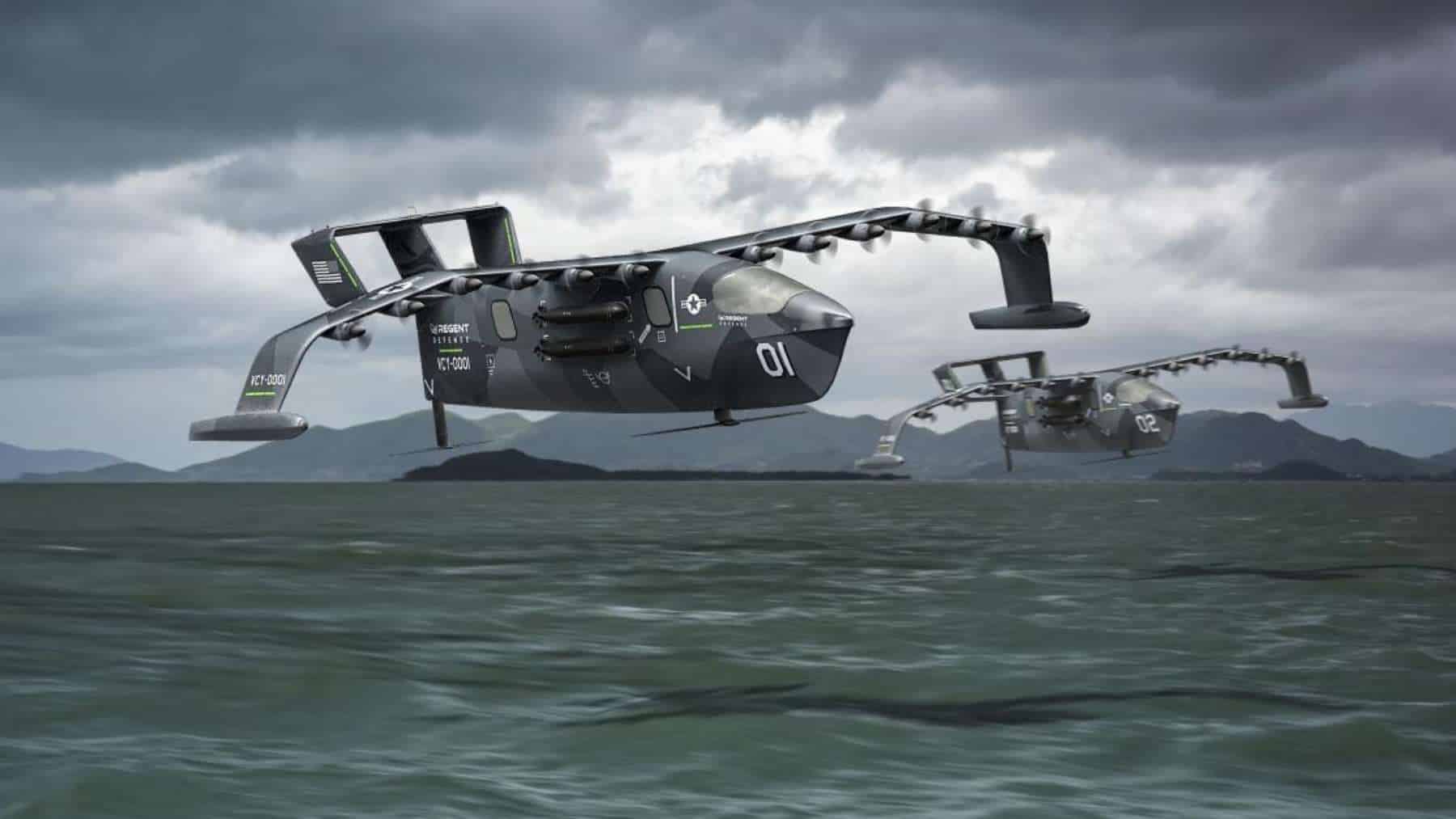
The seaglider that actually left the water last month is the one nobody was looking at. It is called Squire, it carries no people, and it was built for the Pentagon. On April 13, 2026, off North Kingstown, Rhode Island, the autonomous drone, made by the startup REGENT, completed its first ground-effect flight, becoming the first defense-specific wing-in-ground-effect craft to fly in the United States. The passenger version is still doing laps on the water. The war drone flew first.
The drone flew. The flying boat didn’t
Both craft run on the same trick. A wing-in-ground-effect vehicle flies just a few feet over the surface, riding the cushion of air trapped between its wing and the water, which makes it efficient and keeps it under line-of-sight radar. The passenger Viceroy is the crewed take on that idea; Squire is the small uncrewed one, and for now it is the only version with real flight data behind it.
The word “first” gets abused in this industry, so it is worth being precise. Squire did not break a record or cross an ocean. It lifted off in ground-effect mode over Rhode Island, the first time a military-purpose WIG craft has done that on American water. Plenty of odd aircraft have logged milestones lately, from a piloted hydrogen-powered helicopter that flew a full airport circuit over Quebec to a parade of electric air taxis. But a vehicle designed to skim the waves rather than climb into the sky is a different animal, and a more militarily interesting one.
A China play with a shaky backdrop
The pitch is unapologetically about China. The flight was framed as a way to help the U.S. close the gap with Beijing in low-signature maritime systems, and the mission list reads like a Pacific contingency plan: intelligence and reconnaissance, what the company calls tailored logistics, search and rescue, and anti-submarine warfare. The appeal is easy to see. A cheap, fast, autonomous craft that hops between islands without a runway or a deep-water port is exactly what planners want when the big ships and aircraft are the first things an adversary tries to find and sink.
The catch is that America’s broader bet on autonomous sea drones has not been going well. A Reuters investigation last year laid out a run of setbacks in the Pentagon’s effort to field a fleet of unmanned vessels to counter China: two drone boats from rival contractors collided during a Navy test off California, a support boat capsized in an earlier trial, the acquisition unit lost its top admiral, and the Defense Innovation Unit quietly paused a contract worth close to $20 million with software supplier L3Harris. None of that touches Squire directly, since it is a different kind of vehicle from a different company. But it is the climate Squire is flying into, one where a single clean demonstration counts for a lot precisely because so many others have face-planted.
The appetite itself is not in doubt. The Pentagon’s Replicator initiative, announced in 2023, set out to flood the Pacific with thousands of cheap, attritable autonomous systems as a counterweight to China’s sheer numbers, and the money flowing into unmanned warfare runs into the tens of billions. Squire is a fancier, longer-legged version of that same instinct: not a swarm of throwaways, but a fast courier that can run a hundred miles and come home.
What Squire can do, and what it can’t
Squire is small, and it isn’t pretending to be anything else. Top speed is around 81 mph, or 70 knots, planned range is more than 100 nautical miles, and the payload is 50 pounds. It climbs onto hydrofoils near 35 knots before settling into ground-effect flight, takes off and lands in two-foot seas, and is filed under a category called USA-V, shorthand for Unmanned Surface and Aerial Vehicle.
Those numbers describe a courier, not a gunship. Fifty pounds is enough for sensors, a small resupply, or search-and-rescue gear, not weaponry. The whole value proposition is speed and stealth at low cost: moving useful things quickly and quietly across contested water rather than fighting through it. The military problem it is built to solve is the one the Pentagon keeps citing from Ukraine, where cheap unmanned boats have punched far above their price tag. And the hard part of any uncrewed craft is rarely the airframe; it is the autonomy software that flies it without a pilot, which is precisely what broke down in the Navy’s troubled boat trials. Whether a flying version clears that bar well enough to win an actual program, as opposed to a test contract, is the open question.
The money so far
The funding behind it is modest by Pentagon standards but real. A dedicated defense arm now sits beside the commercial business, and the U.S. Marine Corps Warfighting Lab has been a customer since 2025, starting with a $4.75 million feasibility deal that has since grown to $15 million in total contracted work. Last November the team ran beach-extraction and open-water rescue drills built around casualty evacuation, and earlier this year it briefed Secretary of War Pete Hegseth and his staff on how the craft might fit contested-logistics missions. The Coast Guard, which regulates seagliders rather than the FAA, cleared Squire for testing in 2025.
Fifteen million dollars buys demonstrations, not a fleet. The distance between a tidy flight off Rhode Island and a permanent line in a defense budget is long, and it is littered with promising prototypes that never made the trip.
The drone is airborne. The verdict isn’t.
For now the scoreboard is split in a way nobody planned: the uncrewed war drone is flying while the headline passenger boat is still wet. That is not nothing. In a field where the Pentagon’s marquee autonomous-vessel efforts have been crashing into each other and shedding their leadership, a small craft that actually got airborne is a genuine result. The remaining test was never really aerodynamic. It is whether a 50-pound flying drone can turn a $15 million experiment into the kind of order that builds a fleet, and whether the people signing the checks still believe in autonomous sea drones after the year they have just had.