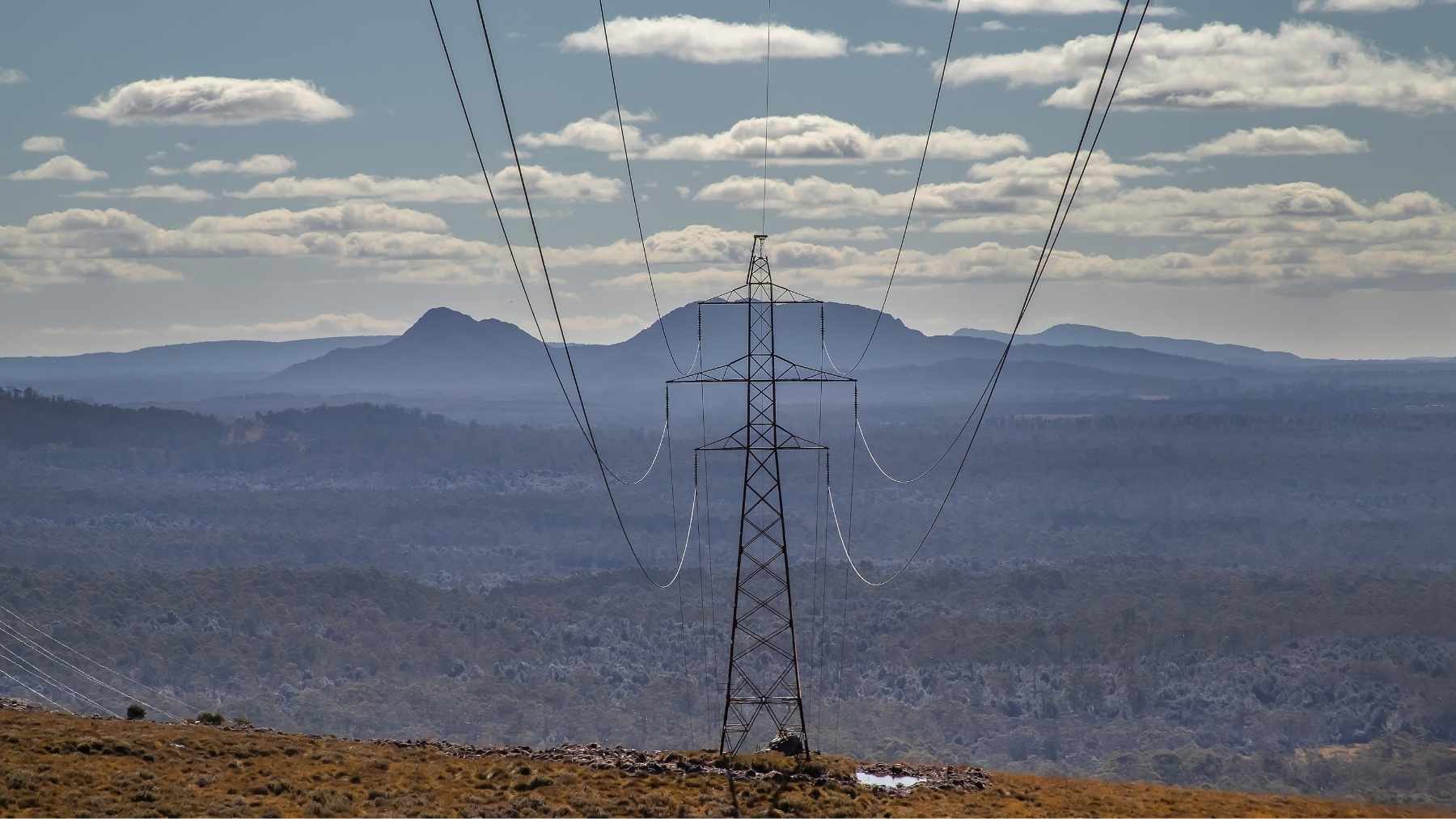

Replacing a transmission tower is the kind of grid maintenance nobody thinks about, which is sort of the point. The lights stay on, the bill shows up, and somewhere a crew is bolting steel together so nothing goes dark. On Tasmania’s north-west coast, though, TasNetworks is doing that job under a rule that makes it much harder than usual. The line it’s rebuilding has been energized since 1949, and it isn’t allowed to switch the thing off.
The corridor runs 71 kilometers from Burnie to Smithton via Port Latta, feeding homes and heavy industry across the region while also carrying renewable power back into the rest of the Tasmanian grid. Cutting it would mean cutting supply, and there’s no spare line sitting around to pick up the load. So the crews are doing the next best thing, which also happens to be the much harder thing. They work alongside live conductors, tower by tower, while electricity keeps moving over their heads.
The 1949 line nobody can afford to switch off
The Burnie–Smithton corridor is one of those pieces of infrastructure that quietly outlived its design assumptions. It was first built in 1949 and carries 287 structures along its length, many of which have spent the better part of eight decades getting battered by coastal salt and Bass Strait wind. That’s the kind of exposure that eats galvanized steel for breakfast.
The work is being funded under a $6.2 million upgrade recovered through TasNetworks’ regulated network revenue, which in practice means it’s baked into what customers already pay through the line’s regulated return. It was approved as part of the utility’s 2024–29 revenue reset, the five-year funding cycle that sets what the company can spend and recover. TasNetworks is now consulting on the next reset, covering 2029 to 2034, which will likely fund the bulk of the remaining tower swaps.
So why not take the line down for a few weeks and rebuild it the easy way? Because it doesn’t just supply homes. It feeds major north-west industry, including the iron-ore operation at Port Latta, and it connects renewable generators in this corner of the state back to the rest of the grid. There’s no second corridor waiting to carry that load. Pulling the switch isn’t an option, so the crews work around the energized conductors instead.
Live-line work on 110,000 volts leaves no room for error
Live-line work is exactly what it sounds like, and it’s as unforgiving as it sounds. Crews climb the structures and rig new steel within striking distance of conductors still carrying 110,000 volts. That’s the operating voltage of the Burnie–Smithton line, and it’s high enough that getting “close enough” is the last mistake you’ll make.
Josh Cunningham, TasNetworks’ head of asset management, didn’t dress up the stakes. He described crews working close to live circuits that are still maintaining supply, then put the margin plainly: “there is very little tolerance for error,” he told Pulse Tasmania.
The reason it works at all is that the corridor carries two separate 110 kV circuits. One can be de-energized for the swap while the other keeps carrying load, which gives crews a working zone with the worst conductor switched off and the rest still humming. Even then, a transmission tower is a brutal thing to replace, because you’re pulling out the structure that holds everything up. The order in which pieces come down, the temporary supports that go in, and the timing of all of it is its own engineering job before a single bolt gets turned.
17 towers down, 270 to go
The pace tells you how careful this is. Between March and May 2026, crews swapped 17 of the 287 structures, with the rest scheduled across coming years. That’s roughly one tower every five or six days during the active window, which sounds slow until you remember what each swap involves: designing a temporary load path, coordinating with control rooms to manage which circuit is live, and physically standing up a new tower next to or in place of the old one while the wire above it stays energized.
Brad Walker, the utility’s head of operations delivery, said the job pulls in nearly every part of the organization at once: field crews, control rooms, switching personnel, engineers and planners, all working to keep the system stable while the swaps happen. Apprentices are on the towers alongside experienced crews too, which matters in a trade that has spent the past decade quietly losing the people who know how to do this safely.
The new towers aren’t a like-for-like swap, either. They’re built to last more than 70 years, which is a deliberate call rather than a default. The 1949 originals were never specced for the coastal punishment they ended up taking, and the new design assumes this corridor still matters in 2096. Given that the same network will be carrying both legacy industry and a growing pile of renewable generation, that’s a reasonable bet.
The whole north-west grid is being rebuilt around it
This isn’t happening in isolation. The Burnie–Smithton corridor sits inside a much larger overhaul of Tasmania’s north-west grid. The wider North West Transmission Developments program covers around 238 kilometers of double-circuit transmission: 172 kilometers of upgrades to existing lines and 66 kilometers of brand-new transmission, tying together substations at Palmerston, Sheffield, Burnie, Hampshire and Staverton. Those new backbone lines run at 220 kV, twice the voltage of the 110 kV line the crews are currently rebuilding.
That build-out is tied in turn to Marinus Link, the planned high-voltage subsea interconnector between Heybridge in north-west Tasmania and the Latrobe Valley in Victoria. It reached a final investment decision in August 2025 and is being delivered in two stages: a first 750-megawatt link, with major construction starting in 2026 and completion targeted for 2030, and a second 750-megawatt stage that goes to governments for a decision in 2026. It’s exactly the sort of subsea power cable that’s becoming central to how grids move renewable energy around, and also the kind of seabed infrastructure now drawing real security attention.
The Burnie substation that this line feeds into has had its own rough patch, too. A fault there in April 2026 knocked out power to about 8,045 customers across the north-west in a single morning, which gives you a sense of how much load is concentrated on this stretch of the network.
Interim chief executive Renee Anderson kept it unglamorous, calling the strength and condition of these assets fundamental to reliable supply for critical industry, generators and regional communities. Which is true, and also why a job like this almost never breaks through. Everyone wants to talk about gigawatt batteries and offshore wind. Almost nobody wants to talk about the steel connecting all of it, standing in salt air since the Truman administration, and the crews who have to climb up and replace it without switching anything off. The 17 towers swapped between March and May are a start. The other 270 will take years, and if it all goes right, you won’t notice a single one.
 @rupert ROOKIE3 months ago