
Every artillery shell ever fired has worked on the same physics. The gun throws it, gravity and drag take over, and the round spends its entire flight slowing down. Engineers have bolted on rocket boosters and shaved drag off the base, and the basic deal never changed: all the energy a shell will ever have, it has at the muzzle.
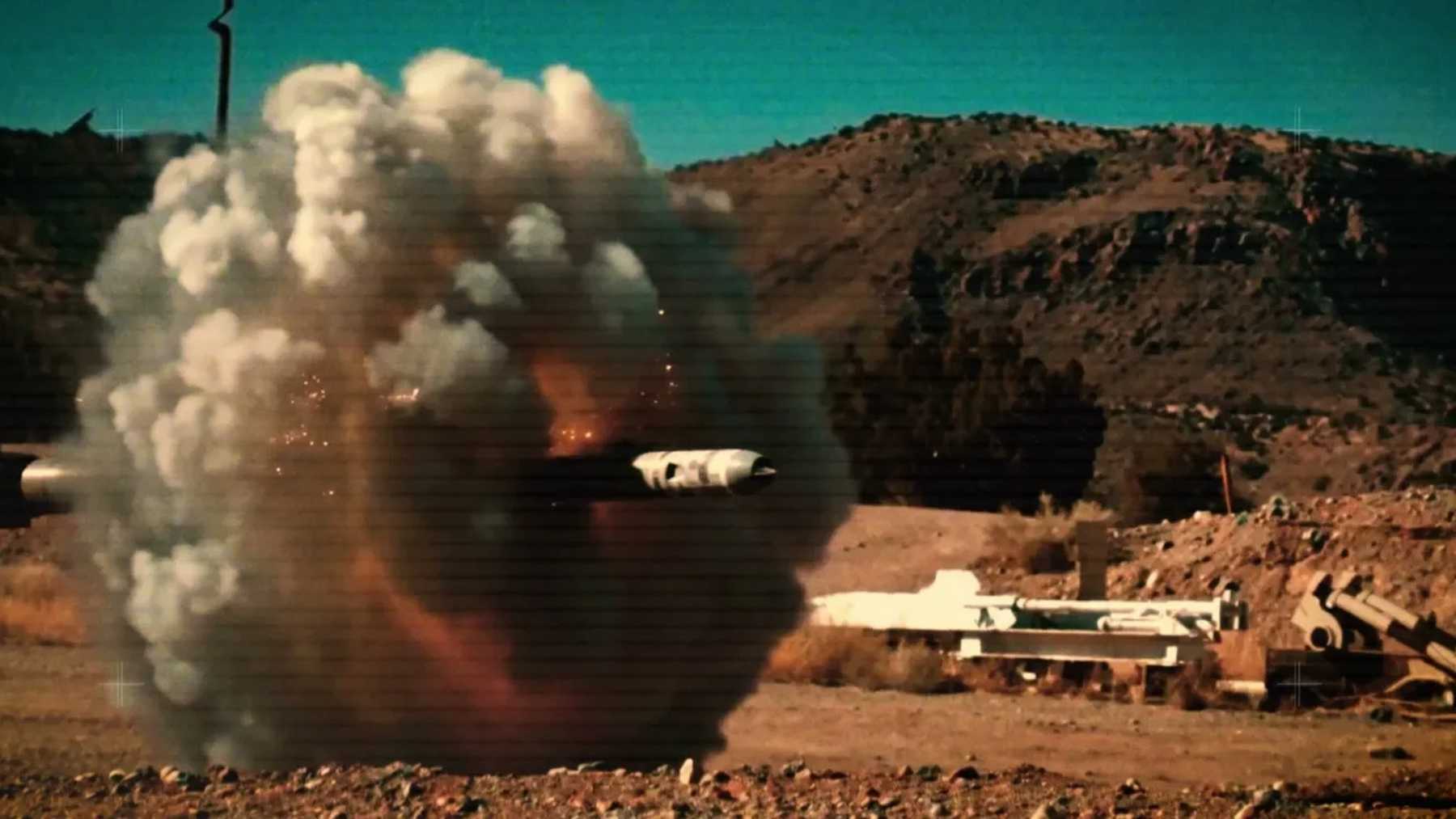
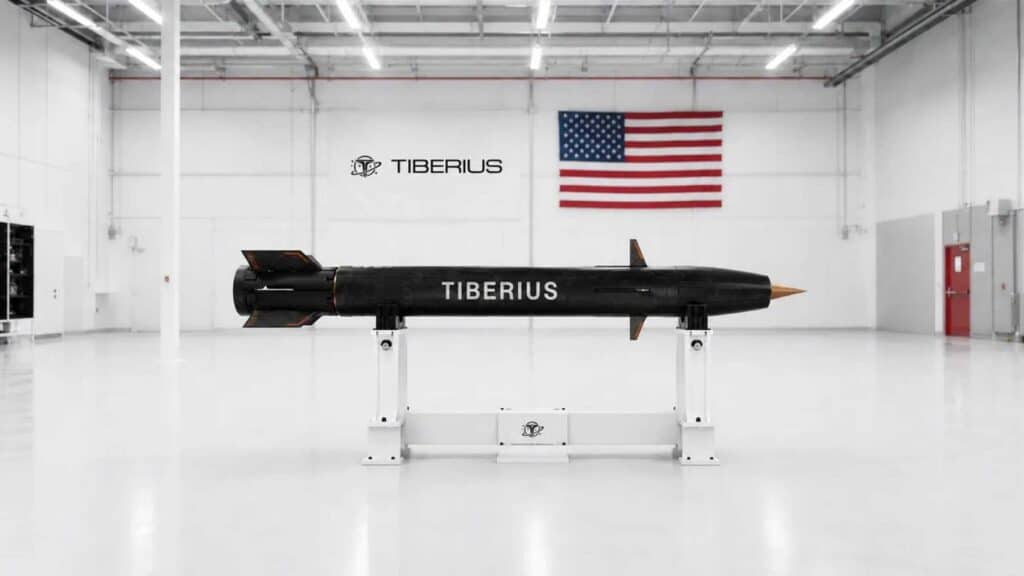
In April, on a range in New Mexico, a 155-millimeter round tore that deal up. The shell left a NATO-standard howitzer, took roughly 18,000 times the force of gravity on the way out, and then lit a liquid-fueled jet engine in midair and flew on under power. Tiberius Aerospace, the startup behind it, is headquartered in Newport Beach, California, and spent three years testing quietly before showing the round in public in May 2025.
On August 5, the US Army signed on.
DEVCOM Armaments Center, the command that develops America’s artillery ammunition out of Picatinny Arsenal, New Jersey, entered a Cooperative Research and Development Agreement with Tiberius to help mature the round, which the company calls Sceptre. The Defense Post reported it is the program’s first partnership with any US government service. A CRADA is not a purchase order. The agreement gives the startup structured access to Army research expertise and test infrastructure, and it gives the Army a front-row seat on a shell that promises 93 miles (150 km) of reach from guns it already owns.
A jet engine with no moving parts
A ramjet is about the simplest jet engine anyone has ever built. It has no compressor, no turbine, no spinning anything. The whole engine is a shaped tube: air rams in the front at supersonic speed, gets squeezed by its own momentum, meets a spray of fuel, burns, and pushes thrust out the back.
The catch is that a ramjet only works if you are already going fast. Below about Mach 2, nothing useful happens. A ramjet on a runway is a very expensive pipe.
A 155-millimeter howitzer solves that problem for free. The gun acts as the first stage, hurling the round out at supersonic speed, so the engine wakes up already inside its operating range.
Missiles have carried ramjets for decades. Artillery has not, and the reason is the barrel. A howitzer breech is one of the most violent places an engine can visit. The shell’s electronics, fuel lines and injectors have to survive about 18,000 g at launch, and a fighter pilot blacks out near 9. Everything inside the round has to take that hit, wake up a second later and run a controlled burn. Tiberius spent its three stealth years getting hardware to live through exactly that.
Surviving the barrel was always the hard part
Boeing and Norway’s Nammo have been flying ramjet artillery rounds for years under the Army’s Extended Range Artillery Munitions Suite program, and their engine burns solid fuel. A solid-fuel ramjet is the simpler machine, and it burns at whatever rate the propellant grain decides. A liquid engine can meter its fuel in flight, and Tiberius designed its round to drink fuel the military already hauls everywhere by the tanker load.
Tiberius fired the first liquid-fueled ramjet ever launched from a standard 155-millimeter howitzer in April, and the company reported ramjet ignition after launch, stable flight dynamics, controlled rotation and clean deployment of the in-flight stabilization hardware. Chad Steelberg, founder and CEO, called it “a genuine world first breakthrough” and said in the same statement that the program now needs to move to much larger ranges for testing, validation and certification.
Steelberg’s own wording draws the line between proven and designed. The 18,000-g launch, the midair ignition and the stable flight happened over New Mexico. The Mach 3-plus cruise, the 65,000-foot (19,800 m) apogee and the 93-mile (150 km) reach remain design targets, written on the spec sheet rather than in a flight log.
Excalibur, the Army’s current guided 155 round, reaches about 25 miles (40 km), and Sceptre’s design target of 93 miles (150 km) comes out of the same guns. A battery that today threatens a circle 50 miles across would threaten one 186 miles across without moving its trucks.
The Army gets the range without buying a single new gun
Longer-range artillery usually arrives attached to an enormous bill. The Army spent years developing a longer-barreled next-generation howitzer, shut the program down in 2024, and has been shopping for range it can buy as ammunition ever since.
The Sceptre pitch lands squarely on that nerve. Tiberius says the round needs no modifications to current NATO 155-millimeter platforms and no dedicated launcher. Steelberg told reporters in May 2025 that the company had been running trials every three to four weeks from a BAE Systems M777, the towed howitzer both the Army and the Marines field, and planned to certify against other NATO guns.
A CRADA fits that shopping style. The Army commits research expertise and test ranges, not procurement money, and Picatinny’s instrumented facilities would cost a private company a fortune to replicate. Tiberius gets the infrastructure. The Army gets the data.
Boeing and Nammo keep working their solid-fuel round inside the ERAMS program. Tiberius sits outside it, holding a research agreement instead of a development contract: two different engines, two different fuels, one 93-mile finish line.
It drinks from the same truck as everything else in the convoy
A solid rocket motor gets its propellant cast at the factory and carries it for life. Sceptre ships empty. A crew fuels the round in the field, and the engine burns widely available fuels, diesel variants including JP-4 and JP-8, according to the company’s April announcement. An army that feeds its trucks, generators and helicopters from one supply line can feed its longest-range shells from it too.
Andy Baynes, the company’s chief strategy officer, put the price at $52,000 a round without payload at the May 2025 launch briefing covered by European Security & Defence, and an Excalibur is commonly estimated at about $100,000. Cost per shot has been eating the Pentagon alive lately, from the $4.2 million torpedoes the Navy fires 79 times a year to the $4 million Patriot shots spent on drones that cost less than a used pickup.
The trade-off sits in the warhead. Company launch materials list a maximum payload of 11.5 pounds (5.2 kg), and a standard M107 high-explosive shell carries more than 14.5 pounds (6.6 kg). Tiberius is betting that a small charge landing within 16 feet (5 m) of the target beats a bigger one landing somewhere in the neighborhood, and its GPS-plus-inertial guidance is specced to hold that accuracy even when jammers are working the area.
Two governments in, zero shells ordered
The UK Ministry of Defence signed a development and trials contract for Sceptre last September, with a value neither side disclosed, after what Baynes described as high-tempo live-firing and synthetic test cycles through the summer. The August 5 CRADA makes the US Army the second government to put its name next to the round, eleven months later.
Nobody has ordered a production shell.
The distance between a midair ignition and a certified 93-mile weapon runs through range campaigns, warhead qualification and the kind of instrumented failure-hunting Picatinny was built for, and that is the work the new agreement covers. Tiberius fired the first liquid-fueled ramjet ever launched from a standard 155-millimeter howitzer over New Mexico in April 2026, and signed its research agreement with DEVCOM Armaments Center on August 5, 2026.