
Anyone who keeps a boat on a northern lake knows the fall ritual. The water is about to turn solid, and ice is remarkably good at cracking, crushing and dragging under whatever gets left in it, so out the boat comes. That same problem explains why floating solar has stayed a warm-water technology. Panels have been spreading across lakes and reservoirs around the world for years now, but almost nobody leaves them out where a real winter can get at them.
A team at Western University in London, Ontario, decided to try it anyway. They built a 7-kilowatt floating array from 40 flexible solar panels and sheets of waterproof foam, parked it on a stormwater pond in the village of Ilderton, and left it out through an entire Canadian winter. The equipment guarding the whole experiment from the ice was, for all practical purposes, an aquarium pump sitting on the shore.
The results landed this June in the journal Applied Energy, and they fill a real gap. Floating solar had barely been studied in freezing climates at all, the authors note, which left an obvious question hanging over every icy pond in Canada. Now there is a full year of measured data, and the numbers are better than the technology’s warm-weather reputation suggested.
Foam slabs instead of pontoons
Most floating solar rides on plastic pontoons, with rigid panels tilted up toward the sun. That works fine on a reservoir in a mild climate. It also gives wind something to grab, and it puts a lot of hardware in the water for ice to chew on.
The Western team went simpler. Their 40 semi-flexible monocrystalline modules were attached directly onto thick slabs of waterproof foam, so the whole array sits low and flat against the water. Less wind exposure, fewer moving parts, and a lot less structure for a freezing pond to grip.
Floating solar hardware has gotten genuinely weird lately. Germany recently stood 2,600 panels bolt upright on a Bavarian gravel lake to satisfy a shading law, and the Dutch have been hanging shellfish cages under a 73,000-panel array to see what moves in below. Foam rafts on a frozen pond fit right into the family.
The pond itself was instrumented to the teeth. An open-source data platform logged sunlight, air temperature, wind, humidity, water and panel temperatures, and power output through summer and winter, with cameras keeping a visual record the whole time. So when something froze, or didn’t, the team had the receipts.
An aquarium pump versus a Canadian winter
Snow on the glass is an annoyance. The pond turning solid around the array is the real threat: ice locks the structure in place and squeezes it. Earlier computer models had suggested a hard freeze could stress or even damage a floating structure, which is a big reason cold-climate deployments never happened. As Koami Soulemane Hayibo, a postdoctoral researcher at Western and the study’s lead author, told CBC News, in Canada “your main challenge is going to be winter ice formation.”
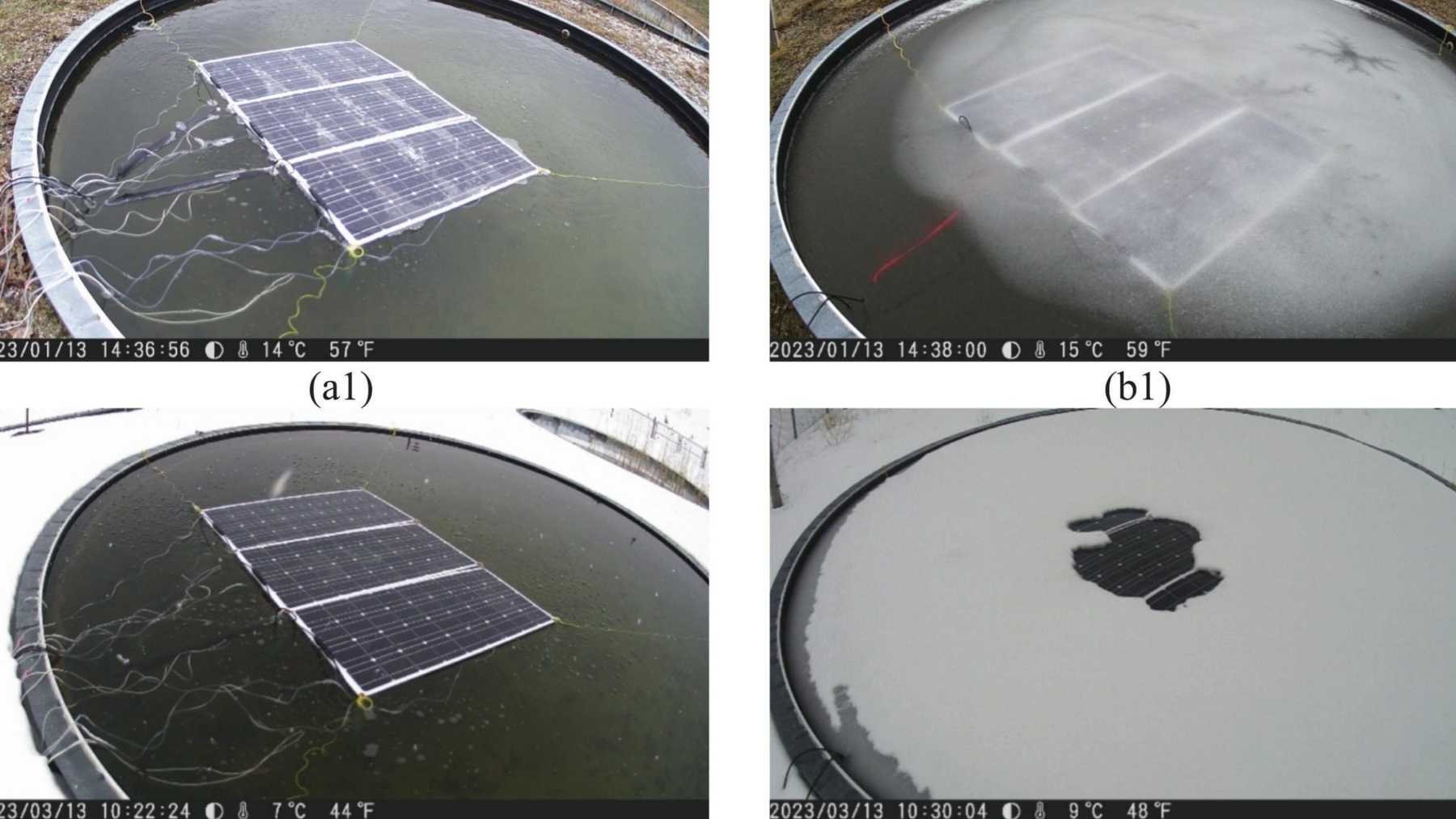
The fix leans on a quirk of pond physics. In winter, the water at the bottom of a pond sits slightly warmer than the surface. The team ran air lines beneath the floating panels and connected them to a pump on shore, the same basic machine that keeps a fish tank alive. Bubbles rise from the pond floor, drag that warmer bottom water up with them, and keep the surface around the modules open.
It worked. The bubbled water stayed ice-free through the whole winter season, while the study’s comparison shots show what happened without the bubbles: after cold snaps and snowfall, the untreated sections iced over. An aquarium pump went up against a Canadian winter, and the pump won.
The ice-control bill: 1.9 kilowatt-hours for the year
Keeping water open all winter sounds like it should cost serious energy. The actual bill depends entirely on how you run the pumps, and the study priced out three ways of doing it.
Run four pumps on a smart schedule, switching on only when ice threatens, and the whole winter’s bubbling consumed 1.9 kilowatt-hours. The worst month was January at 0.8 kilowatt-hours. Against the 7,700 kilowatt-hours the array generated over the year, that is less than 0.02% of output.
Leave those four pumps running around the clock instead and the bill climbs to 893 kilowatt-hours, or 11.6% of what the system produced. Model bubbling across the entire panel surface and it reaches 1.1 megawatt-hours, 14.5% of output. So the real spread runs from 0.02% to 14.5% depending on strategy, and the cheap end of that range was enough. Four scheduled pumps kept the ice off through a typical London, Ontario winter, per the paper.
7.7 megawatt-hours, and the pond lost less water
Across the full year, the 7-kilowatt array generated 7.7 megawatt-hours of electricity. A regression built from the measured data put that at up to 2.7% more energy than standard photovoltaic performance models predicted for the setup. Part of the reason is that those models, written for pontoon systems or ground-mounted panels, misjudge how warm foam-backed modules actually run on winter water.
The array pulled a second job on the side. Sitting flat on the surface, the foam blocks sun and wind, the two things that drive evaporation, and the study found the water savings scale linearly with coverage. Cover half of this particular pond and the modeled saving comes to about 245,000 gallons (927 cubic meters) per year, which matters if the pond in question is the one you irrigate from.
The economics held up too. The study’s cost analysis works out to a payback period of roughly 4.2 years where electricity prices run high, according to pv magazine‘s read of the paper. Cheap foam and an aquarium pump will do that for your budget.
Cold-water floating solar has been creeping in this direction for a while. A salmon farm above the Arctic Circle already runs on more than 90% renewable power from a floating ring around its pens. What Norway managed with ocean water that rarely fully freezes, Ontario has now tested on a pond that genuinely does.
One pond, one winter, and a door that used to be shut
This is a 7-kilowatt experiment on a single stormwater pond, not a power plant, and one Ontario winter is one data point. Bigger arrays, rougher water and nastier cold will all get their chance to complicate the picture, and the authors frame these results as a foundation for larger-scale work rather than a finished recipe.
Still, the door this opens is real. Canada is covered in stormwater ponds, irrigation reservoirs and old quarry lakes that sit frozen and unused for months, and until now the assumption was that panels on any of them would be an ice casualty by February. As Hayibo put it to Anthropocene Magazine, “winter operation cannot be treated as a minor detail.” It took a design built around winter from the start, plus 1.9 kilowatt-hours’ worth of bubbles.
The boat still comes out of the water in October. The panels, apparently, can stay.
 @mikethompson ROOKIE2 months ago