
Pretty much every car on sale in America got slammed into a wall before you were allowed to buy one. The automaker crashes a few dozen prototypes on purpose, films it with high-speed cameras, and reads the dummies afterward. No one thinks that’s strange. It’s how you find out where a design breaks before a customer does.
Nuclear fuel goes through the same thing, and I’d love to tell you I came up with that comparison myself, but Idaho National Laboratory beat me to it. The lab’s version of the crash wall is a reactor in the desert west of Idaho Falls called TREAT, short for Transient Reactor Test Facility, and its whole job is to hit a sample of fuel with a burst of power no commercial plant would ever see and watch what happens.
So what does a reactor built to break things actually look like?
Basically a block of graphite with a dusting of uranium in it
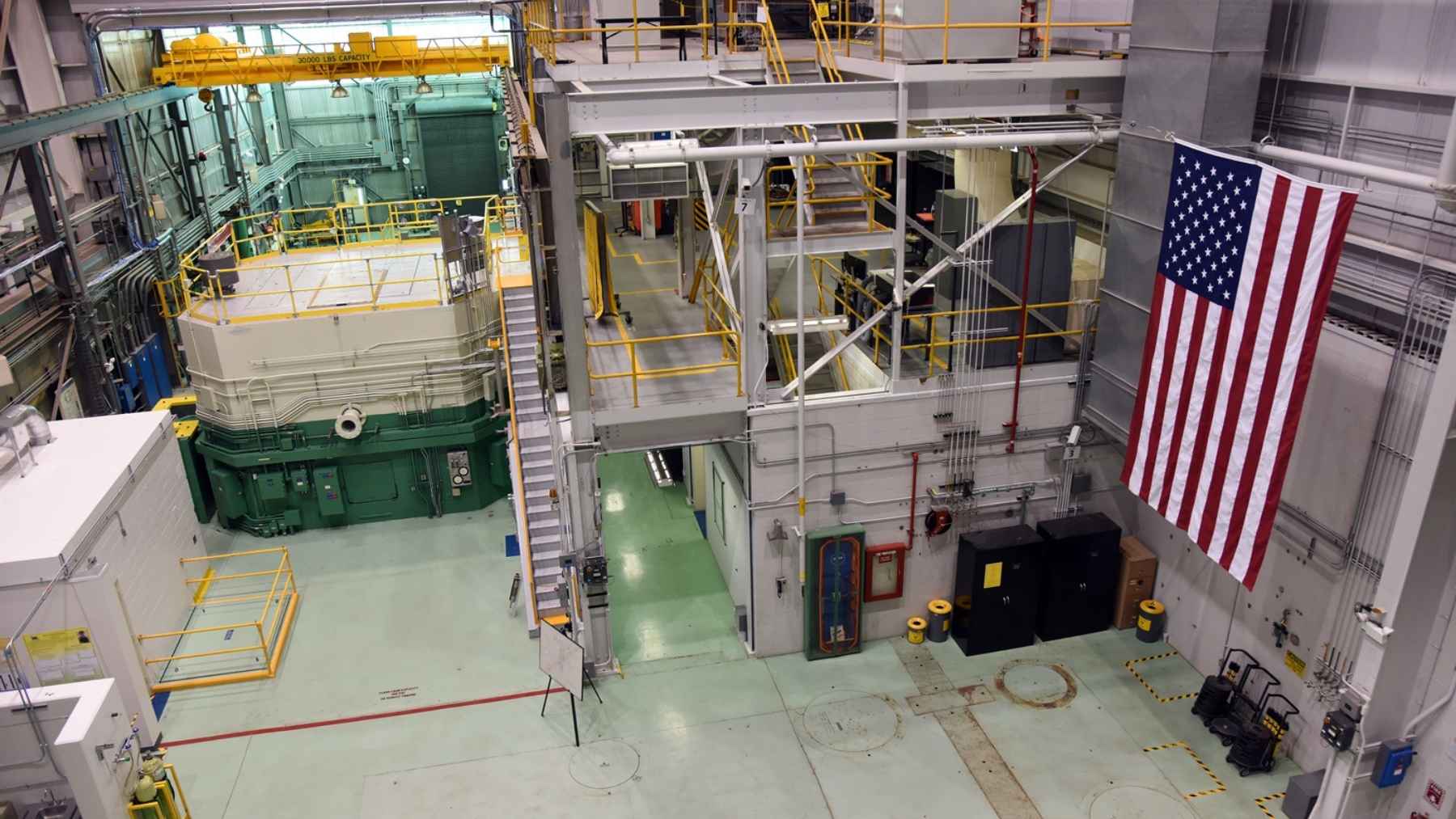
Picture a stack of graphite about 6 feet on a side and 9 feet tall, made of bars slotted into a 19-by-19 grid with 361 positions. Each bar is 4 inches square and weighs around 100 pounds, and the fuel inside it is a sprinkle of highly enriched uranium oxide mixed into the graphite at roughly 10,000 carbon atoms for every atom of uranium. Around that sits a couple of feet of plain graphite reflector, then 3 to 5 feet of concrete. That’s the reactor.
INL describes it as simple, self-limiting and air-cooled, and that’s the lab’s polite way of saying there’s no pressure vessel at all. The cooling’s a set of blowers that push plain air through the core once and out the stack. Left alone, it idles at no more than 120 kilowatts, roughly what a DC fast charger pushes into an EV.
So how do you get 19,000 megawatts out of something that idles at 120 kilowatts?
You yank the control rods. TREAT has eight transient rods driven by hydraulics at up to 140 inches a second, that’s about 8 mph, and a computer runs them during the shot. Pull them and the power jumps more than a hundred thousandfold in a fraction of a second. Then physics takes over. The graphite heats up, hot graphite hands the uranium faster neutrons than uranium-235 likes to split on, and the chain reaction chokes itself off before anyone in the control room has to touch anything. The lab calls that a negative temperature coefficient. I’d call it a reactor that gets tired fast, and I mean that as a compliment.
About that 19,000 figure. It’s the number the lab used when it brought the machine back, but the current TREAT user guide puts it at more than 18,000 megawatts and the user facility catalog rounds up to 20 gigawatts. Pick whichever you like, because the Department of Energy’s own comparison is that a pulse runs more than five times the output of the largest commercial power plants in the country.
The pulse can be as short as 80 milliseconds or stretched into a shaped burst running up to a minute, and the only hard cap is how much heat the graphite can soak up per shot, about 2,500 megajoules. The fuel in the core stays under 1,112°F the whole time, and it’s all run from a control room about half a mile away.
So what’s a hodoscope?
Here’s where it gets pretty clever. You can’t actually see the fuel while this is happening. The sample sits inside a sealed steel capsule in the middle of the reactor, it’s far too radioactive to open for weeks, and by the time it reaches the hot cell you’re looking at the wreckage rather than the wreck. An X-ray won’t help either, because the steel stops it long before it reaches the uranium.
TREAT gets around that by using the fuel as its own light bulb. Uranium that’s fissioning throws off fast neutrons, and a fast neutron will punch straight through the steel wall of the capsule. So the designers left an empty slot 2.75 inches wide running from the center of the core out to its north face, which gives those neutrons a clear line out of the graphite, aimed a steel collimator down it, and parked a wall of detectors behind that.
The collimator’s about 4 feet long and drilled with 360 narrow channels in 10 columns, and each channel looks at a patch of the sample roughly a quarter inch wide and an inch and a third tall. Count the neutrons coming up each channel and you get a map of where the fuel is. Watch the map change and you’ve got a movie.
A pretty low-resolution movie, admittedly. What comes out is a grid of neutron counts, more spreadsheet than cinema. But it’s a grid that moves, and it refreshes 1,000 times a second. In one data set from the lab’s own user guide, two fuel pins go through a transient side by side, and the pin on the right lets go at 17.844 seconds, the fuel sliding down the rod after the cladding breaches. You can’t get a number like that by cutting the capsule open a month later.
When the reactor came back, the detector wall wasn’t fully rebuilt, only 96 channels out of the 360 slots, which was enough to watch a rodlet under about 8 inches tall. In June 2024 the lab’s detector team pulled all of them out and reinstalled 192, according to a paper the team published in 2025, so the two center columns now cover the full 4-foot height of the view. You’ll need that if you want to watch a full-length fuel pin, a bundle of them, or a flowing sodium loop, and that’s apparently where this is headed.
What it’s been shooting at
Mostly the fuel the industry wants answers on. On May 14, 2025, the lab pushed a pulse into a section of rod that’d done a full career inside a commercial power plant, a test the OECD Nuclear Energy Agency logged for its HERA fuel program and the Department of Energy called “the first of its kind in the United States.” The rod came out of a shipment of 25 used rods that reached Idaho in 2024, and DOE said on June 24, 2025 that seven more tests on rods from that shipment are scheduled.
Earlier in 2025 the reactor had also pulsed high-burnup metal fuel left over from the old EBR-II program in a joint series with Japan, the first safety test on fuel like that anywhere in more than 20 years, according to DOE.
The building’s got a side job too. The Pentagon’s Project Pele microreactor gets fueled at TREAT, and its 40,000 fuel compacts shipped there from Virginia in November 2025, waiting on a reactor that was still in Lynchburg, Virginia, when we last checked.
And the argon-filled hot cell at the same complex, the one where a Sharpie wrapped in tape marks the cuts, has cleared more than 10,000 pounds of old gear out of the way to make room for loading sodium loops bound for this reactor. INL also says a second batch of next-generation fuel out of a commercial reactor showed up in December. As far as I can find, the lab hasn’t put a date on the first sodium loop going into the core, or said which of those rods get a pulse.
It still runs on its original fuel
And here’s what frankly gets me. TREAT first went critical on February 23, 1959, racked up more than 6,000 startups and close to 2,900 transients, then sat in standby for 23 years with the fuel still in it. INL brought it back to low power in November 2017 and fired the first fueled shot at 5:05 p.m. on September 18, 2018. The graphite-uranium bars in the grid today are the ones pressed for it in the 1950s.
How’s that even possible?
Each pulse is so short that the fuel barely burns, so the core’s never needed replacing, and as far as I can tell that isn’t something you can say about many reactors. Argonne’s been designing a low-enriched replacement core for years, and the original blocks are still what’s in the grid.
Which brings this back to the crash wall. For fuel that’s going to sit in a reactor for years, the only place in the country where you can shoot that footage is a block of graphite in Idaho that cools itself with blown air.
The lab doubled its detector wall so it could watch longer pins and, eventually, a flowing sodium loop, and DOE’s schedule as of June 24, 2025 has seven more used rods from that commercial shipment lined up for the reactor that was built to break them.